
August 13, 2026 - PBS News Hour full episode
8/13/2026 | 57m 46sVideo has Closed Captions
August 13, 2026 - PBS News Hour full episode
August 13, 2026 - PBS News Hour full episode
Problems playing video? | Closed Captioning Feedback
Problems playing video? | Closed Captioning Feedback
Major corporate funding for the PBS News Hour is provided by BDO, BNSF, Consumer Cellular, American Cruise Lines, and Raymond James. Funding for the PBS NewsHour Weekend is provided by...
August 13, 2026 - PBS News Hour full episode
8/13/2026 | 57m 46sVideo has Closed Captions
August 13, 2026 - PBS News Hour full episode
Problems playing video? | Closed Captioning Feedback
Where to Watch PBS News Hour
PBS News Hour is available to stream on pbs.org and the PBS app.
Providing Support for PBS.org
Learn Moreabout PBS online sponsorshipWILLIAM BRANGHAM: Good evening.
I'm William Brangham.
Geoff Bennett and Amna Nawaz are away.
On the "News Hour" tonight: Israeli settlers lay siege to the home of an American-Palestinian family in the occupied West Bank, sparking condemnation from the U.S.
ambassador and an Israeli military response.
How President Trump's varied construction projects are changing the face of the nation's capital and incurring steep costs for taxpayers.
JON GOLINGER, Democracy Advocate, Public Citizen: It's not transparent, it's not accountable, and it's concerning whether there are side deals being made that nobody knows about it.
WILLIAM BRANGHAM: And the Justice Department deploys a little-used tool to strip naturalized Americans of their citizenship.
(BREAK) WILLIAM BRANGHAM: Welcome to the "News Hour."
Colombia's president says more than 260 people have died in this week's devastating 7.4-magnitude earthquake.
And that death toll is expected to keep rising as hope fades for finding survivors.
Still, on the ground today, rescuers paused in silence for sounds of hope, carefully listening for any calls under the rubble.
The crucial 72-hour window for finding people alive has now passed, and the all-out search has become a last-ditch effort.
For one man who drove over 10 hours when he heard his mother was trapped under her collapsed home, he arrived to learn that she had already died.
ENRIQUE MARIN, Bogota, Colombia, Resident (through translator): At the moment of the quake, she was at the door.
She was in her pajamas and she was going to open the door.
He said they found her with the keys still in her hands.
WILLIAM BRANGHAM: In the wake of the disaster, Colombian President Abelardo de la Espriella has declared an economic emergency.
More than 150 aftershocks have been recorded since the main quake on Monday.
The Colombian government says nearly 500 people remain missing, though that number is believed to be a vast undercount.
Elsewhere, millions of people in Europe are sweltering in their fifth heat wave of the summer.
The U.K., in particular, recorded its hottest day of the year so far.
The air in West London exceeded 100 degrees Fahrenheit, only several degrees short of the country's all-time record for August.
Seen under thermal imaging, this souvenir stand sizzled at over 60 degrees Celsius.
That's 140 degrees Fahrenheit.
The heat is exacerbating drought conditions across the continent, and crews are racing to contain a number of major wildfires, like these in Spain.
Here at home, nearly 20 million people across the Midwest were under flood alerts today as severe storms refused to let up.
MAN: And it's a downpouring.
My car is completely done for.
It ain't going nowhere.
WILLIAM BRANGHAM: Indiana neighborhoods sat in several feet of floodwater yesterday, and the National Weather Service warns that some parts of the state could see another four inches of rain or more.
Some homeowners say they've never seen anything like it, and their road to recovery is unclear.
MICHELLE WILSON, Cambridge City, Indiana, Resident: I rush home, and I open the basement door, and it's all the way filled.
And the backyard was flooded.
My garage is flooded.
I don't know when we can turn our power back on, if it would be safe to even turn it back on without our house catching on fire because it was sparking and stuff like that from the outlets downstairs.
WILLIAM BRANGHAM: Today, Indiana's governor signed a statewide emergency declaration.
Over 250,000 homes and businesses remain without power because of the storms and tornadoes that have slammed this region.
Defense Secretary Pete Hegseth disputed reports that poor conditions aboard the USS Abraham Lincoln have led to low morale and even reported suicide attempts.
He called those reports -- quote -- "completely misrepresented."
Two military-focused publications were first to report that multiple sailors aboard the aircraft carrier have attempted to jump overboard amid burnout and stress.
The Abraham Lincoln has been on a nine-month deployment to the Middle East due to the ongoing war with Iran.
But the Pacific-based aircraft carrier the USS George Washington has begun heading toward the Middle East to relieve it.
The board of the Kennedy Center has voted to move forward with President Trump's plan to close the building for two years of renovations.
And it voted to add Trump's name back to the building's facade.
A board member tells the "NewsHour" that the proposed renovation will include an inscription that reads -- quote -- "Restored and renovated by President Donald J.
Trump."
Today's decision will be subject to approval from a federal judge, who has previously rejected both the addition of Mr.
Trump's name and an earlier attempt to close the venue.
A federal judge in Boston has dismissed a Trump administration lawsuit against Harvard University that had accused the Ivy League school of turning a blind eye to antisemitism.
Siding with Harvard, the judge today said the administration failed to show any institutionalized noncompliance with Title VI, which is the ban on discrimination in programs that receive federal grants.
It marks a blow to President Trump, who had tried to get the school to comply with a number of demands, including limiting admission of foreign students.
And on Wall Street today, the major stock indices were positive across the board.
The Dow Jones industrial average inched up by nearly 70 points.
The Nasdaq rose by 0.8 percent, while the S&P 500 closed at a new all-time record.
Still to come on the "News Hour": the Justice Department accelerates a controversial plan to revoke some immigrant citizenship; the Trump administration ends funding for a key climate report; and veterinarians work to protect the newest baby elephant at the National Zoo from a potentially deadly disease.
Today, the U.S.
condemned the siege of Palestinian homes by Israeli settlers in the West Bank, where they have cut off water, electricity, and essential supplies to some residents.
The U.S.
ambassador to Israel, Mike Huckabee, called the settlers' actions a -- quote -- "act of terror," adding American pressure that appears to have prompted Israeli forces to intervene.
Nick Schifrin spoke with one family victimized by the recent violence, but, first, a look at how it started.
NICK SCHIFRIN: The siege began when Israeli settlers turned a home into a prison brick by brick.
They closed the only road in, cut off the water and power, and trapped nearby families.
Dozens of settlers, as seen in security camera footage, swarmed a home in Qusra, built by a Palestinian-American, trapping his family inside, Qusai Ridi and his teenage son, Ahmed.
Just 2.5 weeks ago, settlers set fire to the village mosques, burning the inside, and on the blackened facade left a menacing message: "The land of Israel is redeemed with blood.
Revenge."
Outside the Ridi family home, the settlers remained even overnight.
Their threat forced much of the rest of the village to flee, including 28-year-old Ruqaya Hassan and her daughter.
RUQAYA HASSAN, House Besieged by Settlers (through translator): We woke up many times at night to the sound of stones being thrown at our house, just like the sound of bullets.
NICK SCHIFRIN: She escaped with the kids.
Her husband remained behind to try and defend their home.
RUQAYA HASSAN (through translator): My daughters were overcome with fear and panic because we were trapped in the house.
My daughter kind of became scared.
She doesn't go to the toilet by herself for fear that settlers might come.
NICK SCHIFRIN: The U.N.
says attacks by Israeli settlers have reached unprecedented levels, more than 1,400 incidents in 260 communities just this year, displacing more than 3,800 Palestinians and killing more than 75.
BENJAMIN NETANYAHU, Israeli Prime Minister: It's actually 150 or so what you would call juvenile delinquents.
NICK SCHIFRIN: On CNN last month, Israeli Prime Minister Benjamin Netanyahu said it was Palestinians who attack Israelis in the occupied West Bank.
Israeli officials speaking to "PBS News Hour"s cite more than 300 Palestinian attacks this May alone.
And they argue they have also arrested dozens of settlers in the West Bank.
Last month, Netanyahu also vowed to reduce settlers' crime.
BENJAMIN NETANYAHU: I think it's wrong on his own account.
I don't want and don't accept vigilantism, and I don't care if it comes from Arabs or Jews.
Our citizens cannot practice violence against anyone.
DANNY DANON, Israeli Ambassador to the United States: We are not going anywhere.
NICK SCHIFRIN: But just this week at the United Nations, Israel's government vowed to expand Israeli control in the West Bank, referred to in the Bible as Judea and Samaria.
DANNY DANON: Jews have never been and will never be settlers in Judea and Samaria.
The vast majority of residents in Judea and Samaria are law-abiding citizens.
Those committing violence are tiny, a tiny fraction of the people living there.
NICK SCHIFRIN: Palestinians say the state and settlers are working together.
Outside the Ridi family home last weekend, an Israeli soldier joined the settlers in prayer.
On Tuesday, the Israel Defense Forces released a statement vowing that any soldier involved will - - quote -- "face disciplinary action."
And the statement described the settlers taking over land as -- quote -- "illegal, reprehensible, and unacceptable activity that harms the residents of the areas and disrupts their daily lives."
Yesterday, the IDF fired tear gas at the Israeli settlers, but the family remained besieged.
So, last night, the U.S.
stepped in.
U.S.
Ambassador to Israel Mike Huckabee issued a rare rebuke, labeling the settlers Israeli terrorists, and: "Actions by those who carried out this horrific act of terror meant to intimidate and harass this family are disgusting."
This morning, Israeli soldiers evacuated the Ridi family, although they have since returned to the house.
The IDF also said it's reinforcing the area with an additional battalion and dismantled nearby settler outposts, which are illegal under Israeli law.
But the Ridi family provided the "News Hour" this video today, settlers still roaming outside the family home.
And I'm now joined by Qusai and Ahmed Ridi, who join us from the house in Qusra in the occupied West Bank, and Loui Ridi, Qusai's brother, who joins us from Ohio.
Thank you very much.
Appreciate your time.
Loui, let me start with you.
You have been watching these events and this video from 6,000 miles away.
When did you realize that effectively your family were trapped?
LOUI RIDI, Palestinian-American: On Sunday, I got up in the morning.
As soon as I looked at my phone, I noticed the settlers building a tent literally in front of the house and setting a block on my brother and his son and neighbor family.
Well, it was a terrifying moment that -- seeing my own brother and his son would be trapped and under siege by the settlers, knowing what those settlers can do when someone get close to them or approach them.
They attack them, they beat them with the clubs.
And they have those ATVs.
They chase them.
They go behind them.
So I was in contact with my brother immediately, and he was -- he was fearing for his life.
He didn't know what to do.
He was alone with his son.
He said they cut off all supplies.
Now no one can go in or out of the house.
The only thing he could have done, and he did do that, he called the police immediately, and an hour later the police dispatched an IDF vehicle, and he had hoped that they would come and help him out.
And instead they went straight to the tent, and they conducted a prayer with the settlers.
and then they celebrated with the settlers, sat down with them on the same table.
And they were chilling and hanging out with them, and absolutely did nothing for my brother and his son on that day.
NICK SCHIFRIN: Qusai, let me ask you.
The Israeli military evacuated you this morning, but you have since returned to the house.
Do you have enough food?
Do you have enough water?
And what's going on outside?
Are the settlers and soldiers still right outside the house?
QUSAI RIDI, Qusra, West Bank, Resident (through translator): From Sunday until now, we are trapped.
They have banned us from accessing food and medicine.
Even the electricity and water is cut off.
We're forced to use solar energy to keep the lights on.
And yet we refuse to leave our house.
But, unfortunately, the solar power is not enough to power our homes.
We have no water.
We have wells.
These wells are not suitable for drinking.
But we had to drink from this water.
We have very limited food.
We don't have medicine.
And this is now a closed military area.
They have forbidden anyone to enter.
I mean, we have lived in terror and fear for a while.
We're in a very difficult situation.
We're asking the government and the institutions to help us and stand with us and protect us from these settlers, who are not human beings.
They are monsters.
NICK SCHIFRIN: And, Ahmed, from your perspective, what have you been feeling as you have had to deal with this?
AHMED RIDI, Qusra, West Bank, Resident (through translator): It's a terrifying feeling to be constantly surrounded by the locals.
It's dangerous.
You stay awake at night watching out to see if they will attack.
A lot of people throw rocks at us.
It's terrifying.
NICK SCHIFRIN: Loui, let me come back to you.
The U.S.
Ambassador to Israel Mike Huckabee last night called the settlers Israeli terrorists, and wrote: "Actions by those who carried out this horrific act of terror meant to intimidate and harass this family are disgusting."
What's your response to the ambassador's intervention?
LOUI RIDI: Well great to hear this, but what's more important what the ambassador said, it's really what's -- what's happening on the ground, the action.
We need this to be implemented to remove those settlers permanently, and not just a post on social media and then nothing happening on the ground.
As you -- we speak right now, that did not change anything on the ground.
NICK SCHIFRIN: And, Loui, I visited the West Bank earlier this year.
I have met other Palestinian-Americans who have been subject to settler violence, even killed, including 19-year-old Nasrallah Abu Siyam.
So what is happening to your family is not happening in isolation.
What do you think it says that even an American passport, frankly, cannot protect some of these Palestinians from this violence?
LOUI RIDI: Well, we contacted the U.S.
Embassy.
We contacted our local U.S.
representative in the Congress, and we have been trying to seek for help, because we know that everybody is a target in the West Bank, and sometimes the U.S.
passport doesn't protect you.
And that's why we are demanding to get protected and get safely into the house, outside out of the house, get supplies to the house, that we -- me and my family over there to live freely when I travel on my own hometown.
NICK SCHIFRIN: Loui Ridi and Qusai and Ahmed Ridi, thank you very much to all of you for joining us.
LOUI RIDI: Thank you for having us.
QUSAI RIDI: Thank you.
Thank you very much.
WILLIAM BRANGHAM: President Trump is pressing ahead with an ambitious effort to reshape Washington, D.C., with new construction and renovations around the nation's capital.
White House projects alone are now estimated to cost at least $900 million.
And despite earlier promises that private donors would cover most of the bills, taxpayers are funding a significant portion.
Our White House correspondent Liz Landers takes a closer look.
LIZ LANDERS: The nation's capital these days seems like a giant construction site, scaffolding, work crews, heavy equipment all part of President Trump's effort to reshape Washington in ways he says will modernize the city and leave a lasting legacy.
DONALD TRUMP, President of the United States: So, we're doing little things.
As a real estate person, I love doing it.
To me, it's an honor.
It's a great honor to do it.
LIZ LANDERS: The projects include paving the White House Rose Garden and renovating the Colonnade, building a new Marine One helipad on the South Lawn, restoring the Lincoln Memorial Reflecting Pool, and gilding massive statues in gold near the Lincoln Memorial, with even more projects being planned.
It's a subject constantly on the president's mind.
DONALD TRUMP: We're building something the likes of which will never be even close to being competed with.
LIZ LANDERS: In the first seven months of 2026, the president mentioned his construction projects at 84 events across 66 days, according to an analysis by the independent fact-checking site PolitiFact.
That accounts for more than a quarter of his public appearances this year.
DONALD TRUMP: I put up the money to build this building along with a lot of great patriots.
LIZ LANDERS: But the biggest project by far, and the one the president has made a signature priority, bulldozing the East Wing to make room for a 90,000-square-foot White House ballroom, along with a new security facility.
DONALD TRUMP: You know, we're building a tremendous military facility at the White House.
It's a ballroom, but it's also a big military facility, a drone port on top and tremendous things underneath.
LIZ LANDERS: The project has been held up with core challenges, but if it is completed, the White House says the ballroom will give future presidents a permanent space to host inaugurations and events and provide a secure state-of-the-art underground presidential bunker for national emergencies.
The total cost for all of this, at least $600 million and climbing.
The White House says private donations will cover the cost of the ballroom itself, but taxpayers are on the hook for the massive security enhancements.
In June, the Secret Service redirected 352 million taxpayer dollars toward the ballroom project, funds drawn from Trump's One Big Beautiful Bill Act passed last year.
DONALD TRUMP: We're on time, on budget.
It's going beautifully.
I have all the money I need.
We're making a gift to the United States.
LIZ LANDERS: The president's 2024 campaign finance chair, Meredith O'Rourke, is leading the fund-raising effort, according to Wall Street Journal reporting.
Donations are funneled through the Trust for the National Mall, a small nonprofit that until now had been used to help fund more minor projects around D.C.
like cherry tree maintenance.
JON GOLINGER, Democracy Advocate, Public Citizen: Almost no donors have revealed what they gave, and they're keeping the arrangement and the meetings that put these things together secret.
LIZ LANDERS: Jon Golinger is a former prosecutor and now works with Public Citizen, a watchdog group suing the administration for information about the ballroom and lack of transparency.
The ballroom fund-raising agreement requires the trust to -- quote -- "preserve the anonymity and privacy of any donor who wishes to remain anonymous."
Last fall, the White House did release a list of donors, but it was incomplete and did not include specific dollar amounts.
Contributors include some of the biggest corporations in the world, including Lockheed Martin, Microsoft, Amazon, Caterpillar, and Google.
DONALD TRUMP: You have been so generous in your contributions, very substantial money, fully financed.
It's fully taken care of now.
And, in fact, we will have money left over.
LIZ LANDERS: A report from Public Citizen found that more than a dozen of the companies that donated to the ballroom have received new or increased government contracts over the last six months worth over $50 billion.
It also found that 16 corporate donors are either facing federal enforcement actions or had actions suspended by the Trump administration, including antitrust actions, merger reviews, and SEC investigations.
JON GOLINGER: All -- the whole arrangement is troubling.
It's not transparent.
It's not accountable.
And it's concerning whether there are side deals being made that nobody knows about it as of yet.
LIZ LANDERS: President Trump says that this is all a gift to the country.
Is it?
JON GOLINGER: This is not a gift.
It's a grift.
I mean, President Trump figured out that he could shake down donors who want something from the government or butter up donors who want access or glory and bring in huge amounts of money that would, he thought, allow him to evade scrutiny and accountability.
LIZ LANDERS: A White House official said no donors are receiving preferential treatment.
A White House spokesperson added -- quote - - "President Trump is generously donating his time and resources to build a beautiful White House ballroom, a project which past presidents only dreamed about.
Since announcing this historic plan, the White House has been inundated with calls from generous Americans and American companies wishing to contribute."
President Trump has taken a personal role in the fund-raising, hosting lavish dinners at the White House.
And The Wall Street Journal reported that President Trump has raised more than $800 million for his pet projects since returning to office.
Douglas Brinkley is a presidential historian at Rice University.
How unusual is it for a sitting president to be so personally involved in this kind of fund-raising?
DOUGLAS BRINKLEY, Professor of History, Rice University: What's going on with Donald Trump, he started really the day one of his second term realizing that I'm going to grab and do what I can quickly.
And I'm open for business.
You have got to write big checks to get my attention.
The message is out.
He's getting those big checks because, for particularly corporations or wealthy individuals, they feel that the access to President Trump is worth that price tag.
LIZ LANDERS: Renovations here at the Reflecting Pool near the Lincoln Memorial have been plagued with problems for months, which the president has blamed without evidence on vandals, even though his own administration acknowledges in court that shoddy work is at fault here.
That has pushed the price tag to more than $16 million, and it could go higher, as contractors make repairs and try to prevent green algae blooms from quickly filling the water.
The Trump administration awarded two no-bid contracts for the Reflecting Pool because it said there was an urgent need to complete the project by July 4.
The work is being paid for with taxpayer money, including a portion of the entrance fees paid by visitors to national parks across the country.
DONALD TRUMP: I think, to me, the most exciting of all is going to be the Triumphal Arc.
We're going to build one of the most beautiful arcs in the world.
LIZ LANDERS: Work hasn't begun yet on President Trump's Triumphal Arch, a massive 250-foot structure to be located between the Lincoln Memorial and Arlington National Cemetery.
A much-smaller-scale model of the arch was the centerpiece of the Great American State Fair this summer.
There's no official final budget for the arch, but some estimates are more than $100 million.
A White House official anticipates that it will be funded by a combination of private donations and taxpayer money.
The National Endowment for the Humanities has quietly reserved $15 million for initial planning.
Brinkley believes that, at Trump's age, the president is considering his legacy in Washington.
DOUGLAS BRINKLEY: He's in his 80s, and you can't defy the time clock, so he feels that he may not go for a third term, but history will notice that Trump built and -- built the new Washington, and we will see what exists in the end.
Will this ballroom be the Trump ballroom at the White House, or does it become just the White House ballroom, or is there going to be a great Arc de Triomphe Trump, or is it just going to be known as a memorial for the wounded warriors of America?
We don't know.
It's a president that's got just a couple years left, and he's trying to cram it with anything he can't.
LIZ LANDERS: For the "PBS News Hour," I'm Liz Landers.
WILLIAM BRANGHAM: Earlier this month, federal prosecutors moved to strip citizenship from 25 naturalized Americans, accusing them of lying about their pasts and hiding serious crimes.
It's called denaturalization, and the Justice Department now calls it one of its top priorities.
Justice correspondent Ali Rogin looks at what's behind this dramatic shift in law enforcement strategy.
ALI ROGIN: Since President Trump returned to office, the Justice Department has filed more denaturalization complaints than the Biden administration did during its entire four years.
To help us understand why they're using this tool more, I'm joined by Cassandra Burke Robertson, a law professor at Case Western Reserve University.
Cassandra, thank you so much for being here.
I first want to ask you, how does the Trump administration's use of this tool differ from what we have seen from previous administrations over the past few decades?
CASSANDRA BURKE ROBERTSON, Professor of Law, Case Western Reserve University: Yes, I think that the Trump administration's use of denaturalization differs in a couple big ways.
One of those is that the Trump administration is just filing many, many more cases.
Another way that they are differing from previous administrations is that these statements put out by the Trump administration seem to suggest that denaturalization is an end goal all by itself and that it's in fact part of the administration's immigration priorities.
And then the third way that the administration has used it differently is that the administration has used denaturalization as a political tool.
So the administration has talked very specifically about pursuing denaturalization against individuals that have made statements that perhaps angered the government.
ALI ROGIN: And you mentioned how this administration is using denaturalization as an end goal in and of itself.
How does that differ from what used to be done?
What sort of cases might be subject to denaturalization?
CASSANDRA BURKE ROBERTSON: So, in the modern era, denaturalization has been incredibly rare, less than 10 cases a year, on average.
And, generally, the cases that we have seen have been cases involving issues of national security.
So, for example, we saw denaturalization cases against former Nazi concentration camp guards.
And we saw a few denaturalization cases brought as part of the war on terror, trying to focus in on national security interests.
ALI ROGIN: And, in your review of these cases, do any of them strike you as ones prior administrations would have also sought denaturalization for?
CASSANDRA BURKE ROBERTSON: there are a few that likely would have been brought under any administration.
But the current administration is filing some cases based on facts that happened years ago or decades ago, when other administrations could have reviewed those same facts and decided to file a denaturalization case, but didn't decide to do so.
ALI ROGIN: Could this be further politicized or weaponized?
I'm thinking here of New York City Mayor Zohran Mamdani, himself a naturalized citizen.
Some of his critics, including a couple of Republican lawmakers, have called for his citizenship to be revoked and for him to be deported.
Is he a possible target here?
CASSANDRA BURKE ROBERTSON: It's not a realistic proposition, in the sense that if they were to try to denaturalize somebody like Zohran Mamdani, he has access to the absolute best attorneys.
The constitutional issues would be fully litigated.
I think he would lodge a very quick and strong defense.
ALI ROGIN: The Trump administration in most of these cases cites as part of the basis for bringing these complaints lying about somebody's past in order to gain citizenship.
Is that in and of itself enough to qualify for denaturalization?
CASSANDRA BURKE ROBERTSON: It is not enough by itself.
The Supreme Court has said that, if somebody makes a misstatement as part of the naturalization process, the government has to show materiality, that the misstatement would have made a difference, that somebody -- in the most common situation, the person would not have been granted citizenship if the government had been told the truth.
ALI ROGIN: Who adjudicates these cases?
Where -- how do they move through the system?
CASSANDRA BURKE ROBERTSON: They go to federal court.
And, in court, the government has to prove that the elements of the denaturalization case are satisfied, so typically showing that somebody maybe lied materially in the process.
So, once somebody loses citizenship status, whatever facts were brought as part of that denaturalization proceeding can also then be used in a subsequent removal proceeding or a deportation proceeding.
ALI ROGIN: Cassandra Burke Robertson with Case Western Reserve University, thank you so much for joining us.
CASSANDRA BURKE ROBERTSON: Thank you.
WILLIAM BRANGHAM: This week, the Trump administration said it would stop funding the Arctic Report Card, a longstanding effort to synthesize the latest research about the fastest warming place on Earth.
Now scientists are scrambling to find a way to publish this major annual report anyway to continue to track how climate change is transforming the Arctic, impacting everything from glaciers to native communities to global fishing and shipping routes.
This decision is the latest in a series of moves by the administration to curtail scientific research into the impacts of climate change, which the administration argues is plagued with misinformation and alarmism.
For more on what this means, we are joined again by glaciologist Twila Moon.
She's been a lead editor of the Arctic Report Card, and she's the deputy lead scientist for the National Snow and Ice Data Center at the University of Colorado Boulder.
This conversation is part of our ongoing series Tipping Point.
Twila Moon, so nice to have you back on the program.
The administration argues that the underlying research will continue, will not go away, just their support of the synthesis of it into this report.
If that's the case, what does it matter if the report goes away?
TWILA MOON, U.S.
National Snow and Ice Data Center: Well, unfortunately, the simple existence of data does not mean that people are finding that data and being able to access it, use it, and understand what it means.
So the Arctic Report Card has played a really important role in bridging the gap between raw data, which is really difficult for most people to understand or work with, towards something that can serve nonscientists so that they can be making good decisions with proper, up-to-date environmental awareness.
WILLIAM BRANGHAM: Could we step back for a second and explain why we care about what's happening in the Arctic?
Because, to many people in the Lower 48, they might think this is just a distant place that they will never go to, and who cares really what happens up there?
Why is it going to impact me?
TWILA MOON: Well, what happens in the Arctic does not stay in the Arctic.
Changes that we see happening with permafrost or frozen ground, also changes with sea ice that forms on the surface of the Arctic Ocean, those changes actually themselves influence the weather we experience down here in the Lower 48.
But we can also see, because the Arctic is warming so quickly, we're seeing a lot of increase in geopolitical tensions, an increased attention to security and military activity in the Arctic, and that means that the Arctic has become a U.S.
administration priority in regards to paying attention to security, international relations, changes with shipping, and also economic development in the area.
WILLIAM BRANGHAM: I mean, we have seen other instances, like these former NOAA staffers who were pushed out and then started their own independent Web site called Climate.US to maintain a repository of climate data.
Do you think that that's something that you and your colleagues are going to have to do now here?
TWILA MOON: Well, myself, the other lead independent editors and our incredible authors -- we have usually more than 100 authors from a dozen countries.
This is an international effort.
We're going to do everything we can to get those data to the people who need them for making decisions and having environmental awareness.
But I want to point out that simply being able to do this in another space does not mean that it's going to have the depth, all of the resources and tools that people expect.
So there's a real loss in moving this to being something that's no longer supported by NOAA, where we have spent two decades building tools, resources, and a really trusted resource for folks.
WILLIAM BRANGHAM: I mean, as I mentioned and as you well know, the Trump administration has taken other steps like this.
They have dismissed scientists who were working on the National Climate Report.
They put a climate change skeptic in charge of that document.
They have dismantled the preeminent atmospheric research center, NCAR, in Colorado.
They have stopped updating the federal database that tracks the cost of hurricanes and floods and things that we know are driven by climate change.
The president argues that climate change is a hoax.
Members of his administration argue that all of this work is full of alarmism and is just meant to terrify people.
As someone who does this benchmark science, what -- how do you respond to that?
TWILA MOON: Well, the Arctic Report Card and all of the science that we're reporting in it is specifically emphasizing direct observations of changes.
So, this is not a report that is projecting about the future or making inferences about what's happening on the ground.
This is a resource that is providing real, accurate, and complete, peer-reviewed, trustworthy information about what is actually happening in place.
And there's no arguing with reality.
It's not a political position.
It's a scientific resource.
WILLIAM BRANGHAM: I mean, I know you have spent a lot of time on Capitol Hill talking to legislators and their staff about the importance of this.
We have seen in the past pushback by Republicans and Democrats to certain cuts to climate research.
What is the argument that you make to legislators?
And how do they respond to you when they see substantive cuts like this going on?
TWILA MOON: I think that many representatives really, clearly understand how valuable environmental intelligence is for making decisions right now, especially in a world that is changing quickly and giving us many different risks and hazards that we have never faced before.
And so I honestly hold on to hope that we may still have a pathway to see the Arctic Report Card as a NOAA report.
But, like I say, we are going to do our darndest to ensure that this data is getting to those people who need it, because there are many people within the U.S., within states, local communities, Alaska, our Arctic state, and also folks in other countries who look to this report for getting information, making decisions, and educating their students and work force.
WILLIAM BRANGHAM: Twila Moon of the National Snow and Ice Data Center, always great to talk to you.
Thank you.
TWILA MOON: Appreciate it.
WILLIAM BRANGHAM: A disease that's the leading cause of death among young Asian elephants has been extremely hard for scientists to combat.
But a baby elephant at the National Zoo here in Washington, D.C., is giving them a chance to try a new approach.
The "News Hour"'s Deema Zein went to meet the young little calf at the center of their efforts.
DEEMA ZEIN: Fueling up on elephant formula, following in the footsteps of her older aunties, and taking a quick dip, every day is an adventure for Linh Mai, the National Zoo's baby elephant, the first born here in 25 years.
And she's already a hit.
CHILD: They're cute.
CHILD: They're cute.
CHILD: She was super cute playing around and she looks really active.
DEEMA ZEIN: She's the result of the zoo's yearslong process to build a herd that would aid in the survival of endangered Asian elephants.
But the elephant in the room, calves like Linh Mai, are vulnerable to an often deadly disease.
It's called elephant endotheliotropic herpesvirus, or EEHV, and all Asian elephants will get it in their lifetime.
While it stays latent in some, roughly 60 percent of baby elephants that develop the disease will die from it.
Scientists think it spreads through trunk-to-trunk contact.
TONY BARTHEL, Director of Animal Care, Smithsonian's National Zoo: That's an insidious disease that really has a significant impact on this species.
DEEMA ZEIN: Tony Barthel is the director of animal care at the Smithsonian's National Zoo.
TONY BARTHEL: After that immunity is dissipated, they can have a real crisis.
And they can go from your first subtle symptom to death in a day.
It can be dramatic.
And so cracking that nut is a massive focus of ours here too.
DEEMA ZEIN: So, this year, the zoo's animal care and vet teams are testing a new approach to manage the disease.
Their hope, to expose Linh Mai to EEHV now, while she still has strong antibodies from her mom to fight it.
JAMES STEEIL, Veterinarian, Smithsonian's National Zoo: If we can take hold of the narrative in some ways where we can help expose Linh Mai at times when she is most apt to fight the infection off.
DEEMA ZEIN: James Steeil is one of the zoo's veterinarians.
JAMES STEEIL: Gives us the best ability for her to survive the infection and also then develop lifelong immunity to it.
DEEMA ZEIN: Here's how it works.
Staff squirts saline up the elephant's trunk.
MAN: Good girl.
DEEMA ZEIN: The elephant lowers its trunk, blowing that mucus-filled fluid into a sample bag, collected and sent over to the zoo's EEHV lab for testing.
And, slowly, Linh Mai is exposed to those positive EEHV samples herself via syringe.
JAMES STEEIL: My hope and dreams for this project is that we can develop another tool in the tool chest that allows us to fight this disease at various time points to help prevent the death of any elephant.
DEEMA ZEIN: It's a labor of love for a baby elephant with a rough origin story.
Born in February, Linh Mai's mother behaved aggressively towards her.
So zoo staff worked around the clock to find just the right formula for her to thrive.
TONY BARTHEL: It was a bit of a rocky start, so that sort of consumed all of our time and all of our thoughts and emotions for weeks at the beginning there.
MAN: Stir it for a while, and then we will sift it.
DEEMA ZEIN: They feed Linh Mai every few hours, even overnight, mixing a special formula in their Elephant Community Center.
It's helped pack on the pounds, all 848, and have paired her with companions or -- quote -- "aunties" to help her adjust and grow.
Barthel says it's all worth it for the star of the show.
TONY BARTHEL: It gives us a chance to connect with our guests and bring them into these stories, and tell them about elephants and why elephants are so incredible, and get them engaged in elephant conservation or just interested in elephants in general.
And that's the -- that's the side effect benefit for us to have this little star in our group.
DEEMA ZEIN: Over the sound of little apes nearby attempting to get their five minutes of fame, he says he has big hopes for little Linh Mai.
TONY BARTHEL: My hope for Linh Mai moving forward is that she grows up to be an integral member of an elephant herd and a contributing member of our overall elephant population.
I hope that she has a vibrant social life here.
DEEMA ZEIN: And, clearly, she's already the life of the party.
For the "PBS News Hour," I'm Deema Zein at the Smithsonian's National Zoo.
WILLIAM BRANGHAM: And we will be back shortly to hear about a teacher who is empowering her students to see themselves as art.
But, first, take a moment to hear from your local PBS station.
It's a chance to offer your support, which helps keep programs like this one on the air.
For those stations staying with us, the music of Hermanos Gutierrez marries a blend of Latin traditions, surf rock, folk, and movie Westerns into an entirely new instrumental journey.
Geoff Bennett spoke with the Swiss Ecuadorian brothers earlier this year about how they are turning their gaze homeward.
GEOFF BENNETT: Their forthcoming album, "Los Ojos Del Condor," draws on the musical traditions of South America and their family's roots in Ecuador and Peru.
Their new music produced by Dan Auerbach of The Black Keys is both a celebration of heritage and an invitation to discover the cultures and landscapes that shape them.
As part of our arts and culture series, Canvas, we're joined now in studio by Hermanos Gutierrez.
It's great to have you both here.
ALEJANDRO GUTIERREZ, Musician: Thank you so much for having us.
GEOFF BENNETT: Alejandro, your music tells stories without a single lyric.
What does instrumental music capture that other types of music can't?
ALEJANDRO GUTIERREZ, Musician: It really captures the connection of both of us, the connection that we have as brothers.
And with cinematic or instrumental music, it's just the case that listeners can put way more of their individual experience into the music.
And we love that.
We really love that element.
GEOFF BENNETT: You both have said that this new album is a love letter to South America.
In what way, Estevan?
ESTEVAN GUTIERREZ, Musician: Our mom is from Ecuador.
Our dad is Swiss, but we always had this strong connection to Ecuador and in general to South America.
And so with this journey, we wanted to take our listeners to that beautiful, yes, South America, and we're excited to share this new journey with everybody.
GEOFF BENNETT: As you mentioned, you're more than bandmates.
You're brothers.
How does that relationship show up in your music?
ALEJANDRO GUTIERREZ: There's a lot of connection there, but it's like any other relationship.
We got to work on it.
But the beautiful thing about is that music has kept us together over the years.
GEOFF BENNETT: I have followed your music for years.
I have seen firsthand how your performances command a certain type of stillness among audiences.
In this noisy world in which we all live right now, what do you think the value is of that?
ALEJANDRO GUTIERREZ: I mean, the feedback we get from most of the people is that they can really be present in our shows, because there's not much distraction.
There's two guitars.
And so the simplicity of it really amazes us in a way that we're like, oh, it's the connection.
It's two guitars and people enjoying the music.
And, apparently, that's enough.
GEOFF BENNETT: So let's experience it firsthand.
This is "Los Ojos Del Condor," the title track off your forthcoming album, Hermanos Gutierrez.
(MUSIC) WILLIAM BRANGHAM: Finally tonight, a story from PBS News Student Reporting Labs, which is our national high school journalism training program.
In this story, reporter Shane Mukasa meets an artist and educator here in Washington, D.C., who shares her passion for empowering students through art.
BLU MURPHY, Artist and Educator: Put your white gloves on before you touch any of my babies, right, because they deserve that level of respect.
I am a photographer.
I am a mixed media visual artist.
But before anything, I am an educator.
I've been teaching for 15 years.
SHANE MUKASA: Blu Murphy's works often feature her students, who attend Perry Street Prep, a tuition-free public charter school in Washington, D.C.
BLU MURPHY: I try to instill in my students that, like, you are the art.
Seeing brown skin, dark brown skin, beautiful coily hair in art galleries makes you value that even more.
You're like, oh, yes, my skin is beautiful.
My hair is amazing.
It's a literal work of art.
That core memory can change you, right?
It can create some type of self-esteem to be like, you know what, I am that girl.
I am the main character, right?
I am art.
LONDYN EVANS, Student of Blu Murphy: When I see Ms.
Murphy's art, I feel, like, really honored.
Seeing how her art has progressed and the meaning behind her art, as I have gotten older, how I interpret it and understand it, it makes me proud.
Everybody is drawn to what her art means.
SHANE MUKASA: Murphy's art is unique and empowering, and it's designed to celebrate her students like Londyn, who still remembers the day they first met.
LONDYN EVANS: I think I was in fourth grade, and I was coming inside from recess, and we were in the lobby, and she stopped me.
She said: "Let me take a photo of you."
BLU MURPHY: So then I did a series of portraits.
She was one -- Londyn was one of them, where the students look angels.
SHANE MUKASA: Some of her most striking pieces come from what she calls her Redline Series.
BLU MURPHY: So, redlining actually started in 1930s, where the U.S.
government and financial institutions took maps and literally drew red lines to determine which areas will be considered hazardous, undervalued, which usually meant poverty, which usually meant Black or urban communities.
I started creating the Redline Series from that, this idea of, like, your eyes are covered to the fact that the red line is surrounding you all the time.
For me, I think my students and teachers, we got so used to having less that they were so blinded by the fact that it always existed.
LONDYN EVANS: I feel the schools that are in redline districts that have less funding are at a disadvantage when it comes to those things.
When I see the progression and how her art has changed over the years, it makes me proud.
Just because we're in this district or this area, or we live in this zip code, doesn't mean we're any less important.
BLU MURPHY: I want people to see redline people, right?
So if you live in a redline area, urban area, low poverty area, whatever you want to call it, I want people to see them as valuable.
Every single one of them are valuable.
And they should be treated as such.
SHANE MUKASA: For PBS News Student Reporting Labs, I'm Shane Mukasa in Washington, D.C.
WILLIAM BRANGHAM: And that is the "News Hour" for tonight.
I'm William Brangham.
On behalf of the entire "News Hour" team, thank you so much for joining us.

Baby elephant at National Zoo helps lead fight against EEHV
Video has Closed Captions
Baby elephant at National Zoo helps lead fight against deadly disease (4m 57s)
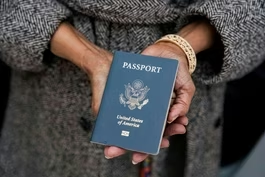
DOJ strips some naturalized Americans of citizenship
Video has Closed Captions
DOJ deploys tactic to strip naturalized Americans of citizenship (5m 23s)
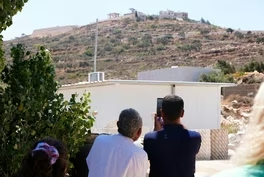
Family recounts siege of West Bank home by Israeli settlers
Video has Closed Captions
Palestinian American family recounts siege of West Bank home by Israeli settlers (5m 32s)

How Trump's construction projects are costing taxpayers
Video has Closed Captions
How Trump's construction projects are changing Washington and costing taxpayers (8m 25s)
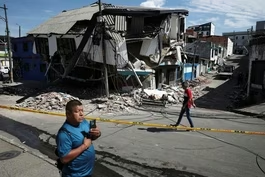
News Wrap: Earthquake death toll in Colombia tops 260
Video has Closed Captions
News Wrap: Earthquake death toll in Colombia tops 260 (5m 45s)
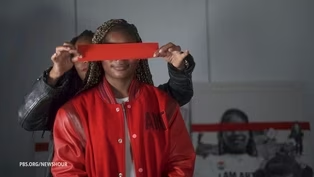
Teacher empowers her students to see themselves as art
Video has Closed Captions
Teacher empowers her students to see themselves as art (3m 23s)
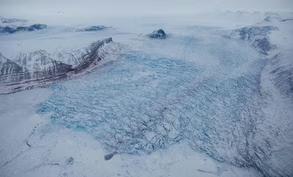
Trump administration ends funding for Arctic climate report
Video has Closed Captions
Trump administration ends funding for Arctic climate report (6m 54s)

U.S. condemns Israeli settler siege of homes in West Bank
Video has Closed Captions
'Act of terror': U.S. condemns Israeli settler siege of Palestinian homes in West Bank (4m 33s)
Providing Support for PBS.org
Learn Moreabout PBS online sponsorship New Episode
- News and Public Affairs

Today's top journalists discuss Washington's current political events and public affairs.

- News and Public Affairs

FRONTLINE is investigative journalism that questions, explains and changes our world.
 New Episode
 New Episode
 New Episode
 New Episode
 New Episode

 New Episode
 New Episode
 New Episode
 New Episode
Support for PBS provided by:
Major corporate funding for the PBS News Hour is provided by BDO, BNSF, Consumer Cellular, American Cruise Lines, and Raymond James. Funding for the PBS NewsHour Weekend is provided by...