
'Blockers' highlights government workers who resisted DOGE
Clip: 10/12/2026 | 7m 58sVideo has Closed Captions
In 'Blockers,' Michael Lewis highlights government workers who resisted DOGE
Elon Musk has donated more than $365 million to support Republicans in the midterm elections. Musk's influence on the federal government is the focus of "Blockers," a new book by Michael Lewis. Lisa Desjardins sat down with Lewis to discuss Musk's time leading DOGE and the federal workers who found themselves in its crosshairs.
Problems playing video? | Closed Captioning Feedback
Problems playing video? | Closed Captioning Feedback
Major corporate funding for the PBS News Hour is provided by BDO, BNSF, Consumer Cellular, American Cruise Lines, and Raymond James. Funding for the PBS NewsHour Weekend is provided by...
'Blockers' highlights government workers who resisted DOGE
Clip: 10/12/2026 | 7m 58sVideo has Closed Captions
Elon Musk has donated more than $365 million to support Republicans in the midterm elections. Musk's influence on the federal government is the focus of "Blockers," a new book by Michael Lewis. Lisa Desjardins sat down with Lewis to discuss Musk's time leading DOGE and the federal workers who found themselves in its crosshairs.
Problems playing video? | Closed Captioning Feedback
Where to Watch PBS News Hour
PBS News Hour is available to stream on pbs.org and the PBS app.
Providing Support for PBS.org
Learn Moreabout PBS online sponsorshipGEOFF BENNETT: New reports out today show Elon Musk has donated more than a quarter-billion dollars to support Republicans in the midterm elections since July.
And that brings his total political contributions this election cycle to more than $365 million, making him by far the largest known donor and one of the biggest political contributors in modern U.S.
history.
Musk has kept a lower profile this election cycle, but questions about his influence on the federal government remain.
And that influence is the focus of a new book by Michael Lewis, the bestselling author of "Moneyball" and "The Big Short."
Lisa Desjardins spoke with him about Musk's time leading DOGE and the federal workers who found themselves in its crosshairs.
LISA DESJARDINS: In the early months of 2025, Elon Musk oversaw DOGE's shock and awe campaign to cut $2 trillion from the federal budget.
Those promised savings never materialized, and Musk left the government after four months.
But the chaos and cuts, including tens of thousands of layoffs, many later deemed illegal, left a lasting impact on the civil service.
A new book by Michael Lewis untangles some of what happened with new details from inside the institutions Musk assailed.
It's called "Blockers: Rebels in the Deep State" after the name Musk used to describe federal workers unwilling to follow his orders.
And Michael Lewis joins us now.
Thank you so much.
MICHAEL LEWIS, Author, "Blockers: Rebels in the Deep State": Thanks for having me, Lisa.
LISA DESJARDINS: You start with the story of Colin O'Brien.
He was the chief of security at the independent Institute of Peace who single-handedly tried to keep out DOGE from taking over their building.
He ultimately failed, but at one point dramatically was able to lock in a group of DOGE employees and security officers to prevent them from getting into the building.
MICHAEL LEWIS: Yes, hermetically seal them within his own building.
LISA DESJARDINS: Why did you start at that point?
MICHAEL LEWIS: Because I think, the very beginning of this story -- it's still going on.
Just because DOGE is gone doesn't mean this stuff is - - stuff like this is still not going on.
But the precondition for what happened in the federal government, in this kind of seizure of power, starts with a pretty crude seizure of all the guns.
Like, you don't think of it because it wasn't a shooting war, but here was this independent entity, the Institute of Peace.
It has congressional funding, but it's chartered to be at arm's length from the president, for sure, and that DOGE was coming in to show that they could take that too.
And to do that, they needed not only the FBI, who they eventually co-opt, but the private security company that the Institute of Peace hires.
And the way they get them is they say, if the guns -- your guns don't come on our side, we're going to remove your State Department contracts.
LISA DESJARDINS: Your much larger contracts.
MICHAEL LEWIS: Your much larger contracts.
They blackmail them into that.
So, if you look at the very beginning of this phenomenon, they seize power very crudely, and then they lop off the heads of anybody who's like an independent referee, the inspectors general, anybody who might identify -- actually identify waste fraud abuse, corruption.
And so they create the environment in which they can do whatever they want to do.
So that's why I started that with that.
LISA DESJARDINS: When I read the book, it felt like you were reaching a few epiphanies, and there's one of them that I'd like you to read.
MICHAEL LEWIS: Oh, sure.
So, yes, look, I think the civil service is like this great undiscovered gold mine of material, of people, and it's incredibly important.
And this is -- I think I'm setting up the civil service.
"American civil servants, as a group, have learned that any attention they receive tends to be negative attention.
And in any case, the sort of person who goes to work for the government isn't usually looking to be the life of the party.
The federal bureaucracy wasn't exactly out of touch with the society it served, but its society was out of touch with it."
LISA DESJARDINS: What do you mean by that?
MICHAEL LEWIS: I mean that I think... LISA DESJARDINS: Society out of touch with federal workers.
MICHAEL LEWIS: I mean I think what I have written about these people demonstrates the point.
They're unbelievably -- unbelievable characters doing unbelievably important things.
Like, I drink this without worrying about it because someone in the government has done something.
And you eat the food because someone in the government has done something.
They're -- it's -- the government is filled with these experts who could make far more in the private sector, who obsessed with some interesting thing the private sector won't deal with.
And their stories don't get told.
I feel like, every politician before they get up to give a speech or do a town hall should have to identify one civil servant whose work they admire and explain why they're important, so we all get a little bit of an education.
LISA DESJARDINS: One of those civil servants that you talk about is Kathleen Walters.
She was the IRS privacy chief essentially in charge of protecting their data when DOGE came to take the data.
MICHAEL LEWIS: Yes.
LISA DESJARDINS: She ultimately was unsuccessful, though, she was able to sort of fend them off for a little while.
MICHAEL LEWIS: She was locking herself in conference rooms with the lights off so they couldn't find her because they were running around looking to fire her.
It was actual hide and seek inside the IRS.
This is the human being who stands between your tax return and a political operation that would weaponize it, that would use it against you.
LISA DESJARDINS: Why was DOGE trying to get that data?
How did they use it?
MICHAEL LEWIS: Well, it was DHS.
LISA DESJARDINS: Yes.
MICHAEL LEWIS: Now, it's probably DOGE and DHS.
It was something called the ICE Innovation Lab.
But inside the IRS, there's a database of seven million tax returns of undocumented workers.
We have told the undocumented community for 30 years that, if you file your taxes, you pay taxes, you're more likely to gain a path to citizenship.
You're showing that you're, like, willing to participate in the society, contribute to the society.
And we have told that community that the tax returns are as sacred as citizens' tax returns.
No information will be used against you.
What DOGE in the DHS figured out, ICE figured out was that tax returns contained the most recent home address... LISA DESJARDINS: Address.
MICHAEL LEWIS: ... of seven million people.
And they were -- they wanted to go find the people in their homes.
What we do know, because I found people who owned and ran apartment buildings for low-income Latinos through the South and Southwest, that suddenly, in April of last year, ICE patrol people, the ICE army, was showing up at midnight with the addresses and knew exactly where people were.
And the people who run the apartment buildings had instituted programs in response, like, we will move you every six months, so your address is always changing.
LISA DESJARDINS: Because we don't know how, but somehow they are -- the federal government has found you.
MICHAEL LEWIS: Yes.
Yes.
When I bumped into these people, they said, wait, wait, you just explained to us how they know where they live.
LISA DESJARDINS: Elon Musk is actually back in government.
He's been appointed to work with the Pentagon on an initiative dealing with the future of warfare.
You were able to speak to insiders around DOGE.
What does that tell you about the culture there and what might be ahead from Elon Musk?
MICHAEL LEWIS: DOGE is mysterious, because Elon Musk isn't a fool.
But he looks like he was on a fool's errand.
He said he was going to cut $2 trillion out of the deficit.
He only attacked a part of the government that was about 20 percent of the budget.
It was never going to cut $2 trillion.
It was never going to work.
LISA DESJARDINS: Right.
MICHAEL LEWIS: It was doomed to fail if actually he was trying to do what he said he was trying to do.
If, on the other hand what he was trying to do was sow chaos and confusion and create a lot of smoke and explosions, so that the huge power grab that then happened could happen without people really paying as much attention because so much is going on at once, well, then it made a lot of sense.
Now, what's odd about it is, if you talk to Elon Musk's friends, they say Elon never lies.
He always at least believes what he's saying.
But IT just seems impossible he could believe what he was saying about DOGE.
The lies are so preposterous.
So what worries me about him anywhere near the federal government now is I just don't trust him.
I mean, like, I don't know what he's going to do.
And I know he's going to -- whatever he's going to say, I know it's not reliable.
He may think it's true, but it's the words of a fabulist.
So, I mean, maybe it's useful.
Maybe he can help, but I'd be very wary.
LISA DESJARDINS: Michael Lewis, the book is "Blockers."
Thank you so much for talking with us.
MICHAEL LEWIS: Thanks for having me.
 New
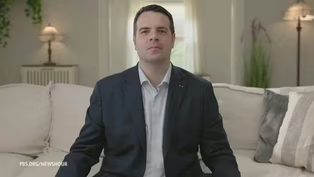
NewA Brief But Spectacular take on giving veterans a chance
Video has Closed Captions
A Brief But Spectacular take on translating military service into civilian life (3m 1s)
 New
NewNews Wrap: Houthi strikes kill 13 at Riyadh airport
Video has Closed Captions
News Wrap: Riyadh airport closed after Houthi strikes that killed at least 13 (5m 19s)
 New
NewRep. Omar alleges political intimidation after home search
Video has Closed Captions
Rep. Omar accuses Trump of political intimidation after agents search her home (5m 51s)
 New
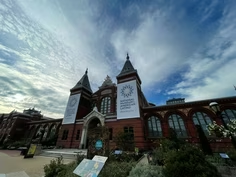
NewSmithsonian's American Latino museum finds permanent home
Video has Closed Captions
Smithsonian's American Latino museum finds permanent home on National Mall (5m 50s)
 New
NewTamara Keith and Amy Walter on GOP's midterm vulnerability
Video has Closed Captions
Tamara Keith and Amy Walter on the GOP's vulnerability in the midterms (8m 21s)
 New
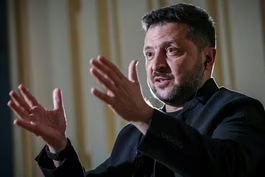
NewUkraine disputes ceasefire as Trump's diesel deal draws fire
Video has Closed Captions
Ukraine disputes Trump's claim of energy ceasefire as Russian diesel deal draws fire (10m 42s)
 New
NewWater access becomes top election issue for Arizona voters
Video has Closed Captions
Water access becomes a top election concern for Arizona voters (4m 51s)
Providing Support for PBS.org
Learn Moreabout PBS online sponsorship
- News and Public Affairs

FRONTLINE is investigative journalism that questions, explains and changes our world.
 New Episode
- News and Public Affairs

Today's top journalists discuss Washington's current political events and public affairs.
 New Episode
 New Episode
 New Episode
 New Episode
 New Episode
 New Episode
 New Episode
 New Episode
Support for PBS provided by:
Major corporate funding for the PBS News Hour is provided by BDO, BNSF, Consumer Cellular, American Cruise Lines, and Raymond James. Funding for the PBS NewsHour Weekend is provided by...