
Ex Sony CEO & Fmr. Clinton Official on What You Can Learn From Their Mistakes
Clip: 3/20/2026 | 17m 32sVideo has Closed Captions
Michael Lynton and Joshua Steiner discuss their book "From Mistakes to Meaning."
As CEO of Sony, Michael Lynton's decision to green-light "The Interview" led to a massive hack of America's systems by North Korea. Joshua Steiner was a young aide during the Clinton administration, and his diary entries helped lead to Clinton's impeachment. Lynton and Steiner, both of whom admit they have made life-defining errors, have written a book about them: "From Mistakes to Meaning."
Problems playing video? | Closed Captioning Feedback
Problems playing video? | Closed Captioning Feedback
Ex Sony CEO & Fmr. Clinton Official on What You Can Learn From Their Mistakes
Clip: 3/20/2026 | 17m 32sVideo has Closed Captions
As CEO of Sony, Michael Lynton's decision to green-light "The Interview" led to a massive hack of America's systems by North Korea. Joshua Steiner was a young aide during the Clinton administration, and his diary entries helped lead to Clinton's impeachment. Lynton and Steiner, both of whom admit they have made life-defining errors, have written a book about them: "From Mistakes to Meaning."
Problems playing video? | Closed Captioning Feedback
How to Watch Amanpour and Company
Amanpour and Company is available to stream on pbs.org and the free PBS App, available on iPhone, Apple TV, Android TV, Android smartphones, Amazon Fire TV, Amazon Fire Tablet, Roku, Samsung Smart TV, and Vizio.
Watch Amanpour and Company on PBS
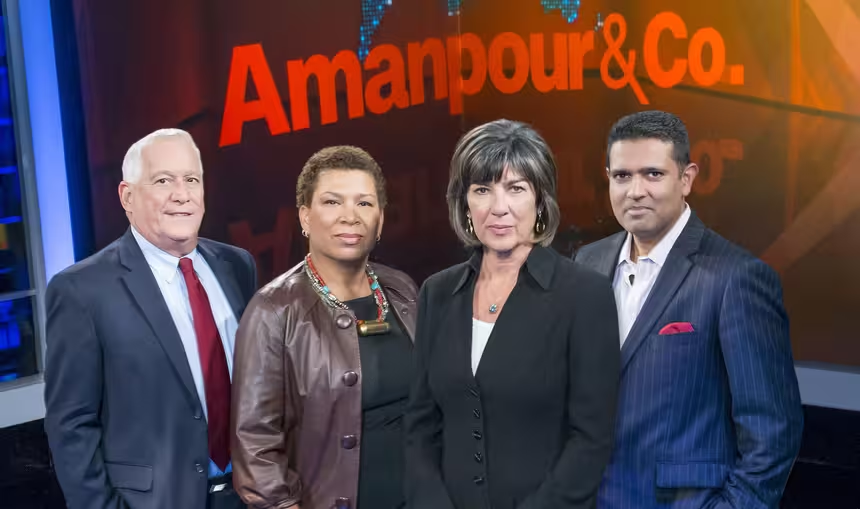
PBS and WNET, in collaboration with CNN, launched Amanpour and Company in September 2018. The series features wide-ranging, in-depth conversations with global thought leaders and cultural influencers on issues impacting the world each day, from politics, business, technology and arts, to science and sports.Providing Support for PBS.org
Learn Moreabout PBS online sponsorshipNow, do you own your mistakes?
Do you confront them?
Our next guests say they've both made life-defining errors.
Michael Lynton was the CEO of Sony Entertainment.
His decision to green light the Seth Rogen movie, The Interview, led to a massive hack of the company by North Korea.
Joshua Steiner was a young aide in the Treasury Department during the Clinton administration, and his diary entries helped pave the way for Clinton's impeachment.
They've just written a book, "From Mistakes to Meaning, Owning Your Past So It Doesn't Own You."
And they're with Walter Isaacson to discuss why it matters.
- Thank you, Chris-John and Josh Steiner, Michael Lynton.
Welcome to the show.
- Thanks for having us.
- You have this book called "From Mistakes to Meaning," and you talk about your own mistakes.
Let me start with you, Michael.
Which mistake do you discuss in the book?
Well, the mistake that I talk about is the mistake that I made when I agreed to greenlight the interview, which was a movie starring Seth Rogen that involved the assassination of Kim Jong-un and resulted in the largest cyber attack on a U.S.
company, namely Sony Pictures.
Remind us of the fallout from your mistake.
What happened with the hack and how you dealt with it.
Right.
So just to relive it for two seconds, we decided to make the movie.
When we finished the movie, we put out a trailer in June of the Christmas period where the movie was going to come out.
And we were immediately warned by the North Korean government that there would be a, they threatened us were we to put it out.
And we continued with the putting out trailers and ads for the movie.
And then in the fall, one day when I was driving into work, I was informed that all of our systems had been hacked.
They had destroyed 70% of computers.
The North Koreans, as it turns out, were the ones responsible.
They leaked vast quantities of emails, finished movies, movies like Annie, Karate Kid, the script of the newest James Bond movie, which had not yet been starting production.
So they really wreaked havoc upon the studio, which couldn't function for almost a month.
What do you wish you had done?
Well, one could argue one thing I wish I had done was not made the movie.
That's for starters.
That was probably- But you actually feel that now?
You know, it's an interesting question.
I think the issue for me, once we decided to make the movie, was that you had to put the movie out regardless, because that's where you go into the realm of censorship.
I think in retrospect, it probably wasn't the best idea to make that movie, just given who we were, who, you know, the fact that at the very end of the movie, you were assassinating the leader of a hostile power, Kim Jong-un, and in retrospect, that was probably a mistake to do that, yes.
But why was that a mistake?
I mean, would it have been a mistake for the publisher to publish Salman Rushdie?
Shouldn't we be doing these things?
Well, no.
I mean, no, the mistake was not putting the movie out.
But to be clear, the issue was that when I decided to make the movie, we threw out the process that we normally had to make those decisions.
Normally, we came together with a group of people, finance, marketing, creative, and deliberated over this.
But in this particular case, we just charged-I charged right in and said yes right after a read-through of the movie.
What made it interesting to me reading about it is you had to look deep in yourself and you said, "OK, why did I do that?
Why did I want to be the cool person who greenlit this movie?"
Right.
So backing up for a moment where, you know, the origins of this was that Josh and I were walking one day, we've been friends for many years, and Josh had this idea that he thought we should both explore our mistakes and potentially write a book about it.
He knew that I had harbored this problem or this issue in me that I had made this mistake many years ago.
Josh equally had one and he thought by exploring those mistakes and trying to get to the bottom of why we made them, we perhaps could release ourselves of, you know, both of us had been avoiding talking about them.
And so when we went through the process of this, it really involved an investigation.
We recruited a professor of psychology from Johns Hopkins and Alison Papadakis.
And in the course of that, I looked back in my life to try and understand what was it in that moment that really made me throw that process out the window.
And what I really discovered was all along I had this deep-rooted desire to be part of a group, the cool group, so to speak, that had come about because when I was a kid, I got moved to Holland from the United States.
And I, you know, developed this-it was a very, very-it was a lonely upbringing.
And that sort of gave birth to this what we describe as schema way of seeing the world.
So, Josh, I first knew you when you were a very obscure Treasury Department official.
And suddenly, one day, you wake up and you're famous.
You're going viral, as we say today.
Explain your mistake and how that happened.
I'm not sure I love the use of the word obscure.
Unfortunately, I'm not sure famous was the right characterization, Walter.
So I was 28 years old.
I was chief of staff at the Treasury Department and I had a great job at an early age.
I was really lucky.
I was working for Lloyd Benson, who was a fantastic person.
And as part of the Whitewater investigation of the Clintons, all of my personal records, my professional records got subpoenaed and I turned over my personal diary, which included references to Whitewater, and those ultimately got splashed across the front page of the New York Times and required me to testify before Congress.
So, as I said, famous is a little generous.
It was an unhappy period of my life.
Why did you turn over the diary?
You know, the speed was very clear, Walter, which said you have to turn over all of your personal and professional records.
And I did something really dopey, which is I kept notes on a very sensitive matter in my personal diary, and I didn't describe it clearly or accurately.
And that was a mistake that I had made.
But it's very different to make a mistake like that than it is to disobey the law.
And the subpoena was clear, and I had a legal obligation to turn it over, and so I did.
Bill just told us that he made his mistake because of a yearning to fit in, a fear of missing out, a wanting to be part of the cool kid crowd.
Your mistake, what caused it, or was it just something that happened?
Well, as we got into studying both of our mistakes, we realized we had to unpack them and unpack them.
And we tell lots of stories about our mistakes and other people's mistakes, and in each case what we found is that mistakes are actually a three-act play.
Act one is what happens before you make the mistake.
To Michael's point, it was his child growing up in Holland.
For me, I had gotten practice writing a diary in a different context.
Act two is the decision where you make the mistake itself, when I actually wrote down what I wrote in the diary.
But the third act is really important, and that's where I made my biggest mistake, which is how do you get over the mistake that you made, that sense of regret, the embarrassment and the shame?
And that just lingered for way too long with me.
It metastasized on the inside.
And long after everyone else had forgotten about it, people could joke about it, and yet I still allowed it to bother me.
And so mine was really an Act III mistake as much as it was an Act II mistake.
Michael, you talk about Alison Papadakis, a professor who helped you do the schema for the book.
Explain who she is and what she taught you all.
Alison was terrific and a wonderful partner and very, very brilliant.
We-Josh actually found Alison to help work with us, and she really helped us in many ways.
The first was to ground us in some of the academic literature.
We're not academics.
A lot of what we were talking about overlaps with much of the research that has been done in this arena.
And Allison was very helpful in guiding us in terms of what to read and not read.
As the second piece of it is, this was done by conducting a series of interviews with a group of individuals whose stories are here, all of whom have made mistakes.
It was done over the course of two interviews, so we would interview these folks over Zoom and then wait a couple of weeks and then interview them again for an hour.
Allison reviewed those interviews with us, and she was extremely helpful in trying to understand and unpack what was at the bottom of what motivated these individuals and caused them to make these mistakes.
So it was on many levels that we worked with Allison.
- Josh, Michael spoke about the fact that you did so many interviews in the book.
They're wonderful chapters, each one.
A lot of them seem to be mistakes of omission rather than commission, things I should have done, but I didn't.
Give me a good example of that.
- Well, exactly to your point, Walter, and going back to your question about Allison, there's this great study where people were asked at the end of their lives what they regret the most.
75% of people regret things that they did not do, not things that they did do.
So we think of regret as making a mistake and regretting having made it, but in many cases, as you say, it's a mistake of omission.
So Michael Govind, who is the director of LACMA, an extraordinary, accomplished man.
Museum of Contemporary Art, exactly.
Excuse me.
So he's an art director of a museum in Los Angeles, very talented.
And he told us this powerful story of how coming out of college, he went to art school.
And his expectation was that he was going to be an artist for the rest of his life.
And then through a variety of circumstances, he ended up at the Guggenheim, which put him on a path to this remarkable career as a curator and museum director.
And the basic story is one of possible selves, which is his path could have gone left, it could have gone right, and he has regret about the fact that he chose this career, which while very, very successful, prevented him from being an artist.
And it's that path question that was very powerful for many people.
Yeah, you see that path question and so many others in the book.
And Michael, your friend, Malcolm Gladwell, had sort of the same thing, which is the regret over the path not taken.
Yeah, very much so.
Malcolm, which not many people know, you would not imagine Malcolm Gladwell, who is clearly one of the most successful authors alive today, regretting his career decision.
That doesn't sound like an obvious thing.
And we certainly didn't expect that to be the case when we asked him in our course of interviewing what was the mistake he wanted to talk about.
But indeed, it was.
And he was, when he was 14 years old, he was one of the best long distance runners, medium and long distance runners in Canada, and had the possibility of going on to have a much bigger career in running.
And at that point, and he loved running, but in that moment, he decided to quit running and focus on his academics, and really double down on that and didn't return to running for a very, very long time afterward.
And that decision, that moment, similar in a funny way to what we talked about moments ago with Michael Govan, he views it as a mistake and he regrets it.
Well, did you ever like look him in the eye and say, you know, with this incredible career he has had as one of the bestselling authors in the world and said, "You got to be kidding.
You really would rather have been a runner?"
You know, to your point, Walter, we did.
And I think the story is actually even less about running than it is about what the decision to run revealed about himself.
And what we found when we talked to him about it is that pattern of making these decisions and not fully understanding why he made those decisions followed him throughout his life, including as it relates to relationship and career choices.
And like many of the people with whom we spoke, it was both a positive and a negative, which is to say there are aspects of Malcolm's success as a writer which can be correlated very closely to his decision to quit running pretty precipitously.
And also that decision reflected some things that caused him pain also.
And so these stories aren't black and white.
And one of the reasons why we found them powerful when you had people like Malcolm is that they were deeply layered.
And some of our strengths obviously are some of our deepest weaknesses as well.
- You all had trouble opening up to each other, close friends early on.
It's got to be tricky getting people to really open up.
Josh, what was the best tactic or trick you used to get people to open up?
And how could people like myself use it in life when we're dealing with our friends?
We made a bunch of mistakes, first of all, when we first tried it.
And the temptation is to rush to a conclusion.
Michael would tell me something, I thought I'd figured it all out.
And he would say, whoa, whoa, whoa, whoa, slow down there.
So one technique that we found very helpful is one that actually didn't come out of psychology, but came from Mr.
Toyota, who was the founder of Toyota, which are the five whys, which is keep asking why, why something happened five times before you come to a conclusion.
That was very, very useful.
Just be curious.
Keep asking questions.
There's some other basic groundings, which is you need to demonstrate empathy.
When people are talking about their mistakes, just show compassion for them and try to get them to forgive themselves just as you're willing to forgive them if it affected you.
And you've got to demonstrate trust.
You can't be someone who's going to go off and gossip about this mistake, as tempting as it is.
So if you're curious, you ask the five whys, you demonstrate empathy, you convince them that you're trustworthy, it makes it much easier for people to open up.
- Josh, does our society now permit people enough room and leeway to admit their mistakes?
- We would certainly argue no.
And one of the reasons why we wrote this book, Walter, was there's so many great books about success and triumph, entrepreneurs, scientists, politicians, and their hero's journeys.
They may have had obstacles, but they're constantly being overcome in some remarkable pursuit of accomplishment.
We also talk about failures, these grand expeditions, and we think of them as siblings.
Success and failure, groups of people come together, they try to do something great, and the difference is just on the outcome.
But mistakes, we stick off in a closet, and we try to hide them, and they get buried under these layers of embarrassment and shame.
And our hope is that people will read the book, they'll go down to their dining room table and say, "You know what?
There's this thing that's been bothering me, and I've never spoken about it."
But if these guys are willing to go and write a book or go on television and talk about their mistakes, if really successful people like Joanna Coles and the late, great Irv Gotti, who are in the book, talk about their mistakes.
You know what?
What the hell?
I'm going to talk about my mistake, and I'm going to talk to my colleagues about it.
If it's something that happened at work, I'm going to talk to my children or my spouse or my partner.
And let's demystify these and allow people not to carry them around and have them cause such pain, and hopefully, as a result, just make fewer of them.
The book is about individuals who make mistakes.
Let me ask both of you, starting with Michael, to what extent should this also apply to societies as we enter the 250th birthday of America?
To what extent should societies, communities, neighborhoods, groups collectively try to acknowledge mistakes and rectify them?
There are times, and we are observing maybe some of them at the moment on both sides of the ledger, where passions rate are such that emotions are really what lead decision making.
And I think in those cases, society is capable of making mistakes.
And I think in those moments, it is a good idea for us to look ourselves in the eye and say, is what we've done in any particular moment a collective mistake?
So I think our current times maybe suggest that we could look at our mistakes as a society as opposed to individuals.
Josh?
Michael's correct.
There's no question that there are aspects of communal action which lead to deep regret.
I think in the end, our hope, though, is that we'll do a little less of, "Oh, it's someone else's fault," or, "Those groups of people are acting badly."
And if each of us was willing to take a moment, be a little bit more accountable for the mistakes we've made, a little more open about what we've done, a little less quick to rush to judgment, the likelihood is the temperature would go down.
We would be more empathetic to our fellow citizens, more willing to listen thoughtfully to difference of opinion, more willing to acknowledge that, as Michael said, in moments of deep emotion or anger, we've acted in ways that we regret.
And that might try to encourage us to do a little bit less of that in the future.
And that, I think, would be a terrific way to celebrate our country's history.
Josh Steiner, Michael Lynton, thank you all so much for joining us.
Thanks, Brad.
Walter, thank you.

- News and Public Affairs

Top journalists deliver compelling original analysis of the hour's headlines.

- News and Public Affairs

FRONTLINE is investigative journalism that questions, explains and changes our world.












Support for PBS provided by: