
Iskigamizigan (Sugar Bush), Artist/Animator Jonathan Thunder
Episode 1 | 26m 46sVideo has Closed Captions
Go sugar bushing and meet artist/animator Jonathan Thunder.
Learn how to count, say animals, and more in Ojibwemowin. We also tag along with the Waasabiik Ojibwemotaadiwin Immersion Program as they go sugar bushing in Obahshiing. Then meet Jonathan Thunder, a talented artist and animator from the Red Lake Nation as he shows us what he's working on.
Problems playing video? | Closed Captioning Feedback
Problems playing video? | Closed Captioning Feedback
Ojibwemotaadidaa! is a local public television program presented by Lakeland PBS
This program is made possible by the Minnesota Legacy Amendment and members of Lakeland PBS.
Iskigamizigan (Sugar Bush), Artist/Animator Jonathan Thunder
Episode 1 | 26m 46sVideo has Closed Captions
Learn how to count, say animals, and more in Ojibwemowin. We also tag along with the Waasabiik Ojibwemotaadiwin Immersion Program as they go sugar bushing in Obahshiing. Then meet Jonathan Thunder, a talented artist and animator from the Red Lake Nation as he shows us what he's working on.
Problems playing video? | Closed Captioning Feedback
Where to Watch Ojibwemotaadidaa!
Ojibwemotaadidaa! is available to stream on pbs.org and the PBS app.
Providing Support for PBS.org
Learn Moreabout PBS online sponsorshipOjibwemotaadidaa!
on Lakeland PBS is funded by the Minnesota Arts and Cultural Heritage Fund with money from the vote of the people of Minnesota on November 4th, 2008.
♪ ♪ ♪ ♪ ♪ ♪ ♪ Maddy: Boozhoo and welcome to the very first episode of Ojibwemotaadidaa!
I'm your host, Maddy Treuer.
This show was created to help share Ojibwe language and culture.
We look forward to highlighting Anishinaabe people.
Today we will go on an adventure with the Waasabiik Ojibwemotaadiwin Immersion Program in Red Lake, meet artist Jonathan Thunder and visit some great kids from the Leech Lake Head Start.
But first, we head to Cass Lake Elementary as students from the Curiosity Center show us how they have been working hard learning Ojibwemowin.
♪ ♪ Child: Bezhig.
Child: Niizh.
Child: Niswi.
♪ Child: Niiwin.
Child: Naanan.
Child: Ingodwaaswi.
♪ Child: Niizhwaaswi.
Child: Ishwaaswi.
Child: Zhaangaswi.
♪ Child: Midaaswi.
Child: Ashi bezhig.
Child: Ashi niizh.
Child: Ashi niswi.
Child: Ashi niiwin.
Child: Ashi naanan.
Child: Ashi ingodwaaswi.
Child: Ashi niizhwaaswi.
Child: Ashi nishwaaswi.
Child: Ashi zhaangaswi.
Child: Niishtana.
♪ ♪ Child: Migizi.
♪ Child: Makwa.
♪ Child: Omagakii.
♪ Child: Waabooz.
♪ Child: Bineshii.
♪ Child: Esiban.
♪ Child: Gaazhagens.
♪ Child: Animosh.
♪ Child: Asabikeshii.
♪ Child: Mikinaak.
♪ Child: Waawaashkeshii.
♪ ♪ ♪ Children singing: Bezhig, niizh, niswi niiwin, naanan, bezhig niizh, niswi, niiwin naanan, ingodwaaswi, niizhwaaswi, ishwaaswi, zhaangaswi, hey, hey, hey midaaswi!
(Children singing lyrics) ♪ ♪ ♪ ♪ ♪ ♪ Maddy: The Waasabiik Ojibwemotaadiwin Immersion Program promotes Ojibwemowin and Anishinaabe culture in Red Lake.
We were able to tag along when they brought their students sugar bushing.
We hope you enjoy it.
(background voices) Binesi: Miigwech gidaa-inaa.
Mii awe gimishoomisinaan.
"Miigwech," izhi!
"MIigwech," izhi!
Zhaawan: I think it's one of the best things that you kids can learn is carrying tobacco.
Ask your mom, your dad, your grandpa, your grandma about the tobacco.
We make offerings with tobacco.
We make offerings with tobacco for people that are gone, gaa-aandakiiwaad.
People that are leaving us.
(background noises) Binesi: Waagaakwadoons.
Child: Waagakwadoons Binesi: Eya, waagaakwadoons negwaakwaan.
Children: Negwaakwaan.
Binesi: He, negwaakwaan.
Negwaakwaanan.
Child: Negwaakwaanan.
Binesi: He, Negwaakwaanan.
Nashke negwaakwaanan.
(children talking) Binesi: Bagoneboojigan.
(Huh?)
Eya.
Enh', Gidaabagjitoomin o'ow bagoneboojigan ji-ozhiga'igeyaang omaa mitigong.
Nashke, mii awe Ininaatig, giwii- bagona'ige na?
Giwii-ozhiga'ige na?
Ahaaw weweni.
(Drilling sounds) Ahaaw, aaniin, aanish ge-izhigeyan?
(drill sounds) (loud blowing sound) Ahaaw, ininamawishin negwaakwaan.
Mii gwayak, howa!
Miigwech.
(blowing sounds) Aandi waagaakwadoons?
Ininamawhishin waagaakwadoons.
Miigwech.
(tapping) Ahaaw, giin, ginjida'an.
(tapping) (tapping) Mii iw minik.
Ahaaw, ininamawishin mashkimod.
Mii gwayak agoodoon.
Aaniin minik negwaakwaanan?
Child: Bezhig, niizh, nisiwi, niiwin, naanan!
Binesi: Mii gwayak!
Giishpin mamooyan bezhig, aaniin minik?
Aaniin minik eshkosegin?
Child: Bezhig, niizh, nisiwi naanan!
Binesi: Hay'.
Aaniin minik eshkosegin negwaakwaanan?
Child: Bezhig, niizh, nisiwi, niiwin.
Binesi: Niiwin, geget.
Giishpin dagonamaan bezhig.
Giishpin dagonamaan bezhig, aaniin minik?
Child: (Inaudible) Bezhig, niizh, nisiwi niiwin, naanan.
Binesi: Eya', naanan.
Mii gwayak, ahaaw.
Howa, giminochige.
(drilling) (tree scratches) (tree scratches) (child voices in back) (tapping) (tapping) Ahaaw, agoodoon.
(background noises) Aaniish epogwak?
Is it sweet?
Wiishkopogwad ina?
Child: It tastes like water.
Binesi: Dibishkoo nibi?
It's kinda like water but there's some...other things in there that are good for you.
Ok, so you know what?
See how that sap is dripping?
Well, it dripped into this bag.
So we're gonna go ahead and put it in your bucket, ok?
And I will pour.
Ziiginige.
Ziiginige.
(background noises) (background noises) (background noises) (background noises) And tip it.... into the bucket.
There you go.
Giminochige, good job.
Good job.
Now go ahead and hang it back on there.
(child voices) Here, I'll help you.
I'll help you.
There we go.
(snow crunching) (snow crunching) (water falling into bucket) (tapping) O, nashke!
(child voices) (background voices) (background voices) (background voices) (background voices) (background voices) (background voices) (child laughing) (snow crunching) (snow crunching) (snow crunching) (background voices) (water falling in bucket) (child voices) (background voices) (background voices) Lift it up, I'll pour it.
(water falling into bucket) Ok, giminochige.
Good job.
you all.
(child voices) Ok, go ahead and put it back.
You got ahold on it there?
(inaudible) Ok, there you go.
You know what you're doing now.
You can come help me anytime.
Gozigwan ina?
Gidaa- wiidookoon ina?
Oh, oh!
Gego bangishiken (background noises) (snow crunching) Giwii-siiga'aan ina?
Ziiginan.
Haa, giminochige.
(child voices) (snow crunching) (snow crunching) (snow crunching) (snow crunching) (child voices) (sap falling into bucket) (child voices) Child: Oh we have a lot of big sap.
(snow crunching) (snow crunching) (snow crunching) (snow crunching) (snow crunching) (sap pouring) Just like that.
Hey?
(child voices) (child voices) Oh yeah, hey you got a lot you go ahead and do it.
O haa.
(laughs) Good job!
Alright!
You guys are good!
You guys are hard workers.
(child voices) It takes me 40 gallons of sap to make 1 gallon of syrup.
So.... we're doing a lot of boiling.
I find it magical.
This whole process of boiling the sap.
And I have a little child like fascination with the whole process.
Ishpi-nannan!
Howa!
He's done.
(loud laughing) Mii omaa ayaan.
Maddy: Jonathan Thunder is a member of the Red Lake Nation who is a talented artist and animator living in Duluth.
You may have seen the beautiful animation he created for Gaa-ondinang Dakwaakowed Makwa- How the bear got a short tail.
He is also a skilled painter and children's book illustrator.
He was kind enough to show us his studio and show us what he's working on now.
Let's check it out.
(knocking) Jonathan: Boozhoo!
Come on in!
Welcome to my studio.
Have a look around.
I'm Jonathan Thunder, animator and artist.
Welcome to my studio here in Duluth, Minnesota, where I animate and create artwork.
Been blessed.I have the opportunity to create animations that teach the Ojibwe language.
So I was born in Red Lake on the Red Lake Chippewa Indian Reservation.
And when I was about 2 we moved to the Twin Cities where I was raised.
I knew that I wanted to be an artist when I was in the 3rd grade.
I was given an assignment to draw a happy face and a sad face.
And...I didn't know how to do it.
I couldn't figure out how to draw this happy and sad face.
So I went home and I was sitting at the kitchen table, obviously flustered trying to do my homework and my mom said, "What are you working on, son?"
So she comes over and I told her what the assignment was.
And she said well, try it like this.
So she sits down and she draws a circle with a little sad face in it.
Almost like an emoji.
And then a circle with a little happy face in it.
And like, to my 3rd grade brain that was brilliant.
Like it just blew my mind completely.
I remember just staring at it and such amazement that I vividly remember it, being a child and thinking I was to be as great an artist as my mom is.
When I start an animation project I will be approached with an idea and that idea often is turned into a script.
So... I'll get it in script form and usually go by the rule that one page equals about 60 seconds of screen time.
Once we get down a game plan on how to execute it visually I'll sit down and do you know, a sketch.
Similar to this sketch that I did with just a big pencil like that.
This sketch I scanned into my work station here with my scanner.
And then I pulled it up into photoshop which is generally where I do a lot of my coloring and layering and that will usually be in layers.
So like the head will be a layer and then I'll go through and kind of make the body.
You know, the arms are often on multiple layers so that way I can if....you know, if anything needs to be animated.
And then once I have that then I'll go ahead and create an environment.
So I'll put her on a bench.
You know, kind of give it some shading also you know I like to create a nice environments for them.
So you can sort of see where they are in the setting to kind of give you a visual lead up to what you know, the story's gonna be about.
From there what I will do is open up a program called Adobe Aftereffects and Aftereffects is pretty much photoshop on wheels.
And that's where I'll do a lot of my animation key frame work, stuff like that.
And start to bring these characters to life.
I'll get some voice over work and then those show up here as these little individual voice over files.
(child speaking Ojibwe) (child speaking Ojibwe) Jonathan: This is a scene where this elder is gonna be asking this young lady, "Look over there.
What is you know like that bird doing?"
Or Look over there what is...what are those puppies doing?
So, I thought it would be cute to have the elders sort of point with their lips before she starts to speak.
Back home I remember you know, my grandma used to always point with her lips.
It was kind of a...something that I really remember about her.
I usually have about 3 or 4 different poses for the mouth.
So I'll start to do the kind of the lip sync they call it.
And then here you can roughly see that you know, the lips are sort of moving.
And then what I'll do is go in and then just try to time it up to the voice and then I'll just give it a little test.
(child speaking Ojibwe) Once I got an animation kind of in progress and it's looking good, I'll usually render it out so I can sort of see what my animations looking like so far.
This is it kind of in real time.
(child speaking Ojibwe) (child speaking Ojibwe) Once that's put together I compile all of the animations in my editing program.
You can see that there's layers and layers of like audio, sound design which is like little ambient noises.
And then I'll, you know, I'll go in and select some nice music.
♪ I also like to put in sort of ambiance which is always nice.
(birds tweeting) These guys will be in a park.
(birds tweeting) So I have this nice clip of you know like birds in a park.
Or something like that.
So then I line them up and then once I get things kind of all put together what I'll do is I'll go in and from the script I'll kind of put a place holder subtitle here where the script is gonna line up with what's happening on the screen and then that's how I know where to put my VO.
And that way I can through and check things shot for shot to make sure that we're like going down our shot list and taking care of everything that we need.
So that not only is the story being told.... for this particular animation being a lesson.
You know the lesson is being delivered in a format that makes sense and once I get that all in place what you have is.....♪ ♪ ♪ ♪ ♪ (child speaking as elder in Ojibwe) (child speaking as elder in Ojibwe) (child answering in Ojibwe) (child speaking as elder in Ojibwe) ♪ ♪ (child speaking as elder in Ojibwe) Jonathan: Animation magic.
This drawing is based on a picture of my grandma.
That I have here is a gal who is from Red Lake and she worked at Head Start most of her life as a the gal who would serve the kiddos lunch every day.
And I think that you know, she would love the fact that you know, she's able to continue to be a part of you know, this sort of thing.
So I got into animation for a couple reasons.
So I....I was that guy who was in his 20's still watching cartoons.
And at the time I was at painting school in Santa Fe, New Mexico and I was studying to be a painter.
I remember seeing this Pixar film called Monsters, Inc.
And it was like....it was so brilliant to me.
I just said, you know what when I get done with painting school I want to go to school for that.
And for animation you know like you can bring your painting skills to the table.
You can bring your story telling skills to the table and you can flex a little technical muscle in the same time.
And you know the reaction that I get when I show some of this stuff is just like, just seeing the look on people's faces is almost worth all the....all the work.
Any art form including animation is gonna be a lot of hitting the books, lot of doing your research, find out like the heritage of animation.
You know, like like Ray Harryhausen was one of the first animators, "Clash of the Titans".
He made the Kraken come to life and did a lot of the Sinbad movies you know with like animated skeletons.
Like know stuff like that, get to love it.
And just study hard.
And work hard.
Really hone your craft and you know when you come to a the point where you're making, you know like animations for yourself you know that love and appreciation for the craft is gonna show through.
One day I got asked to illustrate this book called, "Naadamaading", which you know, was written by multiple Ojibwe language speakers.
And you know, like I said, I'm not a language speaker.
Like I guess I never really thought that I would be asked to be on a project like that.
But I took it and you know I worked closely with the team that was responsible for writing the content and it was a really rewarding experience.
You know, I felt super blessed that.... somebody like me you know, an artist like myself could find in himself on a project where I was gonna be delivering artwork that would do some good.
You know, like it would really like serve a purpose.
Much bigger than myself.
And it also kind of fueled my soul you know, in a way that I hadn't expected.
(children's voices) (Children singing in Ojibwe) (Children signing in Ojibwe) (Children singing in Ojibwe) (Children singing in Ojibwe) (Children singing in Ojibwe) (Children singing in Ojibwe) (Children singing in Ojibwe) (Children singing in Ojibwe) (Children signing in Ojibwe) (Children signing in Ojibwe) (Children singing in Ojibwe) ♪ (Children singing in Ojibwe) (Children singing in Ojibwe) (Children singing in Ojibwe) (Children singing in Ojibwe) (Children singing in Ojibwe) (Children singing in Ojibwe) (Children singing in Ojibwe) ♪ (Children singing in Ojibwe) (Children singing in Ojibwe) (Children singing in Ojibwe) (Children singing in Ojibwe) (Children singing in Ojibwe) (Children singing in Ojibwe) (Children singing in Ojibwe) (Children singing in Ojibwe) (Children singing in Ojibwe) (Children singing in Ojibwe) (Children singing in Ojibwe) (Children singing in Ojibwe) (Children singing in Ojibwe) (Children singing in Ojibwe) (Children signing in Ojibwe) (Children singing in Ojibwe) Maddy: We hope you liked this episode of Ojibwemotaadidaa!
You can see all of the segments online at lptv.org.
We hope to make episodes in the future so if you liked what you saw please share it with others.
Miigwech for watching.
Ojibwemotaadidaa!
is a pilot episode.
Do you love it?
Hate it?
Let us know!
Send us an email to ojibwe@ltpv.org.
♪ ♪ ♪ ♪ ♪ ♪ ♪ ♪ ♪ ♪ ♪ ♪ ♪ ♪ ♪ Ojibwemotaadidaa!
on Lakeland PBS is funded by the Minnesota Arts and Cultural Heritage Fund with money from the vote of the people of Minnesota on November 4, 2008.
♪ ♪ ♪
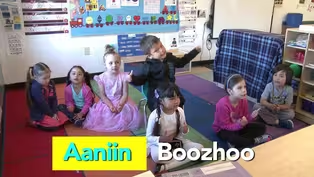
Clip: Ep1 | 23s | A song that teaches how to say hello and say how you're feeling. (23s)
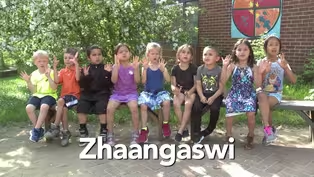
Agindaaso-nagamon (Number Song)
Clip: Ep1 | 22s | Using a song, learn how to count to 10 in Ojibwemowin. (22s)
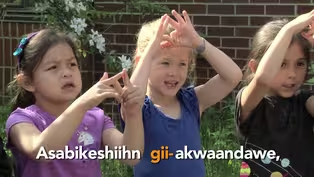
Clip: Ep1 | 23s | Learn how to say "spider" and what a spider does in Ojibwemowin. (23s)
Clip: Ep1 | 1m 16s | Cass Lake Elementary Curiosity Center students identify animals in Ojibwemowin. (1m 16s)
Clip: Ep1 | 37s | Learn how to say colors in Ojibwemowin with Leech Lake Head Start students. (37s)
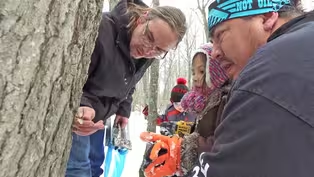
Clip: Ep1 | 8m 27s | Tag along with a group as they go sugar bushing (8m 27s)
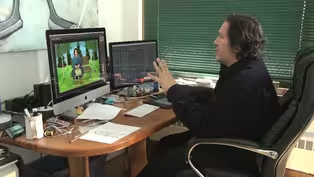
Clip: Ep1 | 9m 59s | Meet an artist & animator from the Red Lake Nation. (9m 59s)
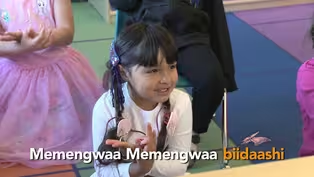
Clip: Ep1 | 49s | Use a song to learn how to say what a butterfly does in Ojibwemowin. (49s)
Providing Support for PBS.org
Learn Moreabout PBS online sponsorship









Support for PBS provided by:
Ojibwemotaadidaa! is a local public television program presented by Lakeland PBS
This program is made possible by the Minnesota Legacy Amendment and members of Lakeland PBS.