
June 4, 2026 - PBS News Hour full episode
6/4/2026 | 57m 46sVideo has Closed Captions
June 4, 2026 - PBS News Hour full episode
June 4, 2026 - PBS News Hour full episode
Problems playing video? | Closed Captioning Feedback
Problems playing video? | Closed Captioning Feedback
Major corporate funding for the PBS News Hour is provided by BDO, BNSF, Consumer Cellular, American Cruise Lines, and Raymond James. Funding for the PBS NewsHour Weekend is provided by...
June 4, 2026 - PBS News Hour full episode
6/4/2026 | 57m 46sVideo has Closed Captions
June 4, 2026 - PBS News Hour full episode
Problems playing video? | Closed Captioning Feedback
Where to Watch PBS News Hour
PBS News Hour is available to stream on pbs.org and the PBS app.
Providing Support for PBS.org
Learn Moreabout PBS online sponsorshipAMNA NAWAZ: Good evening.
I'm Amna Nawaz.
Geoff Bennett is on assignment On the "News Hour" tonight: President Trump's limits are tested after some Republicans in Congress push back, with immigration enforcement funding on the line.
A new proposal could give Trump officials more control over scientific research grants if they don't align with the president's agenda.
CRAIG MCLEAN, Former Acting Chief Scientist, National Oceanic and Atmospheric Administration: I do not want a political appointee making the decisions as to not only what science will we pursue, but what that scientific outcome is.
AMNA NAWAZ: And college graduates begin their job search in a world being transformed by artificial intelligence.
(BREAK) AMNA NAWAZ: Welcome to the "News Hour."
The Senate is in the midst of voting on $72 billion of fresh funding for Border Patrol and Immigration and Customs Enforcement.
The package has been held up for months since federal agents killed two U.S.
citizens protesting immigration crackdowns in Minnesota.
It stalled again when the Trump administration proposed nearly $2 billion for his so-called anti-weaponization fund which could compensate January 6 rioters.
Amendment votes are expected to run well into the night, but it's still unclear at this hour whether Republican leaders will ultimately be able to wrangle enough votes to pass the measure.
Congressional correspondent Lisa Desjardins is here with the latest on that measure and the other Capitol Hill debates driving a wedge between legislative leaders and President Donald Trump.
Lisa, it's good to see you.
LISA DESJARDINS: Good to see you.
AMNA NAWAZ: So where do things stand right now when it comes to funding for ICE and this anti-weaponization fund?
LISA DESJARDINS: After eight months, it does look like the ICE funding is lumbering perhaps toward passage today on the Senate floor, but the process is tedious.
As you can see, this is that process called vote-a-rama.
It is definitely not as fun as that indicates.
It is really more of a stare-down, the process of exhausting senators through an endless series of amendments.
But I am told it could end as soon as tonight on the floor.
Now, in this debate, the two parties are not just divided, Amna.
They really are having two separate debates.
First of all, for Republicans, this is about the ICE funding, about the border and about what they say is a debate over security itself.
SEN.
LINDSEY GRAHAM (R-SC): What you get is a secure border versus a broken border.
What you get is ICE being able to do its job instead of being closed for business.
To my Democratic colleagues, you're on the wrong side of this issue.
You will find out in November.
LISA DESJARDINS: But Democrats disagree.
For them, this is still about ICE conduct, what you just reported, but it is also specifically about the president's anti-weaponization fund.
His attorney general, his acting attorney general, said that it's not moving forward, but Democrats don't trust that.
They think it needs to be codified and put into law now.
SEN.
CHUCK SCHUMER (D-NY): Do we believe, do any of us believe that Donald Trump, who has lied to us day in and day out, will be able to resist getting his sticky fingers in the slush fund, when it would benefit himself and his family?
LISA DESJARDINS: So they are pushing for a law to ban it.
Why are Democrats pushing for that in a separate ICE funding bill?
The answer is actually simple, because they can.
This special process allows them to do that.
Interestingly enough, Amna, Republicans, many of them tell me they also want to have something codified to outlaw this kind of thing, including Lindsey Graham, who I just spoke with, you heard from them there on the floor.
He says he's open to something like that, and he thinks the president might be able to accept it.
So we will watch carefully.
AMNA NAWAZ: We will watch and see.
Separately, Lisa, I have to ask you.
President Trump received what's probably the strongest rebuke yet from Congress yesterday when the House voted to end the war in Iran.
What happened and what does it mean?
LISA DESJARDINS: That's right.
This was significant on the House floor, a vote of 215 to 208 to block the president's actions in a war, an assertion of Congress' war power altogether.
How did it happen?
Well, four Republicans joined with Democrats, there they are right there, to vote to block that war and block any more action in Iran.
For now, House Republican leaders are holding onto that bill.
It's a certain kind of resolution, a concurrent resolution, to become law.
It would also need Senate passage and the president to not veto it.
We do expect the Senate to hold a different vote on Iran in coming weeks, but this was a very strong statement, whether or not it leads to any changes in war policy.
AMNA NAWAZ: Another question we know senators are going to face soon, the president said he's going to nominate to act on a permanent basis as attorney general the current acting attorney general, Todd Blanche.
What do we think will happen?
LISA DESJARDINS: Yes, Mr.
Blanche has had a lot of face time with senators lately over that anti-weaponization fund that is not popular with Republicans.
Now, right now, there are senators telling me behind the scenes that they have doubts with him, especially because of that fund and because he was the personal attorney to the president, but more of them publicly say they favor him.
One said they thought this man, their fellow Senator Eric Schmitt, was going to be the nominee.
So that's another sort of pause for senators.
But I think, in the end, it reminds me of when perhaps Pete Hegseth was nominated and senators had a lot of problems behind the scenes, but in the end, Trump pushed him through.
This could go either way, but I see the winds blowing in Todd Blanche's direction.
AMNA NAWAZ: All right, Lisa Desjardins covering it all, as usual.
Lisa, thank you.
LISA DESJARDINS: You're welcome.
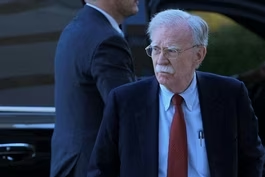
AMNA NAWAZ: In the day's other headlines: President Trump's former National Security Adviser turned critic John Bolton has reportedly agreed to plead guilty to one felony count of illegally retaining classified information.
The deal would settle a criminal case that burst into public view when FBI agents raided his Maryland home and Washington, D.C., office.
Officials say he held onto sensitive diary-like notes that he planned to use for a memoir.
If the deal is approved by a judge, Bolton could either face no prison time or up to five years in custody, plus more than $2 million in fines.
U.S.
officials said today there is no threat of mass infestation from a flesh-eating insect that's been detected in livestock in Texas.
Authorities say the New World screwworm was found in a 3-week-old calf in South Texas, but that no other cases have been confirmed so far.
It's the first time in decades it's been detected in the U.S.
At a hearing on Capitol Hill, Agriculture Secretary Brooke Rollins stressed the threat to livestock production did not mean a threat to the food supply.
BROOKE ROLLINS, U.S.
Secretary of Agriculture: We are using every tool at our disposal to eliminate this threat to our livestock producers and to our national security, and we will actively keep you updated.
Thankfully, this pest does not represent any sort of challenge to our food safety, and that's a really important message.
AMNA NAWAZ: The New World screwworm is a parasitic fly that affects livestock, pets, and wildlife, and, in rare cases, people, though officials say there's no current threat to humans.
Hezbollah rejected the latest cease-fire agreement between Israel and Lebanon today, and instead called for a complete Israeli withdrawal from Lebanon.
Smoke billowed from Israeli strikes in Southern Lebanon today that killed at least four people.
A U.N.
peacekeeper was also killed in the crossfire.
The attacks came just hours after Israel and Lebanon agreed to extend their truce during talks in Washington that did not include Hezbollah.
But, speaking to reporters today, President Trump said he believed Hezbollah wanted to find an end to the fighting.
DONALD TRUMP, President of the United States: I think Hezbollah, I will tell you, they called us and they said, how about stopping?
And I think you're going to see things happen over there.
That's been like a little bit of a different world, but it's interconnected with Iran.
And it would be really nice if Lebanon could have some peace.
AMNA NAWAZ: Meantime, in Gaza, health officials say a series of Israeli airstrikes killed at least 10 people over the last day.
One strike hollowed out entire floors of an apartment building in Gaza City.
Families began burial preparations today.
The victims included two women and two children.
A court in Colorado reversed the homicide convictions today for two paramedics who'd been sentenced in the overdose death of Elijah McClain.
The 23-year-old Black man had been forcibly restrained by police as he walked home from a convenience store in 2019.
The paramedics injected him with ketamine and were found guilty of criminally negligent homicide after a trial in 2023.
Today's ruling sends their cases back to a lower court.
McClain's final words, "I can't breathe," foreshadowed those of George Floyd a year later and helped fuel public anger over police tactics across the nation.
Tens of thousands of people have been getting a sneak peek at the Obama Presidential Center in Chicago.
The facility officially opens on Juneteenth, but friends, students and journalists have been strolling the nearly 20-acre campus this week.
The $850 million project reflects the life and legacy of the nation's 44th commander in chief and first Black president.
It includes a replica of the Oval Office from his time in office, a collection of former first lady Michelle Obama's gowns, and a full-size basketball court, reflecting one of Mr.
Obama's favorite pastimes.
Stocks on Wall Street ended mixed today amid a fall in oil prices.
The Dow Jones industrial average jumped nearly 900 points, but the Nasdaq posted a modest loss of about 20 points.
In the meantime, the S&P 500 rose for a 10th time in 11 sessions.
And the French-Iranian author and filmmaker Marjane Satrapi has died.
She was best known for her graphic novel series "Persepolis" based on her own coming of age in Tehran after the Islamic Revolution.
It was later adapted into an Oscar-nominated film directed by Satrapi.
She spoke with the "News Hour"'s Jeffrey Brown in 2012 on telling complex stories about Iranian people.
MARJANE SATRAPI, Author and Filmmaker: Unfortunately, Iran is reduced to veil and beard and nuclear weapons.
The problem when we reduce people to -- or a country to a notion, then they become abstract, and from the second they stop being human beings, then we can go and bomb them and kill them.
AMNA NAWAZ: She also wrote the graphic novel "Chicken With Plums" directed the Marie Curie biopic "Radioactive" starring Rosamund Pike.
French President Emmanuel Macron called Satrapi an artist devoted to freedom whose work carried a universal message.
Her family said she died of sadness after the death of her husband last year.
Marjane Satrapi was 56 years old.
Still to come on the "News Hour": a new book offers guidance for young people entering the work force during an uncertain time; a musical phenom introduces an old instrument to new audiences; plus much more.
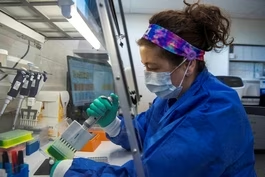
The Trump administration is proposing a sweeping overhaul of how the federal government awards billions of dollars in research grants, giving political appointees a much larger role in funding decisions.
The administration argues these changes are necessary to stop what they call a woke agenda.
But researchers across many fields say this could allow the administration to effectively limit and exert more control over critical scientific research.
Our William Brangham has more.
WILLIAM BRANGHAM: Amna, these proposed changes, which were put out by the Office of Management and Budget, or OMB, call for new criteria to review grants, including no funding or promoting of diversity, equity, or inclusion.
Projects must -- quote -- "demonstrably advance the president's policy priorities."
And, in a major change, political appointees, not necessarily subject matter experts, would be required to give the final OK before money is awarded.
For more on all this, we are joined by Craig McLean.
He is the former chief scientist at the National Oceanic and Atmospheric Administration, where he oversaw grants and awards flowing through that agency.
Craig, thank you so much for being here.
You are part of this organization called Stand Up for Science that is pushing back against this change.
Help us understand why this would make a difference, because, to some people, they might think these are relatively minor changes.
Putting a different person at the top of the decision-making chain doesn't seem like such a huge shift.
Why is this so troubling to you?
CRAIG MCLEAN, Former Chief Scientist: It's remarkably troubling, because, first off, the Trump administration has already demonstrated its ability in the past to displace scientific judgment with their own political pronouncements.
One of them is climate change, believing that it doesn't exist, when, in fact, the evidence is conclusive that climate change is real.
Humans are causing it.
So this is an administration that is quite ready to displace scientific truths for their own convenient interpretation.
And that's remarkably damaging to the integrity of the United States, to the safety of our people, and to the value of science itself.
WILLIAM BRANGHAM: I mean, OMB, in their -- in putting out their statements about this, they told us today that this to them is about eliminating waste, fraud, and abuse, trying to stop woke funding projects.
And they argue on some level that this is the prerogative of any administration to stress the kinds of research they want and de-emphasize others.
What do you make about that argument?
CRAIG MCLEAN: Publicly elected officials have always stated their preference for where the science enterprise might focus, and they state that preference by the annual appropriation, the money that Congress passes, and then hands over to the federal agencies.
And those federal agencies are populated with merit-driven individuals, who then make the judgments as to what should be awarded where.
And we also have seen the use of peer review panels, where non-federal individuals, scientists, come in and evaluate proposals and then make selections.
So what we're doing here that's very different is, we're asking political appointees, who often do not have the credibility or experience in the positions that they're in, to be making those judgments, instead of the people who have spent their entire careers in a position to gain the knowledge and experience as to what's the best investment scientifically.
I do not want a political appointee making the decisions as to not only what science will we pursue, but what that scientific outcome is.
And the Trump administration has repeatedly demonstrated they don't understand science, they don't believe in much of the science, health or climate and other subjects.
And putting people like that in the control seat to determine what the scientific answer is, is unconscionable.
WILLIAM BRANGHAM: This is not just about climate work.
This is across all of government.
And OMB argues that they specifically wanted to eliminate any DEI grant-making that is going on.
What is your sense as to what the impact of that elimination would be?
CRAIG MCLEAN: It would narrow the field of participants.
I think the Trump administration has a very sensitive trip wire that if anyone who doesn't look like their perceived majority of white males winds up in a position of responsibility or an advantage or is a financial recipient awardee that there must be some other reason than their skill and abilities to have found themselves in such a place.
And they're doing it aggressively because I think the National Science Foundation, among other agencies, had a very proud and aggressive stance to try and open and widen the aperture of participation of all Americans with appropriate scientific credentials.
WILLIAM BRANGHAM: I just want to read you a statement that OMB gave us today about the rationale for this.
They write -- quote -- "Federal grants were already politicized by the last administration to promote a far left DEI agenda.
Funding went to projects like drag shows in Ecuador and transgender experiments on mice.
That ends now.
With this new rule, the Trump administration will bring much-needed transparency to the grant making process and ensure taxpayer dollars are spent wisely."
I should say researchers have pushed back quite hard on this assertion that there was any research trying to turn mice transgender.
But to their larger argument, they are saying this is a corrective, a needed corrective.
What do you say to that?
CRAIG MCLEAN: I don't see this as a correction.
I see this as a regression or a degradation of standards that were advanced to make science more open and available to everyone.
The fact that they don't understand what those experiments were like is, number one, disappointing.
But number two, if that's the best answer they could come up with, it reveals that they don't understand science, because that's not what those experiments were.
There were no transgender mice.
I would have been much more inspired to hear OMB talk about things like trying to economize in the regulatory burden on the scientific and academic community and the likes of that.
But they have missed that opportunity and they rely on their political talking points.
WILLIAM BRANGHAM: All right, that is Craig McLean, the former chief science officer at NOAA.
Thank you so much for being here.
CRAIG MCLEAN: Thank you very much for having me.
AMNA NAWAZ: Well, we are in commencement season, when graduates look back on their accomplishments and look ahead to their future ambitions.
But shifts in the economy and the anxiety around it are changing how this generation of grads see their prospects.
Ali Rogin has more on that as part of our series Rethinking College.
ALI ROGIN: Recent college graduates are facing one of the more difficult job markets in many years.
The unemployment rate for recent graduates between the ages of 22 to 27 is over 5.5 percent, and some believe it's higher than that.
It's above the national unemployment rate.
And all of the talk and forecasting about A.I.
wiping out millions of jobs is souring young adults on what they could face.
Take a listen to this montage of recent commencement speeches, where a speaker talked about A.I.
and how they were received by students.
ERIC SCHMIDT, Former CEO, Google: Last December, "TIME" magazine selected its person of the year for 2025 and it was -- this time, it was the architects of artificial intelligence.
Interesting.
(BOOING) GLORIA CAULFIELD, Tavistock Development Company: The rise of artificial intelligence is the next Industrial Revolution.
(BOOING) GLORIA CAULFIELD: Whoa.
(BOOING) SCOTT BORCHETTA, CEO, Big Machine Records: A.I.
is rewriting production as we sit here.
(BOOING) SCOTT BORCHETTA: I know it.
Deal with it.
Like I said, it's a tool.
(BOOING) ALI ROGIN: We're going to talk tonight about some ways of navigating this moment.
It's the focus of a new book by New York Times journalist Jodi Kantor.
It's called "How to Start: Discovering Your Life's Work."
Jodi, welcome back to the "News Hour."
JODI KANTOR, Author, "How to Start: Discovering Your Life's Work": Thank you so much.
ALI ROGIN: We are well into commencement season, and this book really came out of an address you gave last year where you talked to students.
You interviewed many of them before giving your speech about some of the fears that they were facing.
And since that time, it seems like the conditions have only gotten worse.
What are you hearing from students now about their worries about getting into the job market and really start -- beginning to chart the rest of their lives?
JODI KANTOR: Well, one of the reasons they're so worried and one of the reasons why I think many of them have a negative impression of A.I.
is that they are being sent a terrible cultural message.
Graduation is supposed to be a moment of possibility, and they're being told the A.I.
moment is going to make you superfluous, entry-level workers are not going to be needed.
I think, first of all, we don't know that that's true, and it's also a very damaging message.
The other thing that is very important to say is, memo for anyone who hasn't applied for a job in a while.
The job hiring process is very A.I.-fueled right now, and it has turned digital and lonely.
Looking for a job has always been stressful, but these young people are going from gigantic digital job portal to gigantic digital job portal.
They're seeing these listings that may or may not be ghost listings, meaning, do they even represent real jobs?
Some of them are being interviewed by A.I., instead of being interviewed by real people.
So they are entering into the work force and, like - - or trying to -- and essentially meeting nobody.
And they say that this is just a degrading and dehumanizing experience.
So the boos did not surprise me at all.
But, that said, I think there's a more interesting question here.
And this is the question I tried to address in the book.
What are they supposed to actually do?
They need jobs.
They need to move forward with their lives.
So what does it look like for a young person to have a positive, productive response to this very intimidating and degrading environment?
ALI ROGIN: And you offer a lot of advice about how to respond to this degrading environment.
I do want to ask you, though, first, you talk in the book about how every generation has its advice... JODI KANTOR: Yes.
ALI ROGIN: ... that eventually becomes obsolete, whether it's study Japanese or, one word, plastics.
So, in some ways, it does seem like this generation is no different, but then, in others, it seems like the conditions are much harder.
So where do you think this generation lies in terms of how hard things are over the spectrum of when people graduated?
JODI KANTOR: I think we can say what we do know and what we don't know.
What we do know is that there is a long history of people being told exactly what was going to happen in the workplace that turned out to be wrong or misleading.
And also there's, like, a long history of conventional wisdom about the thing you supposedly have to study.
When I was in high school, it was learn Japanese.
We were literally told that the Japanese were going to take over the world economy and that we were going to be losers if we were not fluent in Japanese.
Well, meanwhile, the Japanese stock market after that languished for 30 years.
And then the conventional wisdom was, you need to learn genetics, and then it was Mandarin, and then it was coding.
So these are all great pursuits.
If this is your passion, of course you should study it.
But is it an infallible golden ticket that is going to earn you instant stability?
Of course not.
So I would say the first thing we can say is, like, beware of conventional wisdom or anybody who professes too much certainty about exactly what's going to happen.
I think the second thing we can say is that it's too early in the game to know exactly what's going to happen with the future of work.
It's a really tough hiring point right now, as you alluded to.
A.I.
is not the only reason.
It may not even be the major reason.
I think we are several years out from seeing exactly what the workplace will look like, whether A.I.
is really going to be a revolution or more of a red herring.
And, for that reason, I want us to work with really time-tested materials that will be durable for this generation, no matter what happens.
ALI ROGIN: And a couple of the materials are -- the concepts that you lay out include finding your craft and marrying it with a need that's out there.
Can you flesh that out for us a little bit?
JODI KANTOR: The best careers, the people who are both happiest and most successful, I think, harness two things, a craft and a need.
And I think you want to look for each of those and pair them.
A craft is a special skill you have that other people don't have.
Surgery is certainly a craft, but so is putting together an amazing news broadcast like this one.
Baking can be a craft.
Writing recipes can be a craft.
Teaching can be a craft.
A craft is something you get good at over a long period of time.
It's not instantaneous.
But when you have it, it provides at least some protection from being treated as disposable or interchangeable in the marketplace.
Any employee can be fired, but your craft can never be taken away from you.
And then I think, if craft is authority, I think it gets really powerful when it's paired with a need.
I want to say to young people, using your own eyes and ears, what is your independent assessment of what other human beings are going to need during your time at work?
What products?
What services?
What information?
When you have a need that you're chasing, your career is less like a lonely paddle up a stream, and it's more like you're being buoyed by a rushing river, whether it's an altruistic need or a business need that is pushing you.
I think the need factor is also very important right now because what we talked about a second ago, young people are being told essentially that they're not needed.
That's not true.
I want them to have a rejoinder and a way of seeing, of course my energies and ambitions are valuable.
I'm going to give my dreams a fighting chance here.
ALI ROGIN: Such great advice to end on.
The book is "How to Start."
Jodi Kantor, thank you so much for talking with us about it.
JODI KANTOR: Thank you for having me.
AMNA NAWAZ: Let's return now to Capitol Hill, where the U.S.
House yesterday voted to limit President Trump from further military action in Iran.
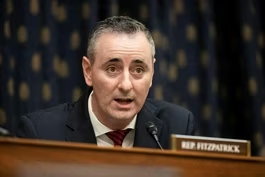
One of the Republicans who voted for that resolution is Congressman Brian Fitzpatrick of Pennsylvania.
He joins us now.
Congressman, it's good to see you.
Welcome back to the "News Hour."
REP.
BRIAN FITZPATRICK (R-PA): Thanks for having me.
AMNA NAWAZ: So we reported earlier you were one of four House Republicans to vote for that Iran war powers bill.
You did vote against it earlier in the year in March and in April.
You changed your vote to yes in May and again last night.
So, why the change?
Why support that now?
REP.
BRIAN FITZPATRICK: Yes, it's very simple.
It's following the law.
The War Powers Act of 1973 has two essential requirements, 48-hour notification in advance and within 60 days of hostilities commencing approval by Congress.
So, as soon as we hit that 60-day mark, every resolution that's been brought to the floor, I have supported.
It's just a simple, basic matter of following the law.
Some people complain about the War Powers Act of 1973.
There's two choices.
You follow the law or you change it.
You can't violate it.
That's not an option.
AMNA NAWAZ: So you don't seem to buy the president's argument then that the clock had stopped when the cease-fire was declared.
But I'm sure you saw the president react to you and the other yes-votes.
He called you bad Republicans and grandstanders.
He said: "Why would you do" -- rather, "Who would do such an unpatriotic thing?"
What's your response to that?
REP.
BRIAN FITZPATRICK: Well, I think following the law is very patriotic.
And, listen, we get criticized all the time in this job.
You can't let that affect your focus.
I report to no person or no party in Washington, D.C.
I work for the people back home in Bucks and Montgomery Counties of Pennsylvania, Pennsylvania's First Congressional District.
They're my bosses.
I listen to them intently.
And my job is to reflect their voice here on the House floor, and I'm going to continue to do that.
AMNA NAWAZ: So this measure is specific to military action in Iran, but we have heard the president threaten to use military action in other places, like Cuba.
I'm just curious if you believe that the president needs congressional approval before any potential military action in Cuba.
REP.
BRIAN FITZPATRICK: Yes, again, follow the law, right?
We have a War Powers Act that spells this out.
By the way, unfortunately, many presidents that have preceded this one have violated it as well.
I was not in Congress then.
I am in Congress now, and I'm going to enforce the law now.
Under President Obama, we had Libya.
Under President Clinton, we had Bosnia and Kosovo.
Under President George H.W.
Bush, we had Panama.
What we have seen consistently is, the executive branch tends to take a view of the War Powers Act of 1973 that's most deferential to Article II, to the executive branch.
But we have three branches of government in this country.
I work for the legislative branch.
We have to be a separate independent constitutional check on the other branches of government, including the executive branch.
So it's pretty basic for me, follow the law.
AMNA NAWAZ: While I have you, I want to ask you as a member of the House Intelligence Committee as well.
We have heard the president say that he will name Bill Pulte as his new director of national intelligence to replace Tulsi Gabbard, though the president said today that it wouldn't be on a permanent basis.
As you all know, Pulte is now head of the Federal Housing Finance Agency, doesn't seem to have any kind of intelligence background at all.
So permanent or not, do you believe he's qualified to serve in that role?
REP.
BRIAN FITZPATRICK: I do not, no.
AMNA NAWAZ: So what do you make of the president's plans to push ahead with this, even if it is on an acting basis?
Does that worry you about the integrity of the job for the top intelligence official in the country?
REP.
BRIAN FITZPATRICK: Well, yes, of course.
You always want somebody with a background in intelligence.
I have been in the intelligence community for 15 years as an FBI agent prior to coming here, and now as the chairman of the CIA Subcommittee on the House Permanent Select Committee on Intelligence.
These are serious jobs.
They require people with a background in the subject matter.
We have a lot of issues, including FISA Section 702, that we're debating right now that the director of national intelligence has a significant voice in.
So, yes, you always want someone with a background.
I have spent my whole life in the I.C., so I think that I answer the question I think that he's not qualified to do it.
And the president appointed him, purportedly on an acting basis, so we will see who gets the nomination.
AMNA NAWAZ: Do you believe there's enough Republicans who've expressed similar concerns that the president could walk back putting Bill Pulte in that job?
REP.
BRIAN FITZPATRICK: In terms of nominating him?
AMNA NAWAZ: Yes.
REP.
BRIAN FITZPATRICK: Well, I don't think he will get confirmed.
I think that's pretty clear.
AMNA NAWAZ: So you have concerns about Bill Pulte.
What about Todd Blanche?
Because we have now heard the president will actually nominate him to be officially the permanent attorney general.
He's been serving in an acting role.
We reported earlier on some of the headwinds he might face in the confirmation process.
Do you believe he should be confirmed in a permanent role?
REP.
BRIAN FITZPATRICK: I do not.
I have been at the tip of the spear on fighting back against this so-called anti-weaponization fund.
I think it was a serious abuse of authority by the acting attorney general, so much so that I introduced the bipartisan bill with Tom Suozzi, my co-chair of the Problem Solvers Caucus, to fix this instance.
But, moreover, we're going to go back and actually get to the root of the 1956 Federal Judgment Act.
The bill is that old.
That has been significantly watered down in 1961 and 1963 and several points thereafter that really migrated a lot of authority away from Article I, Congress, and towards Article II and gave a ton of discretion to the attorney general, too much discretion, that allows it to be abused like it was now.
So we have got to fix that.
But to answer your question, that really undermined my confidence in his judgment.
AMNA NAWAZ: That's Congressman Brian Fitzpatrick of Pennsylvania.
Congressman, so much more to talk about.
We hope you will come back and join us again soon.
Thank you for your time.
REP.
BRIAN FITZPATRICK: You bet.
Thanks.
AMNA NAWAZ: The pipe organ is typically associated with formal concert halls and church music, traditional works by Baroque composers like Bach.
But one musician is broadening the instrument's reputation and has gotten over a million people to tune in.
Our senior arts correspondent, Jeffrey Brown, with help from our friends at Maine Public, went to experience this in Portland.
It's part of our arts and culture series, Canvas.
(MUSIC) JEFFREY BROWN: A lone musician at the console of an instrument capable of enormous and enormously varying sounds, hands and feet flying across the keyboards.
ANNA LAPWOOD, Organist: Oh, my gosh, thank you so much for coming.
I am so excited about this.
(CHEERING) JEFFREY BROWN: It's become a most unexpected phenomenon, playing out before packed audiences.
ANNA LAPWOOD: Hello.
I'm here at the Sydney Opera House.
JEFFREY BROWN: And gaining large followings on social media.
ANNA LAPWOOD: I will give this baby Trader Joe's bag and it's the perfect size for my organ shoes.
JEFFREY BROWN: And for the traditional pipe organ, something big is happening, and Anna Lapwood is helping lead the way.
ANNA LAPWOOD: It's a novelty that people haven't been given the opportunity to understand, because it's been impossible to get them close enough.
But now, with social media, we can bring a million people close enough just through a phone.
They come to the concerts.
They come and they want to hear what you're talking about and they want to understand.
And they have questions.
JEFFREY BROWN: They want to see it live and real.
ANNA LAPWOOD: And they want to feel it.
They want to feel the room shaking.
JEFFREY BROWN: We got a glimpse of the Lapwood effect recently in Portland, Maine, as she prepared for the final performance of a U.S.
tour playing the Kotzschmar Organ built for the city in 1912.
There's a lot going on here, right?
ANNA LAPWOOD: There's quite a lot going on, particularly an organ of this size, actually, because we have five keyboards, five manuals.
You have got the full pedal board.
You have all of the different stops -- these are called stops -- that control the sounds.
JEFFREY BROWN: Ahead of the performance, she spent more than 18 hours registering the organ.
ANNA LAPWOOD: For every moment of the concert, you have to choose the sounds you want.
You have to basically audition the different sounds, for this program, about 350 different settings, all of which have to be programmed individually.
JEFFREY BROWN: Yes.
And this is a completely new organ for you, right?
ANNA LAPWOOD: It is.
JEFFREY BROWN: So, you are getting to know this instrument?
ANNA LAPWOOD: Every organ is totally different.
It's a bit like sort of speed dating.
You have to try and get to know the personality of the organ as quickly as possible and then figure out what that organ wants you to say with the music.
(MUSIC) (CHEERING) JEFFREY BROWN: Lapwood's classical music credentials, Bach and all, are impeccable.
Now the official organist at London's Royal Albert Hall, she was the first female organ scholar at Magdalen College in Oxford, later director of music at Pembroke College, Cambridge.
She tried many instruments in childhood.
Somehow, it was the organ, which she sometimes refers to as a machine, that offered a new kind of connection to audiences and more.
ANNA LAPWOOD: It is a way to connect with them, but I think, for me, it's been a way to connect with myself and figure out who I want to be on stage.
JEFFREY BROWN: What does that mean?
ANNA LAPWOOD: I feel the most free, natural version of myself.
I feel so much more free than I do in normal life, to be perfectly honest.
It is the freest version of myself on stage, because it's the music, which is just like a glove in my mind.
It is just me.
JEFFREY BROWN: When you're playing, do you feel yourself part of the machine or... ANNA LAPWOOD: I just feel like my body has suddenly expanded and this living thing around me is part of me.
JEFFREY BROWN: And it was her own love of movies and film scores that offered a way to reach new audiences.
ANNA LAPWOOD: The thing I give the biggest credit for the shift in how people perceive the organ is the film "Interstellar."
Suddenly, people hear the organ in a totally different context.
They hear the beauty of it.
They hear the sensitivity of it.
If you count how many times a day you hear the "Interstellar" soundtrack scrolling on TikTok or Instagram, everyone knows that music.
It has brought the organ front and center into public consciousness.
JEFFREY BROWN: The popularity she's gained has also led her into some unexpected places, performing with contemporary artists from other musical genres, including a collaboration with the electronic musician Bonobo.
MAN: Toccata and Fugue in D minor.
ANNA LAPWOOD: They heard me practicing at came on stage.
They were like: "This is so cool.
Wouldn't it be cool if we included the organ in our set tomorrow?"
So I ended up joining the show with no notice.
And it was so far outside my comfort zone.
I had no idea what I was getting myself in for.
And then there were these soaring strings, and I just started crying.
The wool had just been pulled from over my eyes, and I went, oh, my gosh, the musical world is about 70 million times larger than I'd ever imagined it could be.
No one knew I was going to be doing it, and the crowd just erupted.
(CHEERING) JEFFREY BROWN: Clearly behind all this, Lapwood's personal effervescence, love of her instrument... ANNA LAPWOOD: "Lord of the Rings."
This is the biggest project I have ever done.
JEFFREY BROWN: ... and desire to communicate directly with her audience, including regular posts of behind-the-scenes of her life and work and middle-of-the-night rehearsals, often the only time she can access these special and unique instruments.
It's paying off with more than four million followers across platforms.
Is that a phenomenon that still surprises you?
ANNA LAPWOOD: All the time.
JEFFREY BROWN: All the time?
ANNA LAPWOOD: I still -- it's so strange.
I always say there's like Anna Lapwood and there's Anna, right?
JEFFREY BROWN: Who's here with me?
ANNA LAPWOOD: Somewhere in the middle, I think, probably a little mix.
I try to bring as much as I can over, and I think there's something that people like about that, because it feels like it gives them permission to be the most authentic version of themselves as well.
JEFFREY BROWN: The Portland concert had ticket holders come from 43 states and four foreign countries.
ANNA LAPWOOD: Hello.
WOMAN: Hi.
Can I give you a hug?
ANNA LAPWOOD: And she greeted many of them for more than two hours after the concert ended.
MAN: She just exudes this enthusiasm.
WOMAN: Hi.
ANNA LAPWOOD: Hi.
How are you?
WOMAN: I'm fine.
And you?
MAN: Her energy, it's just magnetic.
ANNA LAPWOOD: Well, come this way.
Come this way.
Come this way, yes, yes.
WOMAN: The way she lights up, she's so entertaining to watch.
JEFFREY BROWN: Lapwood's growing audiences online and in halls around the world are more than happy with what and how she's playing.
(MUSIC) (CHEERING) JEFFREY BROWN: For the "PBS News Hour," I'm Jeffrey Brown in Portland, Maine.
AMNA NAWAZ: And we'll be back shortly.
But, first, take a moment to hear from your local PBS station.
It's a chance to offer your support, which helps keep programs like ours on the air.
For those of you staying with us, we take a trip back to Antarctica with science correspondent Miles O'Brien.
He traveled there earlier this year with a team of scientists who were trying to understand why the Thwaites Glacier is melting so quickly.
In this encore report, Miles looks at some of the research they conducted despite some major setbacks.
MILES O'BRIEN: The timing was awkward.
New York University glaciologist David Holland and I landed on the Thwaites Glacier almost precisely when the valiant effort to bore through it and install a suite of sensors in the ocean beneath reached an unceremonious dead end.
MAN: Stuck.
DAVID HOLLAND, New York University: We did not succeed in doing what we wanted to do, was to put a weather station in the ocean out there to begin to monitor it.
What we achieved there was nothing, absolutely nothing, a little bit Shakespearian.
MAN: Damn, that's brutal.
MILES O'BRIEN: The tragedy became comedy when Dr.
Holland asked me to give him a hand, which, as an arm amputee, is literally all I had to offer.
But I have a hard time saying no.
OK, these are empty.
Just my speed.
All right.
Let's go!
What are you doing?
Are you doing your end?
DAVID HOLLAND: That's dragging.
No, I think that one is just dragging.
MILES O'BRIEN: All right.
So we started setting up the distributed temperature sensor, the last instrument slated to go down the hole.
The heavy gear connects to a fiber-optic cable that provides continuous temperature readings from the surface to the seafloor.
But now it will come up about 650 feet short.
Once the hole closed up, you could have closed up shop and just come back to the ship, but you didn't.
DAVID HOLLAND: Why?
So it shows the possibility of what we can do in terms of remote instrumentation.
So it would be sugarcoating to say that's really great.
I would say that's better than nothing.
MILES O'BRIEN: The drill project was the marquee event of a monthlong scientific campaign launched from the deck of the icebreaker Araon owned by the Korea Polar Research Institute, or KOPRI.
Despite the drilling failure, they notched some success.
One of the helicopters flew for several days over the ice, surveying with a powerful radar able to peer through the thick ice to measure it and see what the lay of the land is below.
Now in its sixth year, the research campaign is a partnership between KOPRI, the University of Texas, and Montana State University.
CHRIS PIERCE, Montana State University: So they have been out for, what, six hours now, a little over six hours.
MILES O'BRIEN: The field team leader is glaciologist Chris Pierce.
CHRIS PIERCE: We have got really good-quality data and we have got really good coverage coming out of this.
MILES O'BRIEN: He showed me one of their radargrams.
It's a two-dimensional slice of the ice, like an MRI or X-ray, understanding the terrain beneath the ice is a priority for researchers, developing models to predict how fast the glacier might retreat.
CHRIS PIERCE: Once you get past a certain point, you're going to have a really, like, low-friction surface on which the glacier can slide.
So that's one of the reasons that people believe that Thwaites is particularly susceptible to instabilities.
MILES O'BRIEN: To help calibrate his radar, Pierce turns to sea ice scientist Siobhan Johnson of the British Antarctic Survey to get a precise read on the density of firn, snow that is transitioning to ice.
She is an expert in ice coring.
We were on top of Thwaites when she showed me how it's done.
So, a little easier than doing it manually.
So, let's give it a try and see how it goes.
She uses a coring device attached to a cordless drill.
Easy peasy.
This core represents about six months of firn.
It tells a story if you know how to read it.
Clear ice means a warm spell.
SIOBHAN JOHNSON: Oh, actually you see a little here.
It's got some melt layer.
Do you see?
MILES O'BRIEN: Oh, yes, I do.
I do.
When she cores sea ice, she cuts a precise section, then weighs it to determine its density.
In 2016, sea ice here began a sharp and unexpected drop as the climate crisis changes wind and ocean currents.
Melting sea ice does not directly raise sea level since it's already floating.
But its loss can indirectly accelerate the melting of land ice, glaciers like Thwaites.
The role of sea ice in glacier melt forecasts is one of a myriad of uncertainties this expedition was designed to help unravel.
Perhaps the most novel approach was this, a device called RIFT-OX.
Polar geophysicist Jamin Greenbaum of the Scripps Institution of Oceanography at U.C.
San Diego, teamed up with helicopter maestro Dominic O'Rourke to fly into ice canyons on a series of daring missions.
JAMIN GREENBAUM, Scripps Institution of Oceanography: So, at Thwaites, we can take advantage of the fact that it's collapsing and producing these rifts that allow you to get to places that in other glaciers you just can't get to.
MILES O'BRIEN: RIFT-OX is lifted by helicopter and flown to a fractured rift.
It breaks through thin ice and lowers a rosette of canisters as deep as 2,800 feet.
They capture water samples at prescribed depths.
They're looking for telltale signs of subglacial discharge.
Formed under the glacier by geothermal heat and friction as the ice slides over the rock, it squirts into the sea, where it mixes with warm ocean water.
JAMIN GREENBAUM: You know, I like to think of the warm ocean as like the fire.
And this subglacial discharge, I like to think of it like lighter fluid that's getting sprayed into the fire, and it just -- it just blows the whole thing up.
MILES O'BRIEN: His early data have confirmed this hypothesis.
JAMIN GREENBAUM: And, lo and behold, in area three we see direct evidence of subglacial discharge.
So it really is exactly where we thought it might be.
MILES O'BRIEN: Wow.
It's all hard-won data.
KOPRI is vowing to return in two years.
The puzzle pieces are elusive and the hard work here moves at the pace of a glacier.
But this one, the most consequential of them all, is moving faster than efforts to understand it.
For the "PBS News Hour," I'm Miles O'Brien at the Thwaites Glacier.
AMNA NAWAZ: In a northeastern corner of Montana sits the small town of Froid.
Rural and deeply conservative, it backed President Trump during every one of his White House runs.
But, earlier this year, when federal immigration agents detained one of the town's longtime residents, this tight-knit community pushed back.
Here's Montana PBS' Matt Standal.
MATT STANDAL: Just 50 miles from the Canadian border, the town of Froid is home to less than 200 people.
For more than a decade, Roberto Orozco-Ramirez has been one of them.
MARVIN QUALLEY, Resident of Froid, Montana: Roberto's our neighbor.
He's a part of our community.
MATT STANDAL: Over the years, Roberto has come to mean a lot of things to a lot of people here.
He's a local diesel mechanic, little league coach, and father of four boys.
SHERI CRAIN, Mayor of Froid, Montana: Great businessman.
He's my neighbor, been my neighbor next door for 11 years.
MATT STANDAL: But what residents of Froid didn't know until recently is that Roberto is also an undocumented immigrant who had been deported back in 2009.
KEITH NORDLUND, Resident of Froid, Montana: Up until six months ago, I didn't know Roberto was illegal.
MATT STANDAL: Neighbor Keith Nordlund says Border Patrol vehicles started showing up around town in early January.
KEITH NORDLUND: We had -- 24 hours a day, seven days a week, we had at least two Border Patrolmen in our town.
MATT STANDAL: Agents staked out Roberto's house and, according to his neighbors, even harassed Roberto's children.
KEITH NORDLUND: I personally don't believe that's right.
Them four boys are American citizens.
MATT STANDAL: Roberto turned himself in on January 25.
The government charged him with illegal reentry and immediately took him into detention, telling Montana PBS that this enforcement action represents a community safety priority.
KEITH NORDLUND: The beef is donated by local ranchers.
MATT STANDAL: Within days, Keith Nordlund found himself organizing the biggest fund-raiser this town had ever seen to help Roberto.
More people showed up to the Froid Community Center than the town has residents.
They shared a meal.
They bid on hay and gravel and tools, raising thousands of dollars for Roberto's family.
A separate legal fund raised thousands more.
ROBERTO OROZCO-LOZCANO JR., Son of Roberto Orozco-Ramirez: It's really hard seeing that now he's in jail.
MATT STANDAL: Roberto Orozco Jr.
is Roberto's oldest son.
He says his father fled cartel violence in Mexico as a teenager and came here to build a better life.
ROBERTO OROZCO-LOZCANO JR.
: It's incredible seeing such a hardworking man, I mean, my dad.
being in a situation like this.
I just don't find it very fair.
MATT STANDAL: When Montana attorney Laura Christoffersen heard about Roberto, she says she began studying immigration law and hired an expert thanks to those private donations.
And what they found changed everything.
LAURA CHRISTOFFERSEN, Attorney: What we believe is that, even in 2009, at the time of his first deportation, he was not afforded due process, which means he was illegally removed.
MATT STANDAL: Christoffersen says she found mistake after mistake in the way federal authorities handled Roberto's deportation and says, since January, ICE agents have repeatedly violated his rights.
LAURA CHRISTOFFERSEN: I think people should understand that this is the person who's been in the U.S.
more than 25 years, raised a family with four U.S.
citizen children who are contributing members of our community.
They pay taxes.
They obey the rules.
They follow the law.
They don't take from our society.
MATT STANDAL: In this deep red part of the state, there are mixed feelings about Roberto's legal status.
But Keith Nordlund says this ordeal has caused him to question some long-held political beliefs.
KEITH NORDLUND: I'm not OK that Roberto was here illegally.
I don't believe that's right.
However, our system is so broken that a guy like Roberto that's came here, has worked his butt off, has built a business, he's thriving in a niche, and he is a valuable asset to our community, how is there not a way for him to be legal?
WOMAN: Orozco-Ramirez v. Visser et al.
MATT STANDAL: Last month, Roberto's legal team made their case in a Montana courtroom, arguing the Trump administration denied Roberto his constitutional right to due process.
Roberto's neighbors drove six hours across the state to attend the hearing.
MAN: There's probably 25 from the Froid community.
MAN: I think it's kind of crazy to me how much this has affected the community.
WOMAN: He is so important to us as a community.
MAN: Because this isn't just about the letter of the law.
This is about humans.
WOMAN: Good neighbors, the kind that you want.
MATT STANDAL: Roberto's four children sat in the front row while lawyers argued for and against his release.
The federal judge ultimately sided with Roberto and against the Trump administration.
So, after more than 100 days behind bars, Roberto was released from jail.
And as he walked out of the Cascade County Detention Center, his oldest son was there to surprise him.
And when he finally made it back to Froid, Roberto's neighbors lined the streets, cheering him on as he made his way back to home.
(CHEERING) MATT STANDAL: Roberto says this tight-knit community is what got him through ICE detention and helped him to keep one important thing in mind the whole time.
ROBERTO OROZCO-RAMIREZ, Former Detainee: Well, I think knowing that I wasn't alone or my family wasn't alone, you just could be pushing, and I have been going through whatever just to get to this day.
MATT STANDAL: The residents of Froid never expected the nationwide crackdown on immigration to make its way to their tiny town, but, when it did, they were determined to stand up for one of their own.
(HORNS HONKING) MATT STANDAL: For the "PBS News Hour," I'm Matt Standal in Froid, Montana.
AMNA NAWAZ: And that is the "News Hour" for tonight.
I'm Amna Nawaz.
On behalf of the entire "News Hour" team, thank you for joining us.

College graduates begin job search in a world changed by AI
Video has Closed Captions
College graduates begin their job search in a world being transformed by AI (8m 35s)

Conservative Montana town pushes back after ICE arrest
Video has Closed Captions
ICE arrest in a rural Montana town prompts a conservative community to take action (5m 54s)
How Trump officials might gain control of research grants
Video has Closed Captions
New proposal would give Trump officials more control over scientific research grants (6m 33s)

Musical phenom introduces an old instrument to new audiences
Video has Closed Captions
Musical phenom introduces an old instrument to new audiences (7m 55s)
News Wrap: John Bolton to plead guilty to felony charge
Video has Closed Captions
News Wrap: Former Trump adviser John Bolton to plead guilty over classified information (5m 43s)
Rep. Fitzpatrick on what's driving a wedge with Trump
Video has Closed Captions
Rep. Brian Fitzpatrick on what's driving a wedge between some Republicans and Trump (6m 17s)

Trump's limits tested after some Republicans push back
Video has Closed Captions
Trump's limits are tested after some Republicans push back (4m 44s)
Providing Support for PBS.org
Learn Moreabout PBS online sponsorship
- News and Public Affairs

Today's top journalists discuss Washington's current political events and public affairs.
 New Episode
- News and Public Affairs

FRONTLINE is investigative journalism that questions, explains and changes our world.


 New Episode



 New Episode
 New Episode
 New Episode
 New Season
Support for PBS provided by:
Major corporate funding for the PBS News Hour is provided by BDO, BNSF, Consumer Cellular, American Cruise Lines, and Raymond James. Funding for the PBS NewsHour Weekend is provided by...