
March 4, 2026 - PBS News Hour full episode
3/4/2026 | 57m 46sVideo has Closed Captions
March 4, 2026 - PBS News Hour full episode
March 4, 2026 - PBS News Hour full episode
Problems playing video? | Closed Captioning Feedback
Problems playing video? | Closed Captioning Feedback
Major corporate funding for the PBS News Hour is provided by BDO, BNSF, Consumer Cellular, American Cruise Lines, and Raymond James. Funding for the PBS NewsHour Weekend is provided by...
Support provided by:

March 4, 2026 - PBS News Hour full episode
3/4/2026 | 57m 46sVideo has Closed Captions
March 4, 2026 - PBS News Hour full episode
Problems playing video? | Closed Captioning Feedback
How to Watch PBS News Hour
PBS News Hour is available to stream on pbs.org and the free PBS App, available on iPhone, Apple TV, Android TV, Android smartphones, Amazon Fire TV, Amazon Fire Tablet, Roku, Samsung Smart TV, and Vizio.
Providing Support for PBS.org
Learn Moreabout PBS online sponsorshipGEOFF BENNETT: Good evening.
I'm# Geoff Bennett.
Amna Nawaz is away.
On the "NewsHour" tonight: The death# toll from the war against Iran rises## and the U.S.
pledges to strike# deeper into Iranian territory.
Lebanon's government and its civilians are## caught in the middle of the war that's# reignited between Israel and Hezbollah.
AHMED MAZLOUM, Displaced Beirut Resident# (through translator): Nobody is looking## out for us.
Nobody answers when .. GEOFF BENNETT: And the results from# primary elections in key states,## including Texas, start to shape the# midterm matchups for this November.
(BREAK) GEOFF BENNETT: Welcome to the "News Hour."
The U.S.
defense secretary said today that# the war with Iran .. the war expanded once again.
Iran for the first# time fired a drone into NATO territory, and the## U.S.
used a torpedo fired by a submarine to sink# a warship for the first time since World War II.
The U.S.
says it has struck more than# 2,000 targets.
Iran's Health Ministry## says more than 920 people there have been killed.
Our Nick Schifrin starts our coverage.
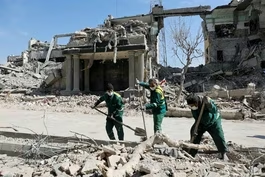
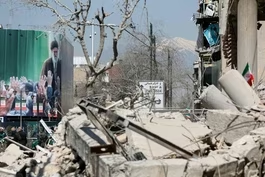
NICK SCHIFRIN: Today, Tehran woke to terrifying# booms that engulfed the night sky and flames,## by day, the capital's Revolutionary# Square battered, many buildings broken,## and structures shattered as rescue# workers prayed for the dead.
Monireh Tehrani cannot believe what she's seen.
MONIREH TEHRANI, Tehran Resident (through# translator): I hope this ends sooner,## and so many people won't be killed anymore.
PETE HEGSETH, U.S.
Defense Secretary:# We are punching them while they're down,## which is exactly how it should be.
NICK SCHIFRIN: In Washington, Pentagon leaders# said U.S.
strikes had so far focused on Iran's## ballistic missile infrastructure and drones in# Iran's west and northwest.
And U.S.
strikes will## soon spread deeper into Iran now that the# U.S.
has more control over Iran's skies.
GEN.
DAN CAINE, Chairman, Joint Chiefs of# Staff: We will now begin to expand inland,## striking progressively deeper# into Iranian territory.
NICK SCHIFRIN: And the U.S.
expanded the# war zone today with an event not seen in## more than 80 years.
A submarine's torpedo# sunk the Iranian warship IRIS Dena off the## coast of Sri Lanka.
The ship was returning home# from an exercise hosted by India.
Sri Lankan## authorities rescued 32 sailors and recovered# nearly 100 bodies, with dozens still missing.
In total, the U.S.
says it has sunk 20 Iranian# ships.
And, today, Israel said it continues## to attack Iran's military, including internal# security services and leadership.
In Southern## Iran, the war has trapped civilians.
At this# hospital, the Iranian Red Crescent showed a## neonatal ward whose ceiling was damaged.# Medical staff evacuated premature babies.
Outside Tehran University, Iranians remembered# assassinated Supreme Leader Ali Khamenei and## the bloodstained belongings of# more than 100 killed schoolgirls,## an attack that the U.S.
says# it is still investigating.
MOHAMMADREZA JAMA'ATI, Tehran Resident# (through translator): The system does## not depend on one person.
If one .. NICK SCHIFRIN: And Iran's resistance has included# firing more than 2,500 missiles and drones,## although the U.S.
today said these missile# launches have recently reduced by 23 percent.
Today, for the first time, one targeted# NATO.
Turkey said air defense shot down an## Iranian missile in the country's south.
Many of# Iran's targets are Arab Gulf energy facilities,## including this Emirati oil industry zone,# today covered in flames and thick smoke.
Iran's president wrote directly# to Arab governments today,## saying -- quote -- "The American# Zionist military attack has left## us no choice but to defend ourselves.# We respect your sovereignty and still## believe that the region's peace must be# ensured by the countries of the region."
REP.
MIKE JOHNSON (R-LA):# We're not at war right now.
NICK SCHIFRIN: On Capitol Hill, Iran has sparked# a divide along party and over nomenclature.
REP.
MIKE JOHNSON: We have to ensure# that they can't fire all those barrage## of missiles at our people, our troops, our# assets, our citizens in the region and our## installations.
We're taking that out.# We had to.
It's a defensive operation.
NICK SCHIFRIN: This afternoon,# the Senate rejected a bill that## would have demanded congressional# approval before further attacks.## But some Republicans are voicing# concerns if those attacks continue.
REP.
NANCY MACE (R-SC): I will# be a no for now.
But if this## thing goes beyond a few weeks, I'm# going to have a lot more concerns.
NICK SCHIFRIN: The war's first American# fatalities, reservists assigned to the## 103rd Sustainment Command out of Des Moines,# Iowa.
They worked behind the lines in logistics,## killed when their reportedly unreinforced# building in Kuwait was hit by an Iranian drone,## 39-year-old Sergeant 1st Class Nicole# Amor, 25-year-old Captain Cody Khork,## 42-year-old Sergeant 1st Class Noah Tietjens, and# Sergeant Declan Coady, whose family says he was## considering extending his deployment to Kuwait# because he found the work hard but rewarding.
Andrew is Declan's father.
ANDREW COADY, Father of Declan Coady: One thing# he did say is that: "I.. but I have had jobs in the civilian world.# And I have been over here for six months,## and I work 12-plus-hour days.
I work six to# seven days a week."
And he goes: "I love it."
KEIRA COADY, Sister of Declan Coady: This was the## morning before we drop.. NICK SCHIFRIN: Keira is Declan's older sister.
KEIRA COADY: He's 20.
He was going to be 21 in# two months.
I just really wish I got to tell## him I love him one more time, because he was just# so amazing.
I can't help but think just he was my## little brother, and he was probably really scared,# even if he didn't want people to know.
So I just## wish he could have known one more time that we# all loved him, because he was so amazing and kind.
NICK SCHIFRIN: Keira said Andrew was the# best little brother she could have had,## just one family, Geoff, of the six Americans# killed so far in this war since Saturday.
GEOFF BENNETT: Our hearts certainly# go out to all of those families, Nick.
We have spoken on this broadcast# over the last couple of days about## the effort to evacuate Americans from# the region.
How is that progressing?
NICK SCHIFRIN: The State Department# said today that 17,500 Americans had## returned from the Middle East, about 6,500# of them thanks to State Department efforts.
U.S.
officials say that most have left on# commercial flights.
Some of them have left on## charter flights and also U.S.-arranged ground# transport to cities where the airports aren't## closed.
As we have been talking about, many cities# across the region, those airports are closed.
And, this morning, the chairman# of the Joint Chiefs also said the## military had opened up seats on# transport and other planes when## those seats had become available.
But# we have spoken to former officials,## a retired three-star who was in the region when# the war started.
I spoke to a former ambassador.
Both of them criticized the Trump# administration for not handling this sooner,## not evacuating people perhaps three, four,# five days before the war started.
President## Trump was asked that question just yesterday.# He said that the war started too quickly and## there was just simply no time to# be able to evacuate people early.
There's also been criticism that the message## played on the phone number for American# citizens to call yesterday, said:## "Please do not rely on the U.S.
government for# assisted departure."
Today, the State Department## updated that message so people can actually# talk to actual human beings to help them out.
And, at this point, this is the guidance that# the State Department is giving.
You can see## this on this graphic right here.
U.S.
citizens# need to register with the State Department.## They have to follow the State Department# on -- via WhatsApp and call this number,## 202-501-4444.
That's the number at the bottom.
Geoff, that's because you have# to make that call because,## until people actually register or tell# the State Department where they are,## the State Department suddenly doesn't know# how many people need to get out and how.
GEOFF BENNETT: Nick Schifrin, thanks,# as always, for your reporting.
NICK SCHIFRIN: Thank you.
GEOFF BENNETT: Let's turn now to "News Hour"# special correspo.. It's good to see you.
So what did it look like today# .. REZA SAYAH: Yes, more airstrikes,# more air raids in the capital, Tehran,## on this fifth day of this war, some of those# airstrikes taking place right over my left## shoulder.
That's Northern Tehran, earlier# in the day to my left in Eastern Tehran.
And that's where you had that same sequence# that we're so used to.
You hear jet fighters## going up above.
A few seconds later, you hear# loud explosions and thick plumes of smoke.
It## is these airstrikes, these explosions that are# chasing away many Iranians from this massive city.
My guess is, millions of people have left# the city, fled the city to get to somewhere,## another city that's not being# pounded by bombs.
Israeli officials,## U.S.
officials continue to say they're# hitting military targets mostly,## but they also acknowledge hitting police# stations and government buildings.
And oftentimes around those buildings you have# residential areas, residential apartments.## And again today, we saw more gruesome,# heartbreaking pictures of civilians injured,## being pulled out of the rubble.
And# the death toll, according to the Red## Crescent rescue and aid group here# in Iran, has eclipsed 1,000 people.
GEOFF BENNETT: What more can# you tell us about the response?
REZA SAYAH: Well, Tehran views it# as bluster.
They understand that## in this war there's going to be a lot of# bluster from Washington, and they dismiss## it.
They have their own bluster.
They say# they're the ones that are inflicting pain.
And as far as claims that their command# center has been destroyed.
Remember,## Iran's Foreign Minister Abbas Araghchi, he# said they're operating without a command## center and they have activated what they're# calling a decentralized mosaic defense.
This is a military strategy, according to# Tehran, where there's no Central Command,## where forces in each province, each area is given# autonomy and independence to fight their own war.## That means if one of them is neutralized, the# other forces in different provinces continue## to fight.
And that could explain why Iran# has successfully fired off so many missiles,## so many drones, something the# U.S.
is trying to neutralize.
GEOFF BENNETT: Meantime, Reza,# the CIA has reportedly contacted## armed Kurdish separatist groups in# Iraq, suggesting that they may be## preparing to join the army in the fight# against Iran.
Any reaction from Tehran?
REZA SAYAH: Iran is aware of it.
They# have acknowledged the reports.
Remember,## even before the reports, you had U.S.
and# Israeli airstrikes hitting border forces in Iran,## suggesting that they're softening the border in# preparation for something like this to happen.
But this has been a long-running threat for# Iran, and that's why, over the past 24 hours,## they have increased their missile strikes and# drone attacks targeting those separate disc groups## in Iraq.
But if indeed this happens, if they# cross the border, that opens up a new front## in this war.
It's more of an escalation,# and it's very likely that Iran is going to## deploy more forces, more Revolutionary# Guard forces, if they haven't already.
GEOFF BENNETT: Reza Sayah# reporting tonight from Tehran.
Reza, thank you.
Now to Lebanon.
Israel continued waves of heavy# airstrikes in the ca.. after Hezbollah began firing on Israel# earlier this week in support of its patron,## Iran.
Nearly 85,000 people in the city have been# displaced already, according to the government of## Lebanon.
The Israeli military has started a ground# incursion into Southern Lebanon, while Hezbollah## chief Naim Qassem said that the group -- quote# -- "will not surrender no matter the sacrifices."
Special correspondent Simona Foltyn# met with the people fleeing the## bombardment of Beirut's southern# suburbs and sent us this report.
SIMONA FOLTYN: The war has returned to Beirut,## with civilians once again bearing the brunt.# Tens of thousands have run from Israel's## punishing bombing campaign, many seeking# safety in schools repurposed into shelters.
Reema Shaheen fled Beirut's southern# suburbs in the middle of the night## with her husband two children,# and her 2-year-old granddaughter,## Matilda, still dressed in her pink# pajamas.
They left everything behind.
REEMA SHAHEEN, Displaced Beirut Resident# (through translator): We were bombed## without any warning.
It was 3:00 in t.. anything else.
We just grabbed the girl# and some milk and diapers and we left.
SIMONA FOLTYN: Reema supports Hezbollah's# decision to reenter the war.
For more than a year,## the Iran-backed group had largely complied# with a cease-fire agreed in November 2024,## showing restraint even as Israel# committed daily violations.
REEMA SHAHEEN (through translator):# We respected the cease-fire for a## year-and-a-half.
Israel didn't.
Israel does what# it wants.
They attack every day as they plea.. SIMONA FOLTYN: Hezbollah supporters# felt the situation was untenable.
REEMA SHAHEEN (through translator):# The situation in the south was bad,## but we were also not doing well.
There was# no work.
When your children leave the house,## you worry they won't come back.
Even for us# in Beirut, this was not a safe way to live.
SIMONA FOLTYN: Hezbollah was# weakened after the last round## of fighting.
Much of its weaponry# was destroyed in Israeli strikes or## later confiscated by the Lebanese army.# Many hoped it would sit this war out.
But Hezbollah resumed its operations on Sunday# to support Iran, claiming responsibility in## videos like these for targeting military# installations in Israel.
These attacks## have inflicted little to no damage, while# Israel's response has been devastating.## Fighter jets have pummeled residential areas.# And, on Wednesday the IDF issued a blanket## forced evacuation order for all of Lebanon's# south as it began a fresh ground incursion.
The Lebanese government has been# powerless to stop the spiral of## violence.
In a last-ditch effort# to force Hezbollah to stand down,## Prime Minister Nawaf Salam announced# an unprecedented Cabinet decision.
NAWAF SALAM, Lebanese Prime Minister# (through translator): The Lebanese## government calls for the immediate banning of all# of Hezbollah's.. as it is considered against the law to# give up its weapons to the Lebanese state.
SIMONA FOLTYN: But Hezbollah has ignored the# government, and the whole country is paying## the price.
In Beirut, Israeli strikes have# spread beyond Hezbollah's areas of influence.
This residential apartment building# was targeted in an Israeli strike## on Monday evening, around the time# when people were breaking their fast,## and it happened without a warning.
Now, this# is a pretty affluent neighborhood.
We're pretty## close to the Mediterranean Sea, and it's not# typically considered a Hezbollah stronghold.
There is no military infrastructure here, although# some Hezbollah members do reside here, and we can## see that Hezbollah personnel have now secured the# strike location.
And I spoke to one of the guards## here, who told me that in total six people# were killed in the strike, one of whom was a## member of Hezbollah, and five of the victims were# reportedly civilians, including children.
Now, we can't independently verify that# information, but what we do know is that,## in the wake of this attack, many civilians# fled this area in fear of additional strikes.
Many of the displaced are struggling# to find a place to sleep.
This family## has been camping out in Beirut's# Martyrs' Square for two nights,## no roof over their heads, only# blankets to shield them from the cold.
AHMED MAZLOUM, Displaced Beirut Resident# (through translator): Nobody is looking## out for us.
Nobody answers when .. a house.
Whoever we ask doesn't have space,# and we don't have the money to rent a place.
SIMONA FOLTYN: Even among Hezbollah's# constituents, dismay is growing, though few## dare to state it explicitly.
Ahmed says his family# can't withstand another round of displacement.
AHMED MAZLOUM (through translator): The people are## tired.
It's impossible.
This.. SIMONA FOLTYN: There is growing# consensus among Lebanon's population## that this country has nothing to gain# and everything to lose from this war.
For the "PBS News Hour,"# I'm Simona Foltyn in Beirut.
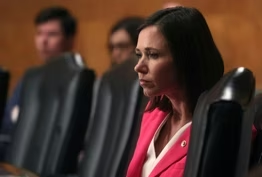
GEOFF BENNETT: For perspective on how# Congress is weighing the unfolding## situation in the Middle East, we're joined now# by Republican Senator Katie Britt of Alabama.
Senator Katie Britt, welcome to the program.
SEN.
KATIE BRITT (R-AL): Thank you,# Geoff.
I appreciate you all having me.
GEOFF BENNETT: The Senate this evening# rejected a war powers resolution that## would limit the president's ability# to strike in Iran.
It would require## congressional approval.
What about# that did you find objectionable?
SEN.
KATIE BRITT: Look, the president# has the authority under Article II to## conduct the strikes that# he is executing right now.
The president's mission has been well# laid out.
He wants to make sure that## we keep Americans safe and secure, that# we ultimately destroy Iran's military,## their missile capability, the# ability to manufacture those,## also their naval fleet, and any ability to# regain or reconstitute nuclear enrichment.
When we're looking at bad actors across the# world, Iran has been at the top of that list.## So allowing the president to finish the mission# that was begun I think is critically important.## We have seen this authority be given to# presidents certainly over my lifetime,## and I, for one, am proud that the president# continues to put Americans front and center.
GEOFF BENNETT: When you say finish the mission,## at what point do you believe Congress# should have a formal vote on this conflict?
SEN.
KATIE BRITT: Well, the president# will have a number of days to obviously## complete this.
He's laid out that it'll take# a little bit of time to be able to do that,## but that we are well ahead of# schedule of where they planned to be.
So the president, not only with the number of# their military leaders and obviously the ayatollah## that have been taken out, but their number of# munitions, missile capabilities and capacity## that has already been diminished.
So I think# they have got a plan in place to finish the## job.
It will not be done overnight, but we will# certainly hopefully conclude in the weeks ahead.
There are no plans at this point# to put boots on the ground,## and the president obviously wants# the safety and security of our troops## to be of paramount importance.
And certainly our# heart is broken and our prayers go out to the## family of those who have already lost loved# ones.
We know that their selfless sacrifice## ultimately are going to keep Americans# safe both in the region and here at home.
GEOFF BENNETT: A question about that, because# regime change in the Middle East has often## produced instability.
History shows that conflicts# with Iran can escalate quickly through proxies.
How confident are you that the U.S.
won't# be pulled into a broader regional war?
SEN.
KATIE BRITT: Look, the president has# made it very clear.
He is going to make## sure that we actually achieve# peace through strength again.
For over 47 years, we have had leaders that look# the other way or tried to placate the regime,## and what happened is, they enriched it.
We# look at what happened to the Iranian people,## not only the conditions in which they were# living, but also the 30,000 Iranians that## were slaughtered just by this# ayatollah that we know about.
It is clear that now is the time to act.
The# president knew, given what happened in the## previous administration, the lax sanctions# when you go even go back before that with## President Obama and the JCPOA, that this# regime utilized that funding to build up## their military capabilities that ultimately put# people there in the region, on our military bases## and obviously our allies, but even has the# ability to put people here at home at risk.
And so I feel confident that the president# will continue to make decisive decisions,## that he is committed to making sure that# we finish the job, and do it thoroughly## and as quickly as possible.
So I know that# one other thing that is important is that,## when he says he's going to do something,# Geoff, he follows through with it.
He gave Iran an opportunity to come to# the table, to make the right decisions,## to move it forward.
But gone are the days# that we're going to look the other way at## the expense of American citizens.
We have seen# that with securing our border.
We have seen that## with making sure that we actually halt fentanyl# and halt that movement throughout our country.
And the president means it when it comes# to the largest state sponsor of terrorism,## which is Iran, the actual head of the snake.# The ayatollah is now gone.
We need to make## sure that their proxies do not have the# funding or the resources or the equipment## to be able to hurt Americans# in the region or here at home.
GEOFF BENNETT: Given, though, that the# Constitution gives Congress the authority## to declare war, if Congress doesn't debate or# take a vote on this conflict in particular,## how are you and your colleagues fulfilling# your roles as representatives of the public## on a decision as consequential as war,# especially when six in 10 Americans,## according to a new CNN poll, say they# disapprove of the strikes in Iran?
SEN.
KATIE BRITT: My question would be,## then how did President Obama do it# and how di.. When you are creating strikes from the air and# you're taking out other people's capabilities,## we have seen parties -- and I actually have# seen clips of Nancy Pelosi telling us that## it is absolutely well within Barack# Obama's constitutional authority to## be able to carry out those strikes and# carry them out for a number of days.
So, at this point in time, we have airstrikes# that are targeted at various targets throughout## Iran.
We have a mission that's been set in# front of the American people.
And I have## full confidence in President Trump and Secretary# Rubio, Secretary Hegseth to finish that mission.
Now, if there is a different -- a# different change of events that occurs,## I feel confident in our ability here in the# Senate to have those kinds of conversations## that need to be had.
And I think that# we're certainly all up to that task.
GEOFF BENNETT: Meantime, the Department# of Homeland Security, as you well know,## remains partially unfunded amid negotiations# over immigration enforcement policies.
You have said that you have reengaged in# negotiations with Democrats.
What concrete## progress has been made toward# ending this partial shutdown?
SEN.
KATIE BRITT: Yes.
And I would say, look, w.. it is not just a partial shutdown.
It# is a complete shutdown with regards## to us not doing our job.
So I think it's# imperative that we come back to the table.
What we have seen over the last 18 days is# conversations between the minority leader's## office and the White House.
At this point# in time, I think it is time for members## who were elected by the people in their states# that stood up and said, yes, I want to serve,## yes, I want to get in a room and have# tough conversations to actually do that.
I think there's absolutely a pathway forward here,## but there's not ever going to be one if we're# not having conversations.
So I've reengaged## with conversations with my Democratic colleagues.# Other Republicans have been doing the same thing.
But I think, at this point in time, where# you have a heightened threat environment here## in our interior, it is of the utmost importance# that the people whose job and mission it is## to keep Americans safe here at home are# not worrying about financial insecurity,## but rather are receiving a paycheck,# that the mission is fully funded,## and that we put the safety and# security of Americans before politics.
And that's certainly what I'm trying to do.
GEOFF BENNETT: Republican Senator Katie# Britt, thanks for joining us this evening.
SEN.
KATIE BRITT: Thanks so# much, Geoff.
I appreciate it.
GEOFF BENNETT:## The midterm elections kicked off in earnest# with contests in Texas, North Carolina and## Arkansas yesterday.
There was some confusion at# the polls, and the results led to sharp words,## a few upsets and more questions# about the elections still to come.
A late night turned into# an early morning in Texas.
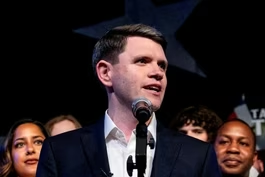
STATE REP.
JAMES TALARICO (D-TX), Senatorial# Candidate: We are not just trying to win an## election.
We are trying to fundamentally# change our politics.
And it's working.
GEOFF BENNETT: State Representative James Talarico## won a hard-fought Democratic primary to be# the party's Senate candidate in November.
STATE REP.
JAMES TALARICO: Tonight, the# people of our state gave this country## a little bit of hope.
And a little# bit of hope is a dangerous thing.
GEOFF BENNETT: Defeating# Congresswoman Jasmine Crockett,## who sent her supporters home early# after a day of turmoil at the polls.
REP.
JASMINE CROCKETT (D-TX): I have no# idea of when we're going to get results,## and I fully anticipate it won't be until tomorrow.
GEOFF BENNETT: Rule changes in one of# the state's most populous counties led## to confusion about where voters should cast a# ballot.
A judge extended voting by two hours,## but the state Supreme Court quickly stepped in to# block the ruling, instead ordering late votes to## be separated out and leaving questions# about if they will be counted at all.
Crockett conceded this morning.
And Talarico# now turns his attention to November,## hoping to be the first Democratic senator elected## from Texas in nearly 40 years.
But# who he will face is still unknown... SEN.
JOHN CORNYN (R-TX): We are on to the run-off.
GEOFF BENNETT: ... as the most expensive Senate# primary in U.S.
history heads to a run-off.
Republican incumbent John Cornyn,# running for a fifth term, is in## the political fight of his career, narrowly# leading Texas Attorney General Ken Paxton.
SEN.
JOHN CORNYN: I refuse to allow a flawed,## self-centered and shameless candidate# like Ken Paxton risk everything we have## worked so hard to build over these many# years.
There is simply too much at stake.
GEOFF BENNETT: Paxton, the MAGA-aligned,# scandal-ridden fighter who has challenged## Democratic policies in court, turned# his focus to his primary opponent.
KEN PAXTON (R), Texas Senatorial Candidate: After# all the personal attacks, which there were many,## and after all the lies, you listened to what John# Cornyn was selling and you weren't buying it.
GEOFF BENNETT: The deeply personal battle will## only intensify with a new onslaught of# spending and efforts to gain President## Trump's endorsement before Republican# voters return to the polls in May.
Across Texas, newly drawn congressional maps# led to some big changes.
Republican Dan Crenshaw## is the first incumbent congressman ousted this# midterm year, losing to state Rep.
Steve Toth.
STATE REP.
STEVE TOTH (R-TX),# Congressional Candidate: That was the## White House wishing .. the president's MAGA movement, Crenshaw was the# only incumbent in the state without Mr.
Trump's## endorsement.
Other current lawmakers were forced# into run-offs, including embattled Republican## Tony Gonzales, facing scrutiny after an alleged# affair with a staffer who later died by suicide.
A newly launched Ethics subcommittee will# investigate any potential wrongdoing.## Gonzales will face gun manufacturer# and YouTube star Brandon Herrera## in a district that includes Uvalde.# Democratic Congresswoman Julie Johnson## and former Congressman Colin Allred will# compete for a safe blue Dallas area seat.
REP.
CHRISTIAN MENEFEE (D-TX):# We are in first place tonight.
GEOFF BENNETT: For two Democratic# incumbents competing in the same district,## a tight race remains undecided.# Freshman Christian Menefee,## in office for just over a month, holds# a narrow lead over 11-term Congressman## Al Green in Houston.
But neither has reached# the 50 percent threshold to avoid a run-off.
Meantime, in North Carolina, a potential recount# in the state's bluest congressional district,## with Democratic incumbent Valerie Foushee# leading her challenger by just 1,200 votes.## And in the closely watched Senate race,# both parties had all but cleared the## field for their preferred candidates to fill# the seat of retiring Republican Thom Tillis.
Michael Whatley, the former GOP chair, promised# to stay inside by side with the Trump White House.
MICHAEL WHATLEY (R), North Carolina Senatorial# Candidate: This election is bigger than a primary.## This election is a choice, a choice between a# conservative champion for North Carolina who## will be an ally for President Trump in the Senate# or a champion for the failed policies of the left.
GEOFF BENNETT: While former Democratic Governor# Roy Cooper made his pitch to moderate voters.
FMR.
GOV.
ROY COOPER (D-NC), SENATORIAL CANDIDATE:# I will be a strong independent senator who will## work with this president when I can and# stand up to him when the people need me to.
(CHEERING) FMR.
GOV.
ROY COOPER:## I will always, always put the people of North# Carolina fir.. GEOFF BENNETT: All setting up a# high-stakes showdown in November,## as Republicans work to# maintain their Senate majority.
In the day's other headlines: The congressional# investigation into files related to Jeffrey## Epstein is widening.
The Republican-led# House Oversight Committee has voted to## subpoena Attorney General Pam Bondi for what the# "News Hour" has learned would be a closed-door## taped deposition.
Five Republicans voted# with Democrats in favor of the measure.
Bondi will be the highest-ranking sitting# official to appear before the panel.
She## had already fielded Epstein-related# questions during a combative appearance## before a separate committee last month.# It comes soon after lawmakers requested## interviews with seven other people, including# the billionaires Bill Gates and Leon Black.
Separately, the Justice Department says that tens# of thousands of Epstein files that were recently## taken down will be reposted soon, telling the# "News Hour" -- quote -- "More than 47,000 files## were offline for further review and should be# ready for reproduction by the end of the week."
Minnesota's governor and attorney general told# lawmakers today that the Trump administration's## immigration crackdown hurt their state's# efforts at fighting fraud.
Tim Walz and## Keith Ellison appeared at a House Oversight# Committee hearing today.
The committee chair,## James Comer, accused them of, in his words, not# being good stewards of the taxpayer dollars.
They, in turn, tried to put the hearing's focus# on the surge of federal agents to Minnesota in## recent months, calling it political# retribution at an unparalleled scale.
GOV.
TIM WALZ (D-MN): I'm with you.
I want# your help on fraud.
Why would I not want## money to go to the programs I care deeply about,# feeding people, clothing people, housing people?## But what ICE did disrupted everything that we# were doing.
It disrupted our federal partners.
GEOFF BENNETT: That testimony comes as# Homeland Security Secretary Kristi Noem## faced a second day of questioning over# her oversight of the administration's## immigration crackdown, including in Minnesota.
Republican Committee Chair Jim Jordan praised# what he called her amazing record on immigration,## while Democrat Jamie Raskin accused her of a smear# campaign against Alex Pretti and Renee Good, two## Minnesota residents killed by federal agents, whom# Noem had claimed had links to domestic terrorism.
The U.S.
says it launched a joint military# operation with Ecuador targeting organized## crime groups in the country.
U.S.# Southern Command posted this video## alongside the announcement, saying it's# focused on combating narco-terrorism,## though further details about# the mission are still unknown.
It's just the latest escalation of military# involvement by U.S.
forces in the region,## following months of strikes# against suspected smuggling## vessels that have killed more than 150 people.
Cuban officials filed terrorism charges# today against six suspects who were aboard## a Florida-flagged speedboat that engaged# in a shoot-out with Cuban forces last week.## Prosecutors say they're being held in# pretrial detention and said they will## receive "due process in defense of our# people and the country's institutions."
The incident took place in the waters off# Cuba's north coast.
Officials say the group## opened fire as they tried to infiltrate the# island to commit acts of terrorism.
Four## suspects were killed, including one U.S.# citizen.
Last week, authorities unveiled## items they say were seized from the boat,# including a dozen high-powered weapons.
On Wall Street today, stocks rebounded as# a bit of calm returned to the markets.
The## Dow Jones industrial average added# nearly 240 points on the day.
The## Nasdaq saw a jump of nearly 300 points.# The S&P 500 also posted a decent gain.
And legendary college football coach Lou Holtz# has died.
Holtz was a giant of the sport, and## especially during his time at Notre Dame, where he# led the Fighting Irish to an unbeaten championship## season in 1988.
Holtz coached 11 seasons.
Holtz# coached 11 seasons there, racking up 100 wins.
Over his five-decade career, Holtz# was known for turning around losing## programs and he was elected to the College# Football Hall of Fame in 2008.
His death was## announced by Notre Dame, which shared# a statement from his family, who cited## his unwavering belief in the potential# of others.
Lou Holtz was 89 years old.
Still to come on the "News Hour": a# survivor of sexual abuse by Catholic## clergy speaks out after the# release of a scathing report;## and one family story of the struggle# to hold on to their farmland.
A new report out today says Catholic# clergy in Rhode Island abused hundreds## of children for decades, while# church leaders minimized the scandal.
William Brangham has more.
WILLIAM BRANGHAM: Geoff, according to# the report, more than 300 children were## molested or sexually assaulted by at# least 75 different clergy members over## 70 years.
The abuses documented date# back to the 1950s all the way to 2011.
According to Rhode Island's Attorney General Peter# Neronha, whose office wrote this report, those## numbers could be even higher.
The report alleges# the diocese kept a secret archive detailing abuse## allegations and often moved accused priests to# new parishes, rather than alerting authorities.
Following the report's release,# the new bishop of Providence,## reverend Bruce Lewandowski, stressed that# the church has instituted new standards for## reporting abuse and he expressed sorrow for# the trauma and pain experienced by victims.
REV.
BRUCE LEWANDOWSKI, Bishop of# Providence, Rhode Island: I take## this opportunity to .. for the failures of church personnel and others in# past decades to protect them and keep them safe.
WILLIAM BRANGHAM: But investigators and## survivors continue to call for a# fuller reckoning of this story.
For more on this investigation, I am# joined by Ann Hagan Webb.
She is a## survivor of clergy sexual abuse and now# advocates for survivors.
Webb was abused## between the ages of 5 and 12 years old# by a priest at her school in West Warwick Ann, thank you so much for taking# the time to talk with us today.
Some of your own abuse stories were detailed# in this report.
And I just wonder how this## must feel to you, after so many years of being# told that your allegations were not credible,## to now have this report out in# the public for everyone to see.
ANN HAGAN WEBB, Abuse Survivor: Thank# you for having me on your show, William.
I -- this means so very much to me to be finally# deemed credible after all these years; 32 years,## the diocese has been calling me# not credible.
In spite of that,## I have tried to work to better the situation for# survivors across New England over these years.
But it really feels much better to have# that be a part of this report.
Up until## just a few weeks -- days ago, I still# thought it was just going to say in## that part under Monsignor DeAngelis# that I wasn't a credible witness.
WILLIAM BRANGHAM: It is very difficult, obviously,# reading this report.
Both the allegations of the## abuse are just ghastly to read, but also the# lengths that the church went to cover it all up.## In this enormous report, what# stands out the most to you?
ANN HAGAN WEBB: Well, a lot stands out.
I mean, most of it is information I knew.
But one# of the things that really struck me in reading## this report -- and Peter Neronha said it today in# his remarks.
In the case of one priest, Santilli,## Father Santilli, the church heard reports# about him about 10 years earlier than 2014.
And then, in 2014, another person came# forward.
He spoke to me first before he## went to the church.
And they told him he was not# credible.
Then, finally, another survivor of that## same priest came forward in 2022.
And I spoke# with him as well before he went to the church.
And they actually said to him, OK, three# strikes, he's out about this priest.
And## they finally took the priest out of service.
That# is simply amazing to me.
We are not talking about## parking tickets or speeding tickets, where you# get three strikes and you lose your license.
These are rapes.
These are child# molestations that change people's## lives.
Many of the survivors committed suicide# over the years.
These are not minor crimes.
And## to have to be reported on three times over# a period of 10 years is just ludicrous.
WILLIAM BRANGHAM: The bishop in his video# statement today said that we have got a## system of reporting that this would never# happen again, that if someone came forward## with an allegation of abuse, that the# reporting and the immediate standards## would kick into place and that we wouldn't# see this hiding and shuffling and denying.
But it sounds like you do not# believe that that's the case.
ANN HAGAN WEBB: Absolutely not.
One of the problems with this report# -- and the report is wonderful because## it really -- it is a horrifying report of# men's cruelty to children over seven decades.## However, it's only the information the church# voluntarily gave the attorney general's office,## and they refused over this whole 6.5 years# to ever come into the A.G.
's office and talk## to them about any questions they# had about what they were reading.
So there's lots left to be discovered.# And I don't for a minute believe that## they revealed all their deepest,# darkest secrets in what they gave## the attorney general's office.
In spite# of that, he produced a phenomenal report.
WILLIAM BRANGHAM: There, as you know,# have been only a few prosecutions,## legal prosecutions over the years.# And the church has said, again,## we apologize for this, it's# not going to happen again.
So what would you like to see happen?
Most of the## men detailed in this report escaped# real accountability for any of their## crimes to children.
What would you# like to see done going forward?
ANN HAGAN WEBB: Right.
Well, first of all, I would like the diocese to be accountable.
Saying I'm sorry as damage# control or we apologize, have they ever## said they're ashamed of what has happened?# Because they should be incredibly ashamed.
This is -- to anyone reading, it has to# be really horrifying that people could,## with such disregard for children's# welfare, put their financial situation## and their good name above children's lives.# I think they have done a lot in terms of## monitoring who's in the schools and# things like that.
They have given## everybody programs about being safe -- how# to be safe with children and all of that.
They are fighting survivors as hard as# they possibly can in the courtrooms,## but especially in the legislature.
They are# lobbying very hard not to get any of the bills## passed that we want that would make them more# accountable.
And they need to stop that yesterday.
WILLIAM BRANGHAM: OK.
Ann Hagan Webb, thank you so much for talking with## us.
I hope today's report offers you and# other survivors a small bit of peace.
ANN HAGAN WEBB: Oh, it does.
It does.# It -- this gives us our power back.
GEOFF BENNETT:## We will be back shortly with a look at one# woman's mission to preserve her family's land.
But, first, take a moment to hear from# your local PBS station.
It's a chance## to offer your support, which helps to keep# programs like the "News Hour" on the air.
When the World Cup kicks off in June,## billions will turn their attention to games# spread across the U.S., Canada and Mexico.
It's an experience Roger Bennett likens to a# solar eclipse, except the earth is completely## engulfed not by darkness, but by soccer.
I# spoke with him recently about his new book,## "We Are the World (Cup): A Personal History# of the World's Greatest Sporting Event."
Roger Bennett, welcome back to the "News Hour."
ROGER BENNETT, Author, "We Are the World (Cup):## A Personal Histo.. GEOFF BENNETT: So, Roger, the# subtitle of this book makes the## case, "A Personal History of the# World's Greatest Sporting Event."
Do you have a favorite World# Cup game, a favorite memory?
ROGER BENNETT: I have so many.# It's why I wrote a book about them.
Look, the World Cup, which happens every# four years, is the spine of my life,## not just my life, but millions of human beings# across the planet.
It's magical.
And the book,## I hope, is a magical telling of the power# of the men's tournament, which I have come## to realize is like a solar eclipse that# engulfs the entire planet for its duration.
That's what we're in store for this summer# when it comes to the United States, Canada,## and Mexico in just over 100 days' time.
GEOFF BENNETT: And you have watched American## soccer culture grow in the three# decades since you came to the U.S.
How have you seen American# fandom change in that time?
ROGER BENNETT: It's incredible.
I moved here right# before the 1994 men's World Cup, which was meant## to turn America overnight into a football-loving# nation.
America then was like space to Captain## kirk, the final frontier, still the biggest# World Cup of all time in terms of attendance.
But it was like a circus that came and went.
And# tournament to tournament, the audience has gotten## bigger and bigger and bigger, also the Internet# that's allowed Americans to feel as close to the## game as if they lived in Manchester, Liverpool,# or Madrid.
There's now a massive young audience.
"The Economist" just said, Geoff, that football,# soccer, is the third most popular sport in the## United States.
It's just taken over from baseball.# So this 2026 men's World Cup will finish off## what '94 was meant to do and make America a true# football-loving nation like the rest of the world.
GEOFF BENNETT: And one through line# in your book is that the World Cup## isn't immune from geopolitics.
You write# that "Football at the end of the day is## just a mirror to the societies that# surround it.
It tells you things."
When you look back at recent# tournaments, what patterns stand out?
ROGER BENNETT: It's the joy of the World# Cup, the depth.
I think Walt Whitman,## who would have been a football fan were he alive# today, would say the thing that makes it contain## multitudes is that, in a World Cup, when two# teams take the field, their nation's histories,## their nation's politics, their nation's# cultures take the field alongside them.
And, honestly, that's what gives the tournament# the unparalleled emotional weight, the power,## the storytelling.
It's what makes it the most# profound, when two Balkans teams who've warred## take the field against each other, when# Senegal plays France, the former colonizer,## when England play Germany, when# England play pretty well anybody.
There's so many depths to the emotions that# have been experienced.
And ultimately that is## what makes the memory so searing and profound# for me and for millions across the planet.
GEOFF BENNETT: And, of course, this year, there# are some major off-field storylines.
You have## the acting director of ICE saying that ICE# will be a key part of security at the U.S.## matches this summer.
We all saw what happened in# Mexico recently with the cartel violence there.
Guadalajara, which saw some of the worst# unrest, is scheduled to host qualifiers as## early as this month, in March.
So is there# any chance, any realistic chance that that## could change the schedule or the locations# of where some of these games are played?
ROGER BENNETT: What I can say is that every# single modern World Cup, 2010 South Africa,## the drumbeat going in was doomsday, the crime,# the carjacking.
Every fan who was going,## it was feared that they would be -- become# instant victims just by walking the street.
It was the most deliriously joyful World Cup# there's ever been.
2014 in Brazil, I was there## the summer before.
There were riots, social and# economic unrest all over the country focused on## the football stadium.
They wanted education.# They wanted social services, not football.
But what happens is, once the ball is kicked, the# second Lionel Messi takes the field, the rational## and the doomsday falls off and the emotional# kicks in and it becomes doomsday, say, is nil,## cognitive dissonance one.
And I believe, I hope,# I pray that's what will happen this summer.
GEOFF BENNETT: How's the U.S.
team looking?
ROGER BENNETT: Yes, we love a dream team in the## United States.
The men's team has# for so long been a dream-on team.
It's a story of my lifetime watching Americans# fall in love with football.
Our women are## perpetual world champions.
Our men -- I mean,# this is amazing.
We put a man on the moon,## we invented the crooner, gifted it to# the world.
We have won one knockout## game in World Cup history, which is an# unfathomable, painful reality to me.
We don't know how good we are because we're hosts.# We have not had to qualify.
I can say we have got## the most talented player-for-player roster... ever been able to draw on in terms of individual## experience and how they perform as a collective.# Please God they will make our nation proud.
GEOFF BENNETT: If 2026 is someone's# first World Cup, as 1978 was yours,## what do you hope they feel?
What do you# hope they take away from their experience?
ROGER BENNETT: The World Cup is like no# other sporting event.
The sense of global## connectivity when a ball has been kicked in# our world of chaos is such a precious currency.
So you will see Lionel Messi and Cristiano# Ronaldo take the field for the last time at## a World Cup.
You will see in American streets# in Kansas, off the field, as joyous as on it,## you will see 50,000 Dutch men and women# clad in orange marching down the boulevard,## screaming to the links, to the# recs, as they bounce to the stadium.
You're going to feel passion.
You're going# to see a world of connectivity.
And I hope,## like the rest of the planet, you# will make some of the most joyful,## most meaningful cross-generational memories# that you will carry with you forever.
GEOFF BENNETT: The book is# "We Are the World (Cup)."
Roger Bennett, no relation,# always great to speak with you.
ROGER BENNETT: Geoff Bennett, you're my# cousin.
You don't have to be ashamed of it.
(LAUGHTER) GEOFF BENNETT: Finally tonight, .. our high school journalism training program.# They take us to a family farm in Upper Marlboro,## Maryland, outside Washington, D.C., to meet# Cameron Oglesby, who explains how her family## struggled to hold on to its land and inspired her# to want to tell stories of environmental justice.
CAMERON OGLESBY, Environmental# Justice Advocate: We're coming## up on our centenni.. This is what it's all about.
I# have received so much of my own## familial history just in sitting down# to conversations learning from my nana.
WOMAN: Look at me.
CAMERON OGLESBY: Oh, you don't know when this was?
WOMAN: Yes, we picketed in Baltimore# and downtown D.C.
at the capitol.
CAMERON OGLESBY: I remember when I was a kid,## and my nana would be going out in the garden or# she would be using her own vegetables to make## things.
I was just absolutely obsessed# with everything she was doing out here.
WOMAN: They were full of berries.
CAMERON OGLESBY: Land is wealth in this country,## and I have seen that right stripped away# from so many people for no other factor## than they are descendant of enslaved# peoples or that they are indigenous.
Some of the challenges the farm has dealt# with include my great-great-grandfather had## to sell-off portions of the land just# to maintain it.
In more recent years,## my uncle and my nana have contended with# someone trying to build a prison next door,## trying to set up facilities that would# generally reduce our quality of life.
We have been very fortunate that every attempt to# do that has been thwarted in a way that allows us## to continue to use the property as we would like# to and as we are entitled to.
I think that's## sort of the connection that helps me bring a# different perspective to the work that I do.
As an oral historian, I can point back to# my own people and say I know exactly what## you are going through, and I want to# help you protect this for yourselves.
We are archiving something that people's children# and their descendants can go back to forever.
The## Environmental Justice Oral History Project is a# repository that I founded to tell a comprehensive,## resilience-based, joy-based story of environmental# justice communities in the U.S.
South.
It's really critical that we understand# the power of storytelling to get people## riled up and to make people cry and# to give people joy and to really bring## out the emotions that undergird all movement work.
The fact that we have this untouched# property here, I can't even put into## words what it means and how unheard of# it feels.
I need to protect this place.## I need to invest in this place.
This place# needs to persist.
It is a symbol that is the## most fundamental right.
Land is wealth in this# country.
That's that generational wealth, man.
It's really solidified for me how important## it is for me to be picking up this# torch and keeping that work going.
GEOFF BENNETT: And that's the "News# Hour" for tonight.
I'm Geoff Bennett.
For all of us here at the "PBS News Hour,"# thanks for spending part of your evening with us.
 New
NewBritt says Trump has authority to 'finish the job' in Iran
Video has Closed Captions
Clip: 3/4/2026 | 7m 32s | Sen. Katie Britt says Trump has the authority to 'finish the job' in Iran (7m 32s)
 New
NewLebanese civilians caught up in Israel-Hezbollah conflict
Video has Closed Captions
Clip: 3/4/2026 | 5m 16s | Lebanese government and civilians caught in middle of renewed Israel-Hezbollah conflict (5m 16s)
 New
NewMaryland family works to preserve 100-year-old farm
Video has Closed Captions
Clip: 3/4/2026 | 3m 15s | Environmental justice advocate works to preserve her family's 100-year-old farm (3m 15s)
 New
NewNews Wrap: House committee subpoenas Bondi over Epstein
Video has Closed Captions
Clip: 3/4/2026 | 4m 35s | News Wrap: House committee subpoenas Bondi over Epstein files (4m 35s)
 New
NewPrimaries in key states begin to shape the midterm matchups
Video has Closed Captions
Clip: 3/4/2026 | 5m 3s | Primaries in key states begin to shape the midterm matchups (5m 3s)
 New
NewResidents flee Tehran as agency says death toll tops 1,000
Video has Closed Captions
Clip: 3/4/2026 | 3m 22s | Residents flee Iran's capital as agency says death toll in Tehran tops 1,000 (3m 22s)
 New
NewRoger Bennett explores personal history with World Cup
Video has Closed Captions
Clip: 3/4/2026 | 6m 45s | In 'We Are the World (Cup),' Roger Bennett explores personal history with the tournament (6m 45s)
 New
NewSurvivor of clergy sexual abuse responds to scathing report
Video has Closed Captions
Clip: 3/4/2026 | 7m 57s | 'This gives us our power back,' survivor of clergy sexual abuse says of scathing report (7m 57s)
 New
NewU.S. to strike deeper in Iran, saying war 'only just begun'
Video has Closed Captions
Clip: 3/4/2026 | 7m 19s | U.S. says it will strike deeper into Iran, saying war has 'only just begun' (7m 19s)
Providing Support for PBS.org
Learn Moreabout PBS online sponsorship
- News and Public Affairs

FRONTLINE is investigative journalism that questions, explains and changes our world.

- News and Public Affairs

Amanpour and Company features conversations with leaders and decision makers.











Out Of The Dark: Teens Talk Mental Health
Support for PBS provided by:
Major corporate funding for the PBS News Hour is provided by BDO, BNSF, Consumer Cellular, American Cruise Lines, and Raymond James. Funding for the PBS NewsHour Weekend is provided by...