
Mountain Gems
Season 23 Episode 15 | 26m 46sVideo has Closed Captions
Experience the charm, flavors and history of North Carolina’s mountains.
Head to the mountains for stops at the Orchard at Altapass along the Blue Ridge Parkway, Main Chick Jammin’ Biscuits in Hickory and Asheville’s historic Block neighborhood. Plus, learn about a North Carolina landmark connected to the American Revolution.
Problems playing video? | Closed Captioning Feedback
Problems playing video? | Closed Captioning Feedback
North Carolina Weekend is a local public television program presented by PBS NC
Mountain Gems
Season 23 Episode 15 | 26m 46sVideo has Closed Captions
Head to the mountains for stops at the Orchard at Altapass along the Blue Ridge Parkway, Main Chick Jammin’ Biscuits in Hickory and Asheville’s historic Block neighborhood. Plus, learn about a North Carolina landmark connected to the American Revolution.
Problems playing video? | Closed Captioning Feedback
How to Watch North Carolina Weekend
North Carolina Weekend is available to stream on pbs.org and the free PBS App, available on iPhone, Apple TV, Android TV, Android smartphones, Amazon Fire TV, Amazon Fire Tablet, Roku, Samsung Smart TV, and Vizio.
Providing Support for PBS.org
Learn Moreabout PBS online sponsorship- This program is made possible in part by generous support from the American Battlefield Trust, connecting you to the places where our nation was forged.
Visit battlefields.org today.
- This program is made possible in part by generous support from Dogwood Health Trust, a private foundation based in Asheville, North Carolina, focused on dramatically improving the health and well-being of all people and communities in the 18 counties and the Qualla Boundary of western North Carolina.
♪ - Next on North Carolina Weekend, join us as we take you to glorious mountain gems.
We'll experience mountain heritage at the Orchard at Altapass, take in a mouthful at Main Chick Jammin' Biscuits, and stroll through history at The Block in Asheville.
Coming up next.
- Funding for North Carolina Weekend is provided in part by Visit NC, dedicated to highlighting our state's natural scenic beauty, unique history, and diverse cultural attractions.
From the Blue Ridge and the Great Smoky Mountains across the Piedmont to 300 miles of Barrier Island beaches, you're invited to experience all the adventure and charm our state has to offer.
♪ - Welcome to North Carolina Weekend, everyone.
I'm Deborah Holt Noel, and this week, we're exploring mountain gems from one of America's favorite destinations, Asheville.
From signature stays with picturesque vistas to outdoor adventures and new nightlife options, there's never been a better time to visit.
We'll highlight a few special stops throughout the show, but first, a little taste of Appalachia.
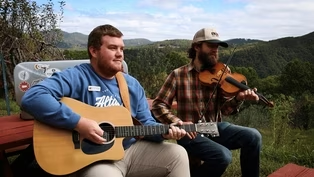
The Orchard at Altapass is part working orchard, part living mountain heritage.
You can stroll through apple trees, enjoy fresh-baked apple pie, listen to mountain music, and enjoy beautiful views of the Blue Ridge Mountains.
♪ - The Altapass Foundation is the arm that manages the Orchard at Altapass.
Our mission is to preserve and protect the land, the butterflies, the birds, the heirloom apples, all these wonderful gifts that we have here on the Blue Ridge Parkway and in the Blue Ridge Mountains.
Goes back to 1908 when this orchard was actually finished and built by Clinchville Railroad.
It went through many changes over the years, and then mid-1990s, our founders decided that they needed to protect it, that this was bigger than any of us ever thought of being.
And so they made it a non-profit in 2006 in order to protect it for generations to come.
- So the aftermath of Helene, it was devastating.
The roof was gone and most of the rafters and structure for the back porch, water was all over the floor.
We lost close to 500 apple trees, landslides all over the orchard, all of our culverts washed up.
I mean, it was a disaster.
Took a lot of work through the winter to open again, and we still have a lot of work to do.
But as devastating as the aftermath was, it could have been so much worse.
[upbeat music] - Our staff are very resilient, and so are the people of these mountains.
I mean, they really stepped up.
So many people were hurt, so deeply lost their homes.
We still have a lot of work to do on the farm, a lot of work to do on the farm.
You have 70 acres that shifted pretty much.
We lost some of it, but actually the trees have never produced so much since I've been here, as they did this year from all the moisture that it brought.
[upbeat music] - People can expect an experience and they can expect to enjoy what we call the good stuff of Southern Appalachia.
Everything we have here, it's the apples, it's the fresh baked apple pie in the mornings, it's these mountain views, it's the mountain music, the dancing, it's the stories, it's the wagon ride, you know, through the conserved land.
So they get a sense of pride, and by coming here, they're taking part in the conservation.
[upbeat music] - My family has been coming up here for, oh my goodness, probably about 40 years.
This is our family reunion place.
You walked in and everybody was so welcoming, aroma of fresh baking apple pies in the oven, it captured us.
The apple picking captured us.
It was just a magic place.
Wonderful friends, great people, became a second family, the orchard family.
So that's how we found it.
And that's why we're still here.
- I think you should make a stop here for a lot of reasons.
One is it's beautiful.
I mean, it's just one of the best places I think you could sit and eat some ice cream on a porch and eat an apple, get a chance to have all these different varieties of apples.
There is this great music that you can come out here and see, and it's just got a great homey kind of an atmosphere.
And the views really, really can't be beat.
It's just got this - and it's just gentle breeze that keeps going while you're up here.
- Every weekend when it's open, I kind of head up a jam group that meets every Thursday and we play tunes.
I play claw hammer banjo.
It's really wonderful.
The atmosphere is why we come here.
I have a daughter that passed away several years ago.
Her ashes are up there in the butterfly garden.
Why?
Because I wanted to put those ashes in a place that's gonna be here for a long time, maybe forever.
(gentle music) - The peace that exists here, we're protecting it so that they can enjoy it.
But most of all, that they enjoy their time here and that they'll come back every year.
And they do, they come back every year and they drive from far away to come back for the experience that they have here.
And they just need to know that we appreciate them coming and that we welcome them here all the time.
And we wanna hear their stories as well 'cause they become part of us.
They're part of our bigger family.
(gentle music) - The Orchard at Altapass is located in Spruce Pine and they're open seasonally beginning early May through the last weekend of October.
For more information on specific hours, visit altapassorchard.org.
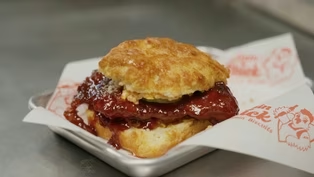
In Hickory, Main Chick Jammin' Biscuits has turned the humble Southern biscuit into a destination meal.
Producer Teresa Litsky takes us to this breakfast brunch spot where classic comfort food meets creative twists.
(upbeat music) - So we want something buttery, flaky.
- Light, airy, dense, fluffy.
- Easy to pull apart without breaking.
- Here, that's how they describe the perfect biscuit.
- My daughter, Brandon, she got some recommendation from work.
Somebody brought in some biscuits that looked really good.
She decided we should come and try.
- Yep, they were from Main Chick.
- We are a vibrant, fun, quirky breakfast joint.
- Chef-driven, over-the-top biscuits, making everything fresh in-house.
- And it all begins with those biscuits.
Thanks to the owners, the Cranford brothers, Jack and Tucker, and executive chef, Ben Sullivan.
- Nice and fluffy.
Secret is not to work it too much, so they stay tender.
- And they don't complicate things.
- That's just good flour, some nice buttermilk, butter, a little bit of salt, and a little bit of baking powder, that's it.
We don't hide behind anything.
We just let the ingredients shine.
- With those biscuits, chicken is the featured protein, and thighs are the preferred cut.
- Dark meat is just more flavorful, more juicy, and you get a more elevated product at the end by using that.
- And we put this into a Cajun batter of rice flour and cornstarch.
This makes for a nice, crispy batter.
- It's not spicy, it just makes it more flavorful.
- The biscuits and chicken may be simple, but what they add to them is anything but.
- Our most popular dish is our hot chick sandwich, which is chicken dipped in hot honey, pimento cheese, and chow chow pickles.
- The Southern influence is everywhere, with collards, cheddar, bacon, and gravy on the thick chick.
Same goes for the side chick biscuit.
- And I've never been a side chick, but I thought I would try the side chick, and it was amazing.
- That comes with bacon, onion jam, fried green tomato, and special sauce.
Plus, there's a biscuit with a nod to North Carolina barbecue.
- La Q or something?
- Oh, the QT.
- QT.
- The barbecue, I think.
- There's barbecue on it, egg, cheese, some kind of jam.
I mean, it's like a whole meal on a biscuit.
It's absolutely incredible.
- And that's just their biscuits.
- Other items we offer, other than biscuits, would be our homemade tater tots.
- Yeah, our tater tots are fresh potatoes poached in lard, and then we add a little bit of starch to that, and then we save them overnight, and then we cut them and deep fry 'em again, so that when we cook 'em, that lard just melts away, so they're crispy, crunchy on the outside, and soft, melty on the inside.
- We load those tots.
We call it a Bubba Tot, where it's topped with pepper jelly and pimento cheese, so it kind of reminisces that old-school loaded fry in a chef-driven breakfast way.
- They also have non-biscuit plates and platters like shrimp and grits.
- So we kinda - that we didn't have a shrimp and grits on the menu.
- We're doing that kind of Cajun gravy, sautéing it with the Tasso ham, collard greens.
- Plenty of chicken and waffles.
- Chicken and waffles is a fried chicken on a nice malted waffle, and we get a hot honey and maple syrup with that.
- And on the sweeter side, bo-nnuts.
- These are fried biscuit dough and cinnamon sugar.
- They're like a little crunchy, but they're super fluffy.
- How should I explain that?
- Oh my God.
- Just great.
- People definitely come to Main Chick for the unique take on Southern breakfast and lunch foods, but their location on the City Walk also means you never have to feel guilty eating all that good food.
- We brought the bikes, and we're gonna ride up and down a little bit where it's flat, and enjoy Hickory.
And I'm really loving seeing it grow like this.
Yeah, City Walk's part of that.
- Love downtown, love sitting outside.
I mean, that was my draw to it.
And then finding out that the food was awesome.
(upbeat music) - Main Chick Jammin' Biscuits is located at 205 Main Avenue, Northeast in Hickory.
They're open from 7 a.m.
to 2 p.m., Tuesday through Saturday, and 8 a.m.
to 2 p.m.
on Sundays.
To find out more information, go to jamminbiscuits.com.
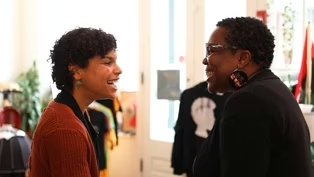
I'm in downtown Asheville with Kirby Gibson, the producer of our next story, which is about Asheville's historic black business district.
Kirby, what was it like covering that story?
- Oh, it was fantastic.
My favorite part was just getting to meet all the amazing people.
We met up with Larry at the Foundry, Alexandria at the Noir Collective, Reverend Sean at the YMI, and I learned so much from all of them, just about not only the block, but about Asheville as a whole.
And so it was very, very exciting.
- Wow, and did you learn a lot about the black history here in Asheville?
- I did, so much.
As someone who's actually lived here for many years, I still did not have this information.
And so I was very grateful for the opportunity, and I even got a private drum lesson in there as well.
- Oh, I can't wait to see and show our viewers.
Take a look.
(upbeat music) - Oh, wow, yeah, this was awesome.
- This is one of my favorites.
- Yeah.
- The eyes are really captivating.
- Really breaks through, yeah.
My name is Kirby Gibson.
Welcome to the block, Asheville's historic black business district.
Once upon a time, this was the thriving epicenter of black Asheville, home to doctors, lawyers, cultural institutes, and more.
The block has changed a lot since its heyday, with urban renewal and gentrification hitting this area hard over the decades.
But it's experienced a bit of a renaissance in recent years, and we're here to check it out.
We are kicking off our day in the beautiful Foundry Hotel, a place emblematic of new life coming into this historic part of town.
A building that was once the Asheville Supply and Foundry Company, a major industrial steel mill in Asheville, which helped form the foundation of the city in an area steeped in black history.
- I'm Larry Crosby, General Manager of the Foundry Hotel, a curio collection by Hilton in downtown Asheville, located in the historic neighborhood of the block.
1915, 1920 are the dates of our buildings.
We did an adaptive reuse project, repurposing these buildings into the wonderful hotel you see today.
What's really unique about it is that each building has a story of its own.
The room that we're in, the workshop lounge, the old carriage and woodworking factory, building A, where we have our restaurant.
We've made concerted efforts in our restaurant and our cuisine to be able to highlight historic traditions through food in the neighborhood.
The Foundry itself kind of represents a return to lodging to this neighborhood.
There is this revitalization of the neighborhood that we're excited to be a part of.
- The earliest memories would go back to 1936, when my parents brought me and my brother and sister to their first restaurant on Eagle Street.
So my father and mother were responsible for the funding and disbursements.
This was in order to help the black businesses develop further and give them some capital in any event they needed it.
The block was the beginning and end, the mix of businesses.
For that type of transition to happen, business-wise, black people.
Sure, we had all the other businesses.
They were good, but this was all brand new.
- On today's exploration, we'll get our start at the YMI Cultural Center, formerly the Young Men's Institute, one of the oldest, most significant historical landmarks in the United States, dedicated to African-American heritage.
- The YMI Cultural Center was built originally as kind of an offshoot of the Young Men's Christian Association, which we know as YMCA.
It was called the Young Men's Institute because in its day, it would have been the segregated space.
Founded in the Gilded Age and the Reconstruction Age.
So our building, the YMI, is older than the NAACP.
It's older than the Urban League.
It's older than most black colleges and older than every NPHC organization, which we call the Divine Nine.
Has just undergone a $6 million renovation.
There's been a lot of effort by lots of parties to help make sure that this area is not forgotten, but also continues to share the history and the legacy of our community.
- As you stroll through the block, you'll notice markers for the Asheville Black Cultural Heritage Trail.
This walk through history celebrates the dignity, humanity, and agency of black people.
- So the Asheville Black Heritage Cultural Trail was a idea that grew out of the brainchild of Catherine Mitchell.
She wanted to have a project that recognized and celebrated the resiliency of the black community in Asheville.
But we really wanted to focus on things around education, the civil rights movement, around black businesses that were a part of Eagle Market Street and Asheville in general, as well as historical figures.
I would say it's the history of the block that makes it so one of those stops that you just have to see.
And when you look at urban renewal and how many of those businesses were displaced, as well as the homes that were around the block area, it becomes a really important part of our history here in the Asheville area.
And so not stopping in the block, you're not getting the full story of the rich history of Asheville.
- Next up, we are headed to a place that is unapologetically B-L-A-C-K, black, which stands for Black Liberation Through Arts, Culture, and Knowledge.
I gotta check that out.
- This place, while it carries 23 different vendors, wares, and the things that they're creating, we've got folks who are coming in from out of town that visit this spot, and magic happens.
So you got the locals, you got people who are visiting, and they wanna talk, they wanna gather, they wanna know the history and where black people are.
And they're here, they're here in this space.
And we need people to recognize and to participate and to make decisions that make sense for building a black cultural arts district.
NOR Collective is inextricably tied to YMI Cultural Center.
We chose to be here because we believe in black art and black enterprise.
So we're about building that.
And I'd like for our city to participate in making decisions that make sense for the people who live and breathe and work here and who are building up the block.
- Our next stop as we tour the block takes us to the headquarters of an international arts organization with a hands-on feast for the eyes and ears.
Get ready to have some fun.
(upbeat drumming, chanting) - Our brand and what we do here is to bring a piece of authenticity to your experience in the place that you visit.
Asheville, known for its cultural arts, its galleries, its music, its food scene, and its people, we embody that here in the block.
We want this to be a place for everyone and we welcome everyone to come here.
- We would love for people to come to Asheville, North Carolina, because we've got an overall city that there's something good for everybody that come here.
- It's a great adventure for a person to come here and witness all those beautiful artists in the area.
So come to Asheville, meet new friends, get a new experience that you can take back home and spread out to other people.
- As Asheville continues to create a new version of itself post-Halleen, I think that it has to remind itself of the past but not get stuck in where it was.
I'm hoping that we can see the block and the YMI as places to celebrate but also places to remember.
- I would say that you really have to come and you have to experience it.
One of the things that we discussed was that we wanted to look at the past but look forward to the future of the foundation that we are now standing on the shoulders of our elders.
(upbeat drumming) - For hundreds of years, Black people have lived, worked, created, innovated and celebrated in Asheville.
For about 130 of those years, the block has been at the heart of it all.
It's a lot different today than it was at the beginning but the story continues and it's a story you can participate in.
So get to Asheville and get to the block.
(upbeat drumming) - The block neighborhood is located in downtown Asheville.
To find a map with all the featured locations and their hours, head to visittheblock.com.
Historic Bethabara Park preserves the site of the first Moravian settlement in North Carolina.
It was intended to be a temporary settlement while the Moravians established the nearby town of Salem.
Today, it's a national historic landmark with buildings, artifacts,and living history demonstrations that help tell the story.
- This is historic Bethabara Park.
Today it's peaceful, fields and forests, but in the 1700s, it was one of North Carolina's most important frontier towns.
But the story of this place doesn't start here.
It begins more than 600 years ago with a man who challenged the most powerful institution in Europe.
In 1415, a Czech preacher named Jan Hus was put on trial for criticizing the Catholic Church.
When he refused to take back his beliefs, he was executed, but his ideas didn't die with him.
Instead, they spread.
For the next three centuries, some of his followers, now known as Moravians, faced generations of persecution before carrying their message across Europe and eventually across the Atlantic.
One place they chose might seem surprising today, the North Carolina back country.
In 1753, Moravians purchased nearly 100,000 acres of wilderness on the colonial frontier and named the tract Wachovia.
Their first settlement here was called Bethabara, meaning house of passage, and it thrived.
- The church has missionaries all over the world and missionaries are great at making more Moravians, but they don't make a lot of money.
And so the church also needs to find a way to fund those missions.
So they're gonna use these frontier settlements to create goods that people on the frontier will need as they spread out further west.
- But within a few decades, something else would arrive in the Carolina back country, revolution and war.
Bethabara found itself caught in the American Revolution.
The prosperous Moravian town supplied passing troops and, after the Battle of Kings Mountain, was compelled to house hundreds of loyalist prisoners.
Today, historic Bethabara Park invites visitors to step into that history, exploring the remains of a frontier settlement shaped by faith, migration, and the challenges of the American Revolution.
- We are at historic Bethabara Park.
This was the first Moravian settlement in this state, and we like to say the birthplace of Winston-Salem.
- If you would spin this up, it'd probably make like a medium quality linen.
- Every day we have different trades going on.
We offer pottery, blacksmithing, woodworking, textiles demonstrations, spinning.
- Open year-round from dawn to dusk, Bethabara Park invites visitors to explore 18th century buildings and stroll through its historic medicinal garden.
- Moravians were very peaceful and very big on helping people, so they would have offered help to anybody that came through.
- Through interpretive stations, you learn about topics like Moravian involvement in war, Moravian medical practices, and visitors can even take part in hands-on demonstrations of traditional Moravian trades, experiencing firsthand the skills and craftsmanship that sustained the early community.
- This corner cupboard is a great example of early Moravian craftsmanship around the time of the American Revolution, actually.
So you're looking at, you know, almost 300 years old.
- The park is also adjacent to three miles of greenway trails for visitors to enjoy.
- If you want to come and you want to learn about the history, we have archaeological foundations and artifacts all over town.
We also have a visitor center with a museum area that you can come explore.
And then if you're more naturally inclined, you can explore our preserve.
We have two historic 18th century Moravian cemeteries, one for Moravians and one for non-Moravians who would have died in town.
- You can also experience Bethabara through guided tours or a free app with English and Spanish audio.
- As an American today, or most of us, luckily, have never had to think about what war happens to look like when it's happening in your backyard, the Moravians would have been very aware of that.
- We're kind of like a hidden gem of the city.
Learn more about the city, learn more about the people here and get to experience something different.
- Historic Bethabara Park is located in Winston-Salem and is open every day from dawn to dusk.
For visitor center hours and more information, visit historicbethabara.org.
- Well, that's it for tonight's show.
Our state truly has some mountain gems and it's always fun showing you what's new here in Asheville and some favorite spots to return to.
And if you've missed anything in tonight's show, remember you can always watch us again online at pbsnc.org and you can find all of our stories on our YouTube channel.
Have a great North Carolina weekend, everyone.
(upbeat music) ♪ - Funding for North Carolina Weekend is provided in part by VisitNC, dedicated to highlighting our state's natural scenic beauty, unique history, and diverse cultural attractions.
From the Blue Ridge and the Great Smoky Mountains across the Piedmont to 300 miles of Barrier Island beaches, you're invited to experience all the adventure and charm our state has to offer.
- This program is made possible in part by generous support from the American Battlefield Trust, connecting you to the places where our nation was forged.
Visit battlefields.org today.
- This program is made possible in part by generous support from Dogwood Health Trust, a private foundation based in Asheville, North Carolina, focused on dramatically improving the health and well-being of all people and communities in the 18 counties and the Qualla Boundary of Western North Carolina.
 New
NewVideo has Closed Captions
Clip: S23 Ep15 | 8m 53s | Explore the Block in Asheville, a hub of Black culture, history and creativity. (8m 53s)
 New
NewVideo has Closed Captions
Clip: S23 Ep15 | 4m 35s | Taste bold biscuit creations at Main Chick Jammin’ Biscuits in downtown Hickory. (4m 35s)
 New
NewVideo has Closed Captions
Clip: S23 Ep15 | 5m 3s | Visit the Orchard at Altapass along the Blue Ridge Parkway, where mountain heritage comes to life. (5m 3s)
Video has Closed Captions
Preview: S23 Ep15 | 29s | Experience the charm, flavors and history of North Carolina’s mountains. (29s)
Providing Support for PBS.org
Learn Moreabout PBS online sponsorship













Support for PBS provided by:
North Carolina Weekend is a local public television program presented by PBS NC