
Now Hear This – “Brahms: Free But Alone”
Season 53 Episode 11 | 53m 54sVideo has Closed Captions
Scott Yoo journeys across Germany to find a window into Brahms’ inner life.
Johannes Brahms was a quiet, private person, but he lived a full life, bearing a responsibility he didn’t want, a woman he couldn’t be with, and a legacy he couldn’t live up to. Scott Yoo journeys across Germany with pianist Elisabeth Brauss and cellists Johannes Moser and Max Hornung to find a window into Brahms’ inner life.
Problems playing video? | Closed Captioning Feedback
Problems playing video? | Closed Captioning Feedback
Major series funding for GREAT PERFORMANCES is provided by The Joseph & Robert Cornell Memorial Foundation, the Anna-Maria and Stephen Kellen Arts Fund, the LuEsther T. Mertz Charitable Trust, Sue...
Now Hear This – “Brahms: Free But Alone”
Season 53 Episode 11 | 53m 54sVideo has Closed Captions
Johannes Brahms was a quiet, private person, but he lived a full life, bearing a responsibility he didn’t want, a woman he couldn’t be with, and a legacy he couldn’t live up to. Scott Yoo journeys across Germany with pianist Elisabeth Brauss and cellists Johannes Moser and Max Hornung to find a window into Brahms’ inner life.
Problems playing video? | Closed Captioning Feedback
How to Watch Great Performances
Great Performances is available to stream on pbs.org and the free PBS App, available on iPhone, Apple TV, Android TV, Android smartphones, Amazon Fire TV, Amazon Fire Tablet, Roku, Samsung Smart TV, and Vizio.
Buy Now
Great Performances Newsletter
Subscribe to the Great Performances newsletter to keep up with the latest full episodes to stream, exclusive content, and more!Providing Support for PBS.org
Learn Moreabout PBS online sponsorshipMore from This Collection
Join Scott Yoo, renowned violinist and conductor of the Mexico City Philharmonic, in Now Hear This, a new four-part documentary miniseries presented by Great Performances that merges music, storytelling, travel and culture, as he chases the secret histories of some of the greatest music ever written.

Now Hear This "Barrios: Chopin of the Guitar"
Video has Closed Captions
Discover Agustin Barrios’ rise from rural Paraguay to becoming a pioneering guitar composer. (54m 24s)
Now Hear This "Rachmaninoff Reborn"
Video has Closed Captions
Discover Rachmaninoff's reinvention as an American artist after losing everything in Russia. (54m 23s)
Now Hear This "Boccherini: Night Music"
Video has Closed Captions
Explore Boccherini’s love for Madrid through a musical night tour of the city with Scott Yoo. (53m 54s)
Now Hear This “Chopin’s Polish Heart”
Video has Closed Captions
Explore Chopin’s musical evolution from Poland to Paris with Scott Yoo and pianist Jan Lisiecki. (53m 54s)
Now Hear This “The Composer is Yoo”
Video has Closed Captions
Follow host Scott Yoo’s journey to compose a piece of music for the first time. (54m 24s)
Video has Closed Captions
Explore how virtuosos become maestros, featuring Yo-Yo Ma, Lynn Chang and more. (53m 54s)
Video has Closed Captions
Explore the work of two legendary virtuosos, Niccolò Paganini and Robert Johnson. (53m 24s)

Video has Closed Captions
Visit Julliard Pre-College with Scott Yoo to play with some of tomorrow’s virtuosos. (53m 54s)
Now Hear This “Albéniz: Portraits of Spain”
Video has Closed Captions
Discover the inspirations Spain provided composer Isaac Albéniz with host Scott Yoo. (54m 25s)
Now Hear This “Andy Akiho Found (his) Sound”
Video has Closed Captions
Experience the creation of music from this Japanese American composer with host Scott Yoo. (53m 34s)

Now Hear This “Schumann: Genius and Madness”
Video has Closed Captions
Visit Scotland, Germany and France with host Scott Yoo. (53m 25s)
Providing Support for PBS.org
Learn Moreabout PBS online sponsorship-I'm Scott Yoo.
Coming up on "Great Performances," Johannes Brahms.
-There are two periods of Brahms -- the pre-beard and the post-beard.
[ Laughter ] ♪♪ -He was a quiet, private person.
That is a single bed.
-And this is the original bed that Brahms actually used.
-But he lived a life worthy of a novel, with a responsibility he didn't want... -He's gonna show us the future.
So you can imagine what kind of burden it was for him as a young man, but also throughout his lifetime.
-...a woman he couldn't have... -If he couldn't have Clara, he didn't want anyone else.
-Mm.
...a legacy he couldn't live up to... -Beethoven back then was, like, a such a big figure, and every composer was scared of Beethoven.
-...until he reached a turning point.
With the help of a few lifelong friendships... -You might think that composers need some kind of godly inspiration, but in the end, it needs relationships.
-...he forged his own path to become one of the greatest composers the world has ever known.
On the next "Now Hear This," come with me across Germany... Alright, here we go.
...to see how Johannes Brahms lived free but alone.
♪♪ Major funding for "Great Performances" is provided by... ...and by contributions to your PBS station from viewers like you.
Thank you.
♪♪ -Johannes Moser is a German cellist whose ancestors actually played with Brahms in the 1860s and '70s.
He's also an expert drone pilot.
♪♪ -I love taking my drone to places where I travel to because obviously you get a different perspective on where you are and -- especially here in Lubeck.
When I look at this waterfront, this is very particular to Northern Germany.
That really brings me to Brahms because this is kind of the landscape that he grew up in.
-It almost looks like Holland or something.
-It does.
This is really almost like a Scandinavian area.
And it really shapes the way people interact, the way people are to each other, and how they also make friends.
It's very hard to really get to know people, but once you know them, they're friends for life.
-So, do you think that was Brahms' personality?
-Brahms was a little bit of a reluctant, maybe at first, cold personality, but I think a real person from Northern Germany, where once someone's your friend, they're really your friend.
-Mm.
♪♪ ♪♪ Brahms was born in Hamburg, but Johannes wanted to start our journey here instead.
-So, as Hamburg was completely destroyed during the Second World War, we take Lubeck as sort of an example what it might have looked like.
And if you want to step in here, you can really feel how cramped and tight the environment was where Brahms might have grown up.
But of course, it was not as beautiful as this.
I mean, there was an open sewage.
There was smell.
There was smoke.
But the architecture probably was like this.
And in the background, you can see one of the many churches here in Lubeck.
And, actually, there's a church up the street we should check out.
You want to -- -Okay.
-Yeah?
Want to give it a shot?
-Sure.
-Okay.
♪♪ ♪♪ So, what you see here from the building material, this red brick is kind of very, very typical for, well, actually, the whole of Northern Germany.
-This place is really flat.
-I mean, we are now, like, here, a little bit above the city, but that's probably as much elevation as you're gonna get.
-Mm.
Alright, here we go.
-Brahms would find refuge outside of the city, and these sort of wide-open spaces that you find in the north inspired Brahms more than we might think and maybe even that he was aware of.
-Mm.
I'd always thought of Brahms as simply a German composer, but already his Northern German roots were helping me understand his personality.
-Ooh, yeah.
-Ooh.
Oh, beautiful.
-Oh, my God.
-[ Laughing ] Oh, that's so cool.
[ Both laugh ] That is so cool.
Look at that.
Look at the square.
That's incredible!
Wow!
♪♪ In Southern Germany, in Munich, Maximilian Hornung would tell me about a fateful meeting between Brahms and Liszt.
-So, Scott, Brahms met Franz Liszt not so far away from this place here, actually, in Weimar.
-How old was he when they met?
-He was 20.
-I mean, what an honor for, you know, a 20-year-old kid to meet the piano superstar.
-Absolutely, absolutely.
♪♪ -In the palace of the Bavarian dukes, Paul Rivinius played us Liszt's infamous B minor sonata.
♪♪ ♪♪ ♪♪ ♪♪ God, that is an incredible piece.
What a shock to people to hear that.
-It's kind of crazy.
It's a kind of revolution, I think, at that time.
-You know, growing up, I always thought that the Liszt B minor sonata was written 70 years after Brahms.
-It sounds like, but it's from the 1850s.
-Can you imagine what audiences in the 1850s thought when they heard this?
-No.
-I mean, they must have thought he was out of his mind.
-There's a little story, actually.
So, Liszt performed his sonata, and Brahms was listening.
And there comes, in the middle of that movement, there comes this part where it's really the most beautiful melody, the most dolce singing melody.
-Maybe you play it for us.
-I play it for you.
I play it for you.
♪♪ ♪♪ ♪♪ ♪♪ ♪♪ -Bravo.
It sounds like a little aria inside a piano sonata.
It's so beautiful.
-Absolutely.
As you can hear, it's such a dreamlike melody.
So, when Brahms heard that, he fell asleep.
He suddenly fell asleep in the middle of this place.
And of course Liszt noticed, and he was furious and went out of the room and disappeared.
[ Laughs ] -I mean, that's maybe not a great way to start your relationship with the most important pianist of the day.
-Probably not.
So, this was basically sort of the beginning of what's been called the War of the Romantics, Liszt being 50 years ahead of his time and Brahms being very much in the tradition, maybe 200 years back of his time.
-You want to play an old Brahms form?
-Yeah, let's do that.
-Okay.
♪♪ ♪♪ ♪♪ ♪♪ ♪♪ ♪♪ This theme and variations, where the composer writes a melody... ♪♪ ...then builds variations on it, each moving farther from the original, is a form that is, in fact, 200 years older than Brahms.
♪♪ ♪♪ ♪♪ ♪♪ ♪♪ ♪♪ So, while Liszt staged his musical revolution, the young Brahms looked to the past to build on the techniques of Beethoven, Bach, and other old masters.
In Lubeck, there's also a Brahms Institute, where we met pianist Mariko Ashikawa and curator Fabian Bergener.
So, I hear you have a fantastic collection here.
-Yes, we have music manuscripts, letters, first editions, early editions, program notes, and the personal photo collection of Brahms.
-Shall we have a look?
Yeah, fantastic.
-There are two periods of Brahms pictures, so to speak, the pre-beard and the post-beard.
[ Laughter ] The young Brahms here with blond, long wavy hair.
-He looks very handsome, very -- very striking.
Beautiful eyes.
-Mm-hmm.
This is a very rare picture because, if you look closely, you see that he's wearing a ring.
For a short period of time in his life, he was engaged to a Goettingen professor's daughter, Agathe Siebold.
-Siebold.
Sure.
-Yes.
He broke the engagement.
He wrote a letter to her saying that he loved her -- "I love you, and I'd like to stay with you, but I cannot wear shackles."
And then, yeah, "Write back to me what you think about this."
-That's probably not the most flattering thing to get a letter from your fiancé saying, "I can't be shackled."
-Yeah.
-That's probably tough to read.
-Yes.
-Did she ever write back?
-No, she did not.
Shortly after his death, she wrote a letter then remembering that period of time and that time of her life and saying how much she was in love with him and how important that was.
-But she ended up marrying somebody else.
-Yes.
-Yeah.
-That's okay.
-It is.
[ Laughter ] -It's not her fault.
Another one of the young artist or even one with a whole person on it.
-Mm-hmm.
-Like a dandy.
-Ah, yes, really posing.
-Yeah, posing and dressed all up.
-Yeah.
-So, these are the photos of when he was trying to become a great composer.
-Composer.
Yes, that's -- -He already was, but he was trying to make a name for himself.
-For himself.
Yes, that's the time.
-Do you have some pictures of the post-beard?
-This is one.
-That's beautiful.
-You see, it's a kind of different attitude, as if he would like to present himself, counteracting the impression that he might be a superficial artist or a Bohemian, something he's really dressed up.
This actually is the last picture taken of Brahms.
It was taken by a friend of his, Maria Fellinger.
-Mm.
He looks very approachable somehow.
-Yeah.
-Much more approachable than in the other pictures.
-Than in the other pictures.
Yes.
-Are there any pictures of Brahms with a short beard?
-No.
-Or just only a mustache or something?
Just beard full on when -- -Or nothing.
-Or nothing, yes.
-Pre- and post-beard, these weren't just two periods of pictures of Brahms.
They were two distinct eras, Brahms' life divided in two.
I would soon find out why.
♪♪ ♪♪ ♪♪ ♪♪ ♪♪ ♪♪ ♪♪ ♪♪ ♪♪ At the age of 20, Brahms went to Dusseldorf and made two friendships that would change his life, in Robert, and especially Clara, Schumann.
-I can only imagine what it was like when they met, I mean, you know, Brahms being this young kid, Schumann being an established composer and, you know, really already a famous personality, musical life, his wife arguably more famous at the time.
She was, you know, not only an amazing artist, but she was probably the breadwinner of the family.
They were like the star couple of classical music.
And in comes young Johannes Brahms.
They instantly fall in love with his music, and Robert Schumann says, "I'm gonna write an article.
I'm gonna write an article about Johannes Brahms, proclaiming him to be the future of music."
-But he's talking about the savior of his vision of classical music, right?
-That's right.
-Not the Liszt-Wagner version of music, which is that music must have some kind of other meaning outside of being music.
-Brahms and Schumann were of the opinion that music should speak for itself, it should be absolute music, and just music for music's sake.
We have to understand that music was not just sort of a secondary pastime.
It was the only thing that was around besides theater and opera.
-Yeah, there's no TV.
-No.
-No electricity.
-No electricity, no shows.
-Yeah.
-And so this meant something.
It wasn't just that someone said, "Oh, he's a good composer."
But, no, "He's gonna show us the future of what is so important to us and so important to our society."
So you can imagine what kind of burden it was for him as a young man, but also throughout his lifetime.
-Mm.
♪♪ Brahms may have felt the burden, but he was thrilled to be the protégé of the great Robert Schumann.
♪♪ I went to Baden-Baden to meet Elisabeth Brauss to play an early work they wrote together.
♪♪ ♪♪ ♪♪ ♪♪ ♪♪ ♪♪ ♪♪ ♪♪ ♪♪ ♪♪ ♪♪ ♪♪ ♪♪ You know, I know Brahms was only 20 when he wrote this, but this -- It's still Brahms.
It's still great.
-Already, yeah, so much in there.
-It's amazing.
-Yes.
-And so much energy.
-So much fun to play.
-So, my understanding was that Schumann wanted to give a gift to Joachim or something?
-Robert Schumann actually had the idea to compose this piece for their mutual friend, Joseph Joachim, who was about to arrive in Dusseldorf.
-Mm.
-So Schumann suggested that he would compose two movements, then Johannes Brahms would compose one movement, and then another composer -- -So, it was another young composer?
-Yes, Albert Dietrich, a promising young composer.
They actually played the piece for Joseph Joachim, and they let him guess who composed which movement.
And apparently he was very quick to realize that this scherzo was composed by Johannes Brahms.
-Of course.
-And the whole sonata is based on the idea of FAE.
-Frei aber einsam?
-Exactly, frei aber einsam.
-Which means "free" -- aber, "but" -- einsam, "alone."
"Free but alone."
-Well, it would more be something like "free but lonely"... -Mm.
-...because it's not so much about being by yourself.
-Mm.
-It's something like longing and wishing to be with someone else but not being able to.
And I think that's a concept that many artists can relate to.
-Mm.
Joachim and Brahms took "Frei aber einsam" as their unofficial motto -- until Joachim fell in love and got married.
That left Brahms free but lonely.
In Hamburg, there's a Johannes Brahms Square in front of the Laeiszhalle with a sculpture of the two Brahms.
So, in relation to this hall, where was Brahms born?
-Well, he was born in the Gängeviertel, which is not far from here.
-Okay.
-A very poor neighborhood, actually.
Remember when I showed you this little part of Lubeck where it feels, like, really tight and narrow?
That's what it looked like.
-Lower middle class.
-Oh, I'd say lower, lower.
-Mm.
-But his parents made sure that he got a music education right from the start.
His dad was a musician.
He was a bass player.
He very early on learned piano from his dad.
He also learned a little bit of cello and French horn, which is probably why he writes so well for this instrument.
And he, of course, tried to escape his poverty and also his situation by playing as many concerts as he could.
So he very early on became a very avid and very celebrated concert pianist.
Brahms returned to Hamburg in his mid-20s after having met the Schumanns.
And he wanted to come back to Hamburg and find a steady life here.
He wanted to be married.
He wanted to have a safe job.
He wanted to have a firm income.
He wanted to become, actually, a choir director, and he was in the run for the position, but then someone else got it, and that, you know, broke his heart.
But whenever Brahms in the future was offered a firm position, he would actually be very interested at first, and then he would decline.
-Mm.
-And I think that longing for a place of belonging, of a family which he never had, of a steady job that he never had -- that is a recurring theme that I think is so essential for understanding Johannes Brahms.
-Mm.
♪♪ ♪♪ ♪♪ ♪♪ ♪♪ While Brahms was in Hamburg looking for work and stability, he got shattering news from Dusseldorf.
-So, this is actually the place where not only Schumann's history changed forever, but also Brahms' and Clara's.
If you look back, this is actually the bridge where Schumann attempted to take his own life.
He knew that he had a mental illness, and he wanted to prevent -- well, witnessing his own decline, but he also wanted to prevent him harming, for example, one of his children.
Of course, this is like two or three bridges ago, but imagine a pontoon bridge in the middle of winter.
It was really cold.
Schumann leaves his house in his bedclothes and he stumbles on that bridge and he dives into the Rhine.
You know imagine that winter water, that shock.
Luckily, there were some fishermen around that tried to rescue him.
He fought them.
They are able to pull him out, to secure him, get him back to the land.
And actually, it was the time of carnival, so he had to walk through a group of people being, you know, in costume and probably being drunk.
And then here they see the music director completely wet.
They make fun of him.
It must have been a very, very demeaning scene, yeah?
He could not continue living at home, so they had to hospitalize him in Endenich.
Well, you know, such a thing is not just traumatizing for the person attempting the suicide, but of course for the people around him.
Clara was now the sole breadwinner.
She had to take care of his medical costs, but also... -The kids.
-...take care of the kids.
So, it was a real challenge for her.
And for Brahms, who had just met the Schumanns and thought, well, this is his new musical home, this is his musical family -- for him, this was such a shock.
And you can hear it in his music at the time.
It is very dark, and fate is really knocking at the door.
♪♪ ♪♪ ♪♪ ♪♪ [ Birds chirping ] -You know Elisabeth, I've never been to Baden-Baden before, but this is a really beautiful, like, peaceful place.
-Yes, it really is.
-It's beautiful.
-So, Baden-Baden is very famous for the mineral baths.
-Mm-hmm.
-And people came here already hundreds of years ago to take care of their health and enjoy a summer here.
And it became very popular, especially in the 19th century.
Many composers and musicians came here, as well... -Nice.
-and just spent a wonderful time here.
-That's great.
♪♪ ♪♪ So, Brahms came here to Baden-Baden.
He wrote a few pieces here.
-Eventually, he did.
After Robert Schumann tried to commit suicide, he moved to Dusseldorf, and he tried to support Clara and the children.
And then Robert Schumann died in Endenich.
And around that time, Johannes Brahms fell in love with Clara Schumann, and they came here together.
♪♪ ♪♪ -So, Brahms loved Clara, right?
-Brahms really did love Clara Schumann, for sure.
We just don't know how this love was felt and lived.
And we also don't know how and if Clara loved... -Him back.
-...Johannes back the way that he loved her.
♪♪ ♪♪ They burned a lot of the letters that they wrote to each other from a certain period in their life, so -- -But Brahms didn't burn his letters as a habit.
He burned those letters.
-Yes, exactly.
-So they were personal.
-They agreed.
They agreed that they would actually burn the letters.
And Clara Schumann left a few because I think a few of her daughters would beg her to not burn all of them.
So we still have a few letters from that time when they first probably fell in love.
But for the rest, we just have to imagine and find cues in the music.
There is probably a lot hidden in there.
♪♪ ♪♪ -But they came here together.
-They came here together many times, 9 or 10 times, and spent the summer here.
Clara Schumann had the children, the kids, and Johannes Brahms had his own apartment.
And it was just a very special time in Baden-Baden, a very special place for them.
-Clearly.
♪♪ ♪♪ The next day, we went to the house Brahms rented here, overlooking a leafy suburb.
♪♪ This is so cool to visit Brahms' country house.
-Yes.
You can see why he chose this house.
♪♪ ♪♪ -Ah, look at this.
-This is the very room where Brahms lived for 9 or 10 summers in Baden-Baden.
I think this is the original furniture that Brahms had.
He sat in this chair.
He probably took a nap here regularly.
It's just -- It's incredible to imagine.
-I mean, it's beautiful, but this is not luxurious.
This is just very simple.
-Oh, yes, it's very humble.
-Yeah.
-And this is the piano.
I think it's not his piano because he had to rent a piano every time he came here.
But this is from the 1860s.
-So this is representative of what he used.
-Exactly.
♪♪ -So, there's some pictures.
Looks like there's a Brahms picture.
-Yes.
-Some Claras.
-Yes, of course.
There's a lot of Clara Schumann in here.
Clara and Johannes stayed constantly in contact during their time in Baden-Baden.
And Johannes Brahms would regularly send her some of his compositions, and she would comment on them.
And sometimes he would even revise his compositions because of that.
-I mean, that shows you how great she was.
-Yes.
-Brahms was going to her, "What did I do wrong, teacher?"
-Exactly.
-That's amazing, right?
-It's truly amazing.
-What's in there?
-I think that's the bedroom.
-That is a single bed.
-Very, very much a single bed.
-Yeah.
-And this is the original bed that Brahms actually used.
-That is... aber einsam.
-Yes, he must have -- he must have been free but quite lonely in there.
-Let's go play some Brahms in Brahms' house.
-Yes, please.
-So, we know that Brahms was engaged to Agatha... -Yes.
-...for a short time.
-Well, he did have a few other romances, but he broke them all off.
He backed out always.
And maybe it's because the relationship that he had with Clara Schumann was on such an existential level that no other relationship could ever live up to that ideal.
And that's why he probably decided that, if he couldn't have Clara, he didn't want anyone else.
-Mm.
♪♪ ♪♪ ♪♪ ♪♪ ♪♪ ♪♪ ♪♪ ♪♪ After nine summers with Clara in Baden-Baden and it was clear there would be no romance, Brahms grew the beard.
He let his appearance go and gained weight... which is not hard to do in Germany.
In Munich again, I met Max at one of the famous Bavarian beer halls.
It looks like they make their own beer glasses here.
-Yes.
Well, actually, each brewery here in Munich -- or in Bavaria even -- they have their own glasses and their own logos.
-That's really cool!
And they're making -- This is not made, like, 30 kilometers outside of town.
It's made right here.
-It's made right here.
All the big Munich breweries are actually located in the city.
So the beer doesn't travel a lot.
It's right -- comes from the tap right on the table.
And why is it so good?
I mean, are there just -- There are just so many breweries that everybody -- you have to be good or otherwise you're gonna fail?
-In Bavaria, we have a purity law, which means that beer is only allowed to be made out of four ingredients.
-That's not a lot.
-Yeah, that's not a lot.
You really have to know what you're doing in order to -- to make it good, to make it great.
-Was Brahms a big beer drinker?
-Yes, he was.
He enjoyed this a lot, and he was also -- he enjoyed food.
He enjoyed beer and having this typical Bavarian so-called Gemutlichkeit, which is -- In English, I don't know.
It's like this relaxed -- -Good feeling.
-Have this relaxed feeling, coming here, enjoying proper food, proper beer, and just having a great time.
-Mm.
-And -- -That's funny because his music is not always like that.
-Um, his music is -- is mainly quite -- quite serious.
But I think he had a humorous side.
Maybe you know the story about the Bach manuscript, when there was meat wrapped into a Bach manuscript at the butcher's stop?
-Oh, sure.
Well, every violinist knows that.
You know, there's a stack of Bach manuscript paper, and a butcher was about to use it to wrap meat with the sonatas and partitas for violin.
-Yes.
-And somebody said, "Ohh, don't do that!
This is probably something important."
-Yeah, there's a similar story about Brahms.
He wanted to fool one of his friends who was a Beethoven scholar.
He studied Beethoven intensively.
And Brahms copied a Beethoven manuscript.
-Mm.
-And he went to a famous sausage shop where his friend always liked to buy his sausage and asked the guy if he can wrap the sausage in that fake manuscript.
-[ Laughs ] -And then he gave it to his friend, the Beethoven scholar.
And it was a big shock for this guy.
-So he's a practical joker.
-Yes, yes, yes, yes.
So, yeah, that's a funny story.
-Oh, so he's a -- you know, he had a light side.
-Yeah, definitely, definitely.
-That's nice.
-Yeah.
Enjoy.
♪♪ Max's wife, the violinist Sarah Christian, and violist Jano Lisboa met us to form a quartet.
♪♪ ♪♪ Nice.
-You know, it's actually so wonderful that we're playing this string quartet because this piece was the first bit of music that got me in touch with Johannes Brahms... -Mm.
-...when I was 6 or 7 years old.
My father used to play in a string quartet -- actually, together with her father.
-Aww.
-And I remember that they were rehearsing this a lot and playing a lot in our house.
I remember I was absolutely fascinated by particularly this quartet.
-I was obsessed with this piece, and I decided I was gonna make an orchestral arrangement of it, which I did.
-That could be great, yeah.
-Because it's just -- This is so symphonic.
It kind of reminds me -- This is Beethoven's 5th, 5B.
-Yes.
-It's -- It's so compact.
-Yeah, it is.
I mean, Beethoven back then was like a godfather.
He was, like, such a big figure, and every composer -- every other composer was scared of Beethoven.
And everybody wanted to keep up with him.
-Yeah, there's this famous Brahms quote -- "One cannot imagine how hard it is for a composer to do what they do with this big shadow of Beethoven on top of them."
-Exactly.
It took Brahms quite a while to write his first string quartet.
-And remember, his first quartets... -Yeah.
-...were not string quartets.
They were a pair of, I mean, fantastic piano quartets.
-That's true.
He was trying to fulfill the chamber music ensembles that Beethoven didn't do.
-Right.
-Yeah.
-And he even destroyed many string quartets before he published that first one.
-Exactly.
-That's really, really sad.
-He actually threw away most of his music.
The stuff that is left for us is, like, the smaller part.
-I have my doubts that they were bad.
For sure, he destroyed stuff that was still really good and that we could really still even have more to enjoy.
-Like a viola concerto, maybe?
-Oh, yes.
That would be very nice.
-He was a perfectionist.
He only wanted to give out what he really thinks is great, so he revised everything a lot.
And it really took him a lot of time and a lot of practice to really get to the point and to really be -- be confident himself.
-You know, a lot of this first quartet is pretty serious, pretty grim, but then, in the third movement, he gives you humor and lightness and a smile.
-Yeah.
-Shall we play the trio?
-Yes.
♪♪ ♪♪ -Living alone, like Beethoven, Brahms could devote his life to music, obsessing over every piece.
His output may have been smaller, but nearly everything he released was a masterpiece, including monumental symphonies and concertos that redefined the form.
♪♪ ♪♪ With that success, he changed his motto from "Frei aber einsam" to "Frei aber froh" -- "Free but happy."
He was alone but not lonely, maintaining a few close friendships.
I met Johannes again at the Dusseldorf Tonhalle.
It's funny that the master symphonist, Brahms, ended up writing for his last symphonic work not a symphony, but a concerto for two instruments.
-Yeah, well, it started out as a cello concerto.
And crocodile tears flow every morning on cellists' pillows because we don't have a cello concerto, but he added a violin to make it into a double concerto.
And for good reason -- because he had a falling out with his longtime buddy Joseph Joachim.
Brahms, in an argument, sided with his ex-wife, with Joachim's ex-wife.
And so Joachim did not like that one bit.
Of course, they were buddies from their 20s, right?
So Brahms could not just let that slide.
But he needed to rekindle together with Joachim.
Ans in typical Brahms fashion, I don't think he wanted to instigate a conversation, but he wanted a musical peace offering.
So he offered this double concerto as sort of a conversation between Brahms, which is represented by the cello, and Joachim, obviously represented by the violin.
I mean, that's typical Brahms.
-That's beautiful, though.
-Shall we have a listen to the Brahms?
-Let's play it.
-Yeah?
♪♪ ♪♪ ♪♪ ♪♪ ♪♪ ♪♪ ♪♪ ♪♪ ♪♪ ♪♪ ♪♪ ♪♪ ♪♪ ♪♪ -By the age of 57, Brahms had accomplished his musical goals, and so he retired.
♪♪ -♪ Bum, bum, ba!
♪ [ Both laugh ] -Until he was re-inspired -- by a clarinetist.
♪♪ So, this is a train station turned into a concert hall.
-Yes, it is really unusual.
-That's beautiful.
-Yeah, and the acoustics are fantastic.
The Berlin Philharmonics have a residency here, and they come here every year.
And I think this is the very last year... -Okay.
-...which has been so wonderful to be here during that time.
-Once more in Baden-Baden, Elisabeth was rehearsing with two members of the Berlin Philharmonic -- Knut Weber on cello and Alexander Bader on the clarinet.
♪♪ ♪♪ ♪♪ ♪♪ ♪♪ -Mm.
Bravo.
Fantastic.
-Thank you.
-Thanks.
-And this is incredible music.
I mean, lucky you.
-Definitely very lucky for me and for all the clarinet players in this world.
I mean, he was -- His last symphony was like six years ago, and he seemed to be -- to get tired somehow.
Lost the energy, the will to compose.
And then he met Richard Muhlfeld, and Brahms got new energy, starting with this clarinet trio.
-Muhlfeld must have been a very good clarinet player.
Maybe it was also the reason that Brahms wasn't inspired by different or other clarinet players before.
-Yeah, I think it's interesting how important relationships are for composers, I mean, in order to be inspired to write pieces like that.
And Johannes Brahms had a few important relationships, both human relationships, but artistic relationships, as well, that inspired him to compose masterpieces like this.
And it's interesting because you might think that composers need some kind of godly inspiration, but in the end, it needs humans and relationships for masterpieces to be created.
-I might argue that I admire the clarinet trio more than all of his other chamber music.
The first 13 notes -- that is the dictionary for everything else that happens in the composition.
The second movement, the third movement, the second theme of the first movement -- they all come from the first 13 notes.
It's all there.
It's like -- It's like DNA.
It takes somebody with genius.
-And a lot of experience, I think, because, I mean, he -- Of course he, you know -- You said after his retirement, and he has been writing so many things already -- and great music still.
But of course, in the end, you get the distillation.
-Yeah.
I'd love to hear a little more.
-Sure.
♪♪ ♪♪ ♪♪ ♪♪ ♪♪ ♪♪ ♪♪ ♪♪ At the end of his career, Brahms the perfectionist was still at work.
He decided to revise one of his earliest pieces -- his first piano trio.
♪♪ ♪♪ ♪♪ ♪♪ There's something really poignant about an old master kind of touching up a boyhood portrait.
-Mm.
-I don't know.
It's -- There's something very wistful and sentimental about that.
-Yeah, and I think it's quite fitting that he revised a piano trio because, you know, it kind of reflects on the protagonists that were most important to him, like Clara Schumann on the piano, Joseph Joachim at violin, and maybe Robert Hausmann at the cello.
-Mm.
-Those were his friends.
Those were his giants, and maybe part of the melancholy of revisiting this was, like, "Yeah, I had a life in music, and I had a life with these people."
-Mm.
-I think that's -- that's a beautiful way to close a career.
-Mm.
♪♪ ♪♪ As for most of us, Brahms' life didn't go as planned.
Instead, he followed his instincts to uncover a path more true to his character.
And that allowed him to become the great artist we remember today, something we can learn from and be grateful for.
I'm Scott Yoo, and I hope you can now hear this.
♪♪ ♪♪ ♪♪ ♪♪ ♪♪ ♪♪ -This program is available with PBS Passport and on Amazon Prime Video.
To find out more about this and other "Great Performances" programs, visit pbs.org/greatperformances and follow us on Facebook and Instagram.
♪♪
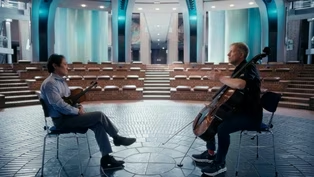
Johannes Moser and Scott Yoo perform Brahms' Double Concerto, 1st mvt.
Video has Closed Captions
Clip: S53 Ep11 | 2m 42s | Johannes Moser and Scott Yoo perform Brahms' Double Concerto, 1st movement. (2m 42s)
 New
NewNow Hear This – “Brahms: Free But Alone” Preview
Video has Closed Captions
Preview: S53 Ep11 | 30s | Scott Yoo journeys across Germany to find a window into Brahms’ inner life. (30s)
Now Hear This Season 7 Preview
Video has Closed Captions
Clip: S53 Ep11 | 27s | Take a look at what we explore in season 7 of "Now Hear This. (27s)
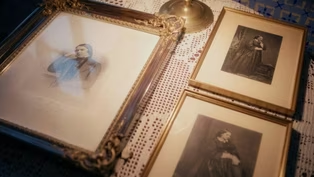
The Story of Clara Schumann and Johannes Brahms
Video has Closed Captions
Clip: S53 Ep11 | 5m 32s | Elisabeth Brauss and Scott Yoo discuss the relationship between Schumann and Brahms. (5m 32s)
Providing Support for PBS.org
Learn Moreabout PBS online sponsorship
- Arts and Music

A rare behind-the-scenes portrait of the Graham Company through the dancers who embody her work.











Support for PBS provided by:
Major series funding for GREAT PERFORMANCES is provided by The Joseph & Robert Cornell Memorial Foundation, the Anna-Maria and Stephen Kellen Arts Fund, the LuEsther T. Mertz Charitable Trust, Sue...