
September 1, 2026 - PBS News Hour full episode
9/1/2026 | 57m 46sVideo has Closed Captions
September 1, 2026 - PBS News Hour full episode
September 1, 2026 - PBS News Hour full episode
Problems playing video? | Closed Captioning Feedback
Problems playing video? | Closed Captioning Feedback
Major corporate funding for the PBS News Hour is provided by BDO, BNSF, Consumer Cellular, American Cruise Lines, and Raymond James. Funding for the PBS NewsHour Weekend is provided by...
September 1, 2026 - PBS News Hour full episode
9/1/2026 | 57m 46sVideo has Closed Captions
September 1, 2026 - PBS News Hour full episode
Problems playing video? | Closed Captioning Feedback
Where to Watch PBS News Hour
PBS News Hour is available to stream on pbs.org and the PBS app.
Providing Support for PBS.org
Learn Moreabout PBS online sponsorshipAMNA NAWAZ: Good evening.
I'm Amna Nawaz.
GEOFF BENNETT: And I'm Geoff Bennett.
On the "News Hour" tonight: A whistle-blower alleges the U.S.
Postal Service is rushing to roll out an untested mail ballot system that could jeopardize votes in the midterm elections.
AMNA NAWAZ: The secretary of the Army resigns after months of tension with Defense Secretary Pete Hegseth, in the latest sign of discontent at the Pentagon.
GEOFF BENNETT: And we visit a community where Haitian residents face deportation now that their protected status has been revoked.
ESTENSON CLERVIL, Haitian-American: It's not like these people came here illegally.
No, they came here legally.
So, why is there all this oppression going on in Ohio right now?
(BREAK) GEOFF BENNETT: Welcome to the "News Hour."
With just days until the first ballots are set to be mailed to voters, a whistle-blower inside the U.S.
Postal Service is warning that a new delivery system could disrupt the handling of election mail and potentially put the midterm elections at risk.
The disclosure also alleges the Postal Service continued developing the system despite a federal court order to stop.
AMNA NAWAZ: That system is designed to comply with President Trump's executive order to exert more federal control over mail-in voting.
And a report published today by the office of Democratic Senator Richard Blumenthal cites an anonymous official from the Postal Service who warns the -- quote -- "risky and haphazard implementation" of the president's order could lead to -- quote -- "catastrophic failure" in the mail ballot system and that - - quote -- "potentially millions of American voters may not receive their mail-in ballot this election cycle in a timely manner or at all."
To discuss, I'm joined now by Jacob Bogage.
He is White House correspondent for Reuters, and he's been covering the story.
Welcome.
Thanks for being here.
JACOB BOGAGE, White House Correspondent, Reuters: Thanks for having me.
AMNA NAWAZ: Let's talk a little bit more about some of these new U.S.
Postal Service rules under President Trump's order.
The whistle-blower raises a few concerns, one, that people might not even receive their ballots, but, another, that ballots cast could be rejected en masse.
What's in the new rules that would allow for that to happen?
JACOB BOGAGE: Yes, this stems from President Trump's executive order that seeks to restrict mail-in voting and asks states and the federal government to verify that everyone who casts a ballot is a citizen.
Of course, noncitizen voting is already illegal, and there's very little evidence that it occurs at scale.
The issues that the whistle-blower raises are twofold.
One is operational, sending ballots out.
The Postal Service would have to verify states' voter rolls.
It does not have the ability to do that.
It's trying to make a portal to do it, and that's going very poorly.
The other is on ballot acceptance, and the issues there are twofold.
One of them, again, is verification when ballots come back in.
The other is that the mail is just very slow right now.
And ballots used to be treated with extraordinary care, and they were routed around processing facilities.
They will no longer be routed around those facilities now and could get stuck in complicated mail streams.
AMNA NAWAZ: You mentioned that the process to implement that portal is going poorly.
In this report, the whistle-blower says the agency had planned to complete this new digital system overseeing mail ballots by September 1.
That is today.
Do we know if that happened?
JACOB BOGAGE: We're not certain if that happened, but the amount of time that it would take to create a system of this nature could be, frankly, years to test it and to implement it and to get feedback from stakeholders.
That work has not been done.
AMNA NAWAZ: So we should note that, despite voting by mail himself, the president has pushed for more restrictions on mail-in voting, more federal control over mail-in voting.
Would this new system allow for that?
JACOB BOGAGE: This new system would inject the federal government into the voting process of every city, town, village, and hamlet in the United States.
And there are constitutional protections, frankly, against that.
The Constitution vests election procedures, the time, place, and manner of an election with state governments.
The federal government really does not have a ton of control over elections.
This would basically make the post office a clearinghouse for ballots in a way that it's never been done before.
And the Postal Service, it does a lot of things really well.
It's, frankly, not equipped for this task.
AMNA NAWAZ: So nearly a third of all Americans voted by mail in the 2024 general election.
JACOB BOGAGE: That's right.
AMNA NAWAZ: You're talking about nearly 50 million votes.
How big an impact could these new rules have, especially when we have just weeks to go before the midterm elections?
JACOB BOGAGE: They could have a large impact, and voting by mail is pretty popular, but it's getting less and less popular.
In 2020, about half of voters voted by mail, in '24, about a third.
We should expect a further drop-off there.
But voters report really liking being able to cast their ballot from home.
It gives them more time to research.
It lets them vote on a convenient schedule.
It saves them from having to take time off of work to go to the polls.
AMNA NAWAZ: I want to ask you too about the leadership at the U.S.
Postal Service.
We know the president played an active role in nominating the current postmaster general.
That is David Steiner.
And there's other questions about some of the nominees that he appointed, Republican nominees, to the board.
It's usually a bipartisan pairing that ends up there.
One of those nominees, in particular, had expressed some skepticism over mail ballots, over who won the 2020 election.
That was actually across the different nominees.
But here is a piece of sound from one of those men, William Gallo, in his confirmation hearing this summer.
SEN.
ELISSA SLOTKIN (D-MI): Do you believe that mail-in voting now is safe and secure?
WILLIAM GALLO, USPS Board of Governors Nominee: That's a very good question.
I would say it's not -- mail-in -- under the proper guidance and monitoring, yes.
AMNA NAWAZ: Jacob, those nominees are not yet confirmed, but if they are, what power do they have over a system that they have expressed doubts in?
JACOB BOGAGE: They have a lot of power on the one hand and a negligible amount of power on the other hand.
And that's because of the Supreme Court.
The Supreme Court ruled earlier this summer that the president can remove independent agency boards, frankly, without a lot of cause.
These postal officials would fall under that ruling.
They could be in office one day, and if the president's cross with them, out of office the next.
At the same time, they do control this agency that anchors a $1.7 trillion dollar economy, that employs 650,000 people, that mails hundreds of thousands of ballots out, that small and medium-sized businesses rely on.
These are very influential positions.
And they have expressed skepticism, in some cases kind of baseless skepticism, about the safety of mail-in voting.
AMNA NAWAZ: All right, Jacob Bogage, White House correspondent for Reuters, thank you for being here.
JACOB BOGAGE: It's a pleasure.
AMNA NAWAZ: There are new questions tonight about what the future of the Pentagon will look like, as another central member of the U.S.
military team steps down.
GEOFF BENNETT: Nick Schifrin looks at how the changes could affect America's war effort and the Pentagon for years to come.
NICK SCHIFRIN: He was the baby-faced modernizer, the 38-year-old veteran and former investment banker who pushed the Army to embrace drones and transform how it buys weapons.
But Army Secretary Dan Driscoll eventually clashed with his boss, Secretary Pete Hegseth, and their boss, the president, declined to stop Hegseth from pushing him out.
His departure creates a leadership void after the forced retirement of the Army's popular top general, Randy George, with no replacement.
DAN DRISCOLL, Former U.S.
Secretary of the Army: I drove straight to General George's house.
We walked right in and we all gave him a hug.
NICK SCHIFRIN: After George's firing in April, Driscoll testified that, at the end of the day, the president and Secretary Hegseth choose their people.
DANIEL DRISCOLL: The civilian leadership, the design of our system is that they get to pick the leaders that they want.
NICK SCHIFRIN: Which is what Hegseth warned before he became secretary.
PETE HEGSETH, U.S.
Defense Secretary: Well, first of all, you got to fire -- you know, you got to fire the chairman of the Joint Chiefs and you got to fire this -- I mean, obviously, you're going to bring in a new secretary of defense, but any general that was involved, general, Admiral, whatever that was involved in any of the DEI woke (EXPLETIVE DELETED) it's got to go.
NICK SCHIFRIN: He's followed through on those threats, not only Chairman of the Joints Chief C.Q.
Brown, who had previously been the first Black military service chief, but also the female military service chiefs, the chief of naval operations, Lisa Franchetti, and Coast Guard Commandant Admiral Linda Fagan, also the Air Force's top General David Allvin, regional four-star commanders, including in Latin America, Admiral Alvin Holsey, in the middle of the U.S.'
largest anti-drug boat strike campaign in history.
Also popular generals, including C.D.
Donahue, described by colleagues as one of his generation's best leaders, as well as multiple top military lawyers known as judge advocate generals.
PETE HEGSETH: If the words I'm speaking today are making your heart sink, then you should do the honorable thing and resign.
NICK SCHIFRIN: It's not only the people.
Hegseth has tried to refashion the military itself in his own image.
PETE HEGSETH: It's completely unacceptable to see fat generals and admirals in the halls of the Pentagon.
NICK SCHIFRIN: And he's launched a campaign of what he's called ending the war on warriors.
PETE HEGSETH: We are leaving wokeness and weakness behind.
No more dudes in dresses.
We're done with that (EXPLETIVE DELETED).
NICK SCHIFRIN: The Pentagon and White House argue Hegseth is delivering on the president's priorities and helping steward the military through multiple conflicts around the world.
Today, Driscoll's departure sparks a mostly partisan response.
Foreign Affairs Committee Chairman Brian Mast: REP.
BRIAN MAST (R-FL): Pete Hegseth is doing a great job making sure that people in the ranks across the board from bottom to top are focused on one thing alone, their capabilities.
NICK SCHIFRIN: Senate Armed Services Committee Ranking Member Democrat Jack Reed.
SEN.
JACK REED (D-RI): Hegseth, as I said from the very beginning, was unqualified to be secretary of defense, both operationally, experientially, and also temperamentally.
J.D.
VANCE, Vice President of the United States: He's a man of integrity.
He's a man of character.
NICK SCHIFRIN: Driscoll is a friend and one-time aide to Vice President Vance, a former Army lieutenant deployed to Iraq and son and grandson of a soldier, none of which was enough to save his job.
For the "PBS News Hour," I'm Nick Schifrin.
GEOFF BENNETT: And for perspective now, we turn to Frank Kendall.
He was secretary of the Air Force during the Biden administration.
He's now a senior fellow at the Center for American Progress and co-author of the book "Lethal Autonomy: The Future of Warfare Whether We Like It or Not."
Thank you for being here.
FRANK KENDALL, Former Secretary of the Air Force: Thank you.
GEOFF BENNETT: How significant is the resignation of the Army secretary and what does it mean for the institution?
FRANK KENDALL: Well, it's a lack of continuity.
There will be a transition phase.
There are people who can step in.
There's an undersecretary who's serving now.
The chief of staff of the Army is also a vacancy right now.
But there's a vice chief of staff who's a likely nominee.
So the Pentagon is pretty good at transitioning as people come and go.
There will be continuity.
What there won't be is new strategic leadership.
The people who are there are acting roles, and they really can't take any major steps, make any major decisions until somebody permanent comes into those jobs.
GEOFF BENNETT: So what's the impact of that leadership vacuum?
FRANK KENDALL: The trains keep running.
The things that normally get done day to day get done.
But the strategic leadership that will make any major changes in policy or in anything else about the Army, its budget, its structure, and so on, will have to wait until these leaders are replaced.
GEOFF BENNETT: What effect do the firings, the resignations, the vacancies have on the people who remain, particularly their willingness to offer candid advice?
FRANK KENDALL: An individual or two leaving like this is not a big deal.
That happens fairly routinely.
But the scope of what Secretary Hegseth in particular has done is totally unprecedented.
A very large number, I think over two dozen, senior officers in particular have been removed without cause.
That is unheard of.
There are also reports that he's taking people off of promotion lists.
That's unheard of.
In my tenure as secretary of the Air Force, that never happened.
The boards that promote these people do a good job.
We review each of them, and then the nominees move on.
He's -- Secretary Hegseth is attempting to impose a number of I will call them culture war initiatives on the Pentagon to structure the leadership, and it's created a climate of fear throughout the entire institution.
I have never seen anything quite like this.
GEOFF BENNETT: This climate of fear, what responsibility do the most senior military officials have when advising the president or defense secretary?
Is it their job to explain what the military can do, or should they be explaining what the military should do, in their best judgment?
FRANK KENDALL: At the most senior levels, they should be doing both.
As you go down the ranks, it becomes more about what you're capable of doing.
There's always an element of what they should do, because what they do should be legal.
It also should be moral and ethical and consistent with our values.
Senior officers in particular who directly advise political appointees like the secretary of defense or the president, they owe them candid advice that is their best overall estimate of the situation and what should be done.
The president does need, and so does the secretary of defense, honest, objective advice from people who are not trying to please them, who are just trying to tell them the truth about what the consequences of any decision they might make would be.
Speaking truth to power is a fundamental requirement for those senior jobs.
GEOFF BENNETT: Given the climate of fear that you described, do you believe that's happening at present?
FRANK KENDALL: I'm convinced it's not.
Right now, what's happening is, people are very much inclined to tell people what they think they want to hear.
People in the military are very concerned about not losing their positions.
They're worried about getting their next promotion.
That's universal.
And they're not going to be dishonest.
They're not going to lie necessarily.
I have rarely seen that.
But they will be influenced by their view of what the boss wants to hear because of the impact it will have on them.
GEOFF BENNETT: And what's that mean down the chain of command for combatant commanders, for instance?
If they get an order that is advised to be legal, but they have concerns about whether it's the right thing to do, what should they do?
FRANK KENDALL: This administration has consciously replaced legal advisers with handpicked people who I think are viewed as loyal and compliant.
It's -- look, lawyers can be very creative in creating justifications under the law for all sorts of things.
A number of things are happening right now.
I think the most egregious is attacks on the drug boats, which almost every legal authority says is illegal, a violation of international domestic law.
These are nonjudicial killings.
They're executions, essentially.
We're not at war with drug dealers.
But there are some lawyers who will support the president's position that we're now in a war and it's just -- it's free -- you're free to kill these people.
Credible people don't agree with that.
But when you put the legal authority that should govern the department into the position like that, where he's supporting the president, then you leave our senior military leaders in a very difficult position.
If at that point they say, no, I can't do that's illegal, I don't care what you say, then they're subject to potentially being court-martialed or being fired from their jobs.
It's an awkward, difficult position, but they still have the duty to do the right thing.
They still have the duty to listen to their conscience, to understand that they represent the American people when they're leading our forces, and they're the highest person who can stand up to our political leadership and just say no when they have to, when something is done that's outside the bounds of law, despite what the lawyers might - - that are in the room might be telling them.
GEOFF BENNETT: Frank Kendall, thank you for joining us this evening, Air Force secretary during the Biden administration.
FRANK KENDALL: Thank you.
GEOFF BENNETT: In the day's other headlines: The U.S.
military says it struck targets inside Iran again today in response to what it called recent attempted attacks against ships in the Strait of Hormuz and U.S.
service members in the region.
Iranian media says the country has responded with strikes of its own.
The latest exchange of fire comes just hours after Iran said it would be willing to go back to the cease-fire agreement reached with Washington earlier this summer.
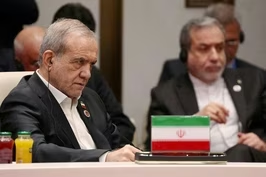
Speaking at a summit attended by Iran's key allies China and Russia, Iran's president struck a more conciliatory tone than usual in remarks broadcast on state television.
MASOUD PEZESHKIAN, Iranian President (through translator): I state clearly that if the United States returns to its commitments in the memorandum of understanding, the Islamic Republic of Iran will immediately reciprocate.
GEOFF BENNETT: In a separate event with Russia's president, Iran's leader insisted that his country will be able to stand against what he called America's unjust sanctions.
Today, U.S.
Treasury Secretary Scott Bessent vowed to hit Iran with additional sanctions as soon as this week.
SCOTT BESSENT, U.S.
Treasury Secretary: We are going to economically asphyxiate this regime.
And, as President Trump said, the reason the MOU did not work, they were not ready for a deal.
My job is to make sure that they want to have a deal.
GEOFF BENNETT: Bessent added that he thinks Iran's leverage over the Strait of Hormuz will be short-lived.
He said that, as countries find more alternate routes to ship oil and other assets from the region, the strait will be rendered, as he put it, a worthless piece of water in two years.
The jury in the Lindsay Clancy trial spent a fourth day deliberating, telling the judge at one point that they were struggling to reach a unanimous decision.
He ordered them to continue.
JUDGE WILLIAM SULLIVAN, Massachusetts Superior Court: This was a long trial, all right?
I know there were over 80 witnesses.
There were over 300 exhibits.
And -- but, because of that, I'm going to ask you to go back out.
GEOFF BENNETT: Clancy sat expressionless as the day's events unfolded.
She faces murder charges for strangling her three children to death.
Clancy does not deny killing them back in 2023, but her lawyers claim postpartum psychosis led to her actions.
Search-and-rescue operations continued at the Grand Canyon today.
Authorities say patrols are looking for one remaining missing hiker, but warn that bad weather could affect their efforts.
Last night, officials released the names of two men who are known to have died in the floods, 46-year-old John Giusti and 42-year-old Brent Rosenkranz.
They say roughly 80 people were rescued since flash floods swept through the area over the weekend.
In Ukraine, local authorities in Kyiv say at least 12 people were killed as the city has suffered six straight days of Russian bombing.
At least three children were injured on the day that many of that nation's students returned to school.
In the capital, sounds of the new school year rang out, but, within moments, air raid sirens sent the crowd hurrying into the school's bomb shelter.
Ukraine's leader, Volodymyr Zelenskyy, visited a school today and condemned the attacks as despicable.
One principal talked about how, for the youngest students, war is all they have ever known.
ROMAN FESHCHUK, Kyiv School Principal (through translator): They react in very different ways to these situations.
Some cry, but, generally speaking, children born during the war are already coming to terms with and seeing this situation for what it is.
For them, this is their reality.
GEOFF BENNETT: Meantime, Germany is blaming Russia for an attempted attack at Leipzig Airport last month after authorities found drones rigged with explosives, including one near a Ukrainian plane.
Speaking to reporters, Germany's foreign minister called Russia's behavior dangerous and announced a series of countermeasures, including the closure of a Russian consulate and tougher entry controls for Russian nationals.
Western governments have accused Russia of carrying out a campaign of sabotage across Europe.
In a statement, Russia's embassy in Germany called Berlin's claims about the Leipzig attack absurd and unsubstantiated.
The CDC says it's reviewing two recent deaths in Pennsylvania that were not included in the agency's latest national count of measles fatalities.
The agency says the available information does not establish whether measles caused or contributed to the deaths or whether the individuals died from other causes while infected with the virus.
Pennsylvania officials last week reported the deaths of two unvaccinated people with measles.
Multiple news outlets report the CDC's new director, Dr.
Erica Schwartz, ordered that the deaths not be added to the federal tally while the agency reviews the cases.
It comes amid a growing dispute between Health Secretary Robert F. Kennedy Jr.
and Pennsylvania Governor Josh Shapiro over how the state is characterizing deaths associated with its ongoing measles outbreak.
In New York City, police have identified the suspect in a Times Square stabbing that left one victim dead and another injured.
Eyewitness video shows a standoff between police and the 49-year-old woman from Queens.
Officials say she had a documented mental health history and had threatened officers before being shot and killed by police.
Police say she stabbed two people, a 68-year-old man who had just exited the subway, and 32-year-old Erin Piacenti, a vice president at Bank of America, who later died at the hospital.
New York City's police commissioner called the attack random and unprovoked.
Well, in the business world, Apple's new boss took the helm today.
John Ternus takes over the role of CEO from Tim Cook, who ran Apple for the past 15 years.
Ternus will be tasked with seeing Apple through the upheaval in the tech industry brought on by A.I.
Apple shares ended the day more than 2.5 percent higher.
Elsewhere on Wall Street today, stocks started the new trading month on uneven footing.
The Dow Jones industrial average lost more than 400 points.
The Nasdaq fell around 1 percent.
The S&P 500 also ended in negative territory.
Still to come on the "News Hour": in Nepal, an increasingly desperate search for the missing after deadly floods; a so-called Super El Nino ushers in unprecedented weather patterns; and a guilty verdict decades after the killing of Tupac Shakur.
AMNA NAWAZ: Authorities in Nepal continued mass burials today, nearly one week after catastrophic floods wore down high mountain valleys in a vast torrent of destruction.
The death toll is now over 1,000, with thousands of people still missing.
Across the border in China, which has been less transparent, officials report just 16 deaths, but nearly 550 people missing.
Neil Connery from our partners at ITV News reports now from the disaster zone in Nepal following a man on a grim search.
NEIL CONNERY: In a remote village, three generations of one family grieve together, struggling to make sense of this disaster, four of their number missing, feared dead.
Pramod Poudel in the baseball cap came from Britain, where he lives, to be with his father, the only surviving member of his immediate family.
This is Pramod's mother, brother, and uncle.
And this is his wife, Sumitra (ph).
They married two months ago.
PRAMOD POUDEL, Family Member of Victims: Born and raised, to live.
As you can see, there's nothing.
Nothing exists.
NEIL CONNERY: This was the scene which confronted Pramod when he came back to his childhood home.
PRAMOD POUDEL: It was beautiful village.
There was lots of greenery, the childhood memory when I used to go to school and when I grew up.
My friends, my family, it's all been taken away.
NEIL CONNERY: As he walked through the destruction in a nearby town, he talks of his wife.
PRAMOD POUDEL: She was living in Croatia before.
She had a very good job.
And I asked her to come here and marry me.
And now she's gone, you know?
So, yes, it's very, very sad, yes.
NEIL CONNERY: Let me ask you about your mother.
What type of person was she?
PRAMOD POUDEL: Oh, my God.
NEIL CONNERY: What of his father, who survived?
PRAMOD POUDEL: He lost his all - - whole life earning.
He lost his family.
He lost his friend.
He lost his neighborhood.
He lost everything.
NEIL CONNERY: Pramod is heading to the rescue center to see if he can get closer to his village to search for any of his missing family.
We watched as he asked the army if he could board one of the helicopter flights.
He wasn't successful today, but will return.
Back up in the village where Pramod is staying with his uncle, high above the destruction, his father is still traumatized by what he witnessed.
PURUSOTTAM POUDEL, Family Member of Victims (through translator): I heard the flood warnings and tried to call my family.
But I couldn't get through.
I jumped on my motorbike to try and warn everyone.
I saw the wave in the distance and ran up the hill.
I survived by seconds.
NEIL CONNERY: He says his son is now his only reason to live.
PURUSOTTAM POUDEL (through translator): I'm so happy to have him.
If it wasn't for him, I'd probably be dead.
I stayed alive for him.
NEIL CONNERY: Pramod and his uncle walked eight hours through this valley to rescue his father on Saturday.
PRAKASH PYAKUREL, Family Member of Victims: He just suddenly saw his son and he was hugging him with a big cry.
So that was a kind of emotional moment.
I think it's - - you cannot describe in words.
NEIL CONNERY: Beneath the Himalayas, the shadow which has descended has touched so many families like Pramod's.
Lost in his memories, the rescue helicopters above bring Pramod back to the president, a brief smile, grateful to be at his father's side to grieve together.
Neil Connery, ITV News, Nepal.
GEOFF BENNETT: Well, the U.S.
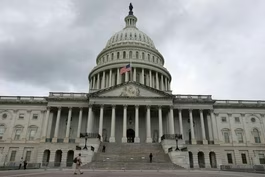
House has returned to Washington after a nearly two-month absence, and lawmakers came back to a changing political landscape.
Since they left town in mid-July, President Trump has escalated or ignited controversies on a host of issues from Iran to the Great Lakes.
Now lawmakers must confront those fights while also facing a looming deadline to fund the government.
Lisa Desjardins was on Capitol Hill today with plenty of questions for lawmakers, and she's back here in our studio right now.
Good to see you, Lisa.
LISA DESJARDINS: Hi.
GEOFF BENNETT: Let's start with the most immediate business facing Congress that's keeping the government funded.
LISA DESJARDINS: Right.
GEOFF BENNETT: The deadline is end of the month.
Where do things stand?
LISA DESJARDINS: Geoff, something unusual has happened.
Congress has met a funding deadline early.
This is what happened today.
The House of Representatives gave final passage to a bill funding government through December 11.
It also delays a ban on some hemp products until that time.
It passed 370-48.
Those no-votes were from both parties.
This bill now goes to President Trump.
What happened?
How was this so easy and normal?
This was a priority for Senate Leader Thune.
But also we're weeks from an election.
No one wants a shutdown.
GEOFF BENNETT: Now, all of this comes as the president, as we said, he's taken consequential, in some cases controversial actions.
Republicans control Congress, obviously.
What are you hearing from them about how he's using executive power?
LISA DESJARDINS: Those are good words for this, and a reminder that Congress, whoever's in the White House, has oversight power over the executive branch.
And I asked members of Congress about these actions that President Trump has taken.
A reminder to look at them quickly, a lot of them.
First of all, Iran war has escalated.
We're in a trade war with Canada.
We also have now imported tons of foreign beef.
We have a president trying to rename a great lake, and he has also threatened to demolish the Kennedy Center.
I asked Speaker Johnson about all of those, if he agrees with those decisions, or if he understands those Republicans who disagree.
He started with Iran.
He said the president is right to address a threat.
And he said that Iranians are bad faith negotiators.
REP.
MIKE JOHNSON (R-LA): Some of these things are out of our control, world events, what's happening in Iran.
Yes, we want to resolve that as quickly as possible.
The president is -- has steady hands at the wheel.
He is working every day to try to resolve this and negotiate it in a way that is in the best interest of the American people and freedom-loving people around the world.
So, look, you take issue by issue, we have got a strong hands-on president, and he is -- his record speaks for itself.
LISA DESJARDINS: But some other Republicans think it doesn't speak well.
Here's Nebraska's Don Bacon.
REP.
DON BACON (R-NE): Some of the things he's done, that it smells like chaos, it smells destructive.
Like, the Lake Ontario thing is just silly, right?
Most people think it's dumb.
I mean, swing voters are like, what?
It's just -- it's a self-goal by him.
It hurts the Republicans.
I would say the tariff war does too.
The president's focused on issues that are unpopular.
Why does he not talk about the border?
Why does he not talk about -- I think he's not done a good job on Iran convincing Democrats that it's the right thing to do.
LISA DESJARDINS: Bacon's retiring, but I spoke to other Republicans who aren't that agree with him.
GEOFF BENNETT: Well, let's drill down on one of these issues.
That's beef imports.
That's put some Republicans from cattle producing states in a in a tough spot.
What are they telling you about the president's move?
LISA DESJARDINS: This is probably the deepest problem for the president in red states.
Now, the cattle industry has been struggling.
Not all of that is because of President Trump.
But as he's trying to bring down prices, we will see if that happens.
Cattlemen say that's going to hurt them.
He's trying to mitigate that.
But I spoke with several cattle country lawmakers who are diplomatic, but they are pushing back.
REP.
RYAN ZINKE (R-MT): A lot of these cattlemen who are 10 to maybe 50, so they're not really big producers.
But it seemed like a hit to them.
There's a lot of anger out there and uncertainty.
REP.
DEREK SCHMIDT (R-KS): I think the administration's heart is certainly the right place.
I think that they perhaps got some sour advice and ought to reconsider the whole approach.
And we have said that to the White House.
We have said it to USDA.
LISA DESJARDINS: Overall, Republicans still support the president, but they are questioning his actions more.
GEOFF BENNETT: And finally, Lisa, the House took action against one of its own accused of sexual harassment.
What happened?
LISA DESJARDINS: Right.
We're talking about North Carolina's Chuck Edwards.
The vote tonight was to censure him.
It was almost unanimous.
Edwards is accused of sexual harassment towards two female staffers, one as young as 19, when he met her, giving them things, jewelry, purses, even trips, those kinds of things that they say were unwanted.
They asked him to stop through a supervisor, and he did not.
It's an interesting case because he says that he did nothing wrong, this was just affectionate.
There's no physical contact that's alleged from him.
However, the House Ethics Committee and now Congress itself has said, no, you crossed a line here.
This was unwanted behavior, and it was inappropriate, and it was an improper power dynamic.
GEOFF BENNETT: Lisa Desjardins, thanks, as always.
LISA DESJARDINS: You're welcome.
AMNA NAWAZ: In June, the Supreme Court cleared the way to end Temporary Protected Status, or TPS, for hundreds of thousands of Haitians and Syrians living in the U.S.
Late last month, the Trump administration let that status expire.
And, overnight, about 350,000 Haitians became at risk of deportation.
The impact is now hitting the small city of Springfield, Ohio, long a political flash point in the debate around immigration.
Stephanie Sy has that story.
STEPHANIE SY: In Springfield, Ohio, the streets have become quieter, with some businesses that cater to the city's Haitian community shutting their doors.
At Rose Goute Creole Restaurant, once a busy gathering place for Haitian food, Estenson Clervil, passing through from Columbus, found the door locked.
ESTENSON CLERVIL, Haitian-American: That's why he's slowing her business down.
It's not like these people came here illegally.
No, they came here legally.
So, why is there all this oppression going on in Ohio right now?
STEPHANIE SY: Within the past six years, Springfield grew as thousands of Haitians settled there, working, starting businesses, and transforming the community, while also fueling tensions with some locals who said the new arrivals were straining social services and changing the city's culture.
Laura Rosenberger, a resident and then-executive chairman of the Clark County Republican Party, told us this earlier this year: LAURA ROSENBERGER, Springfield, Ohio, Resident: There's definitely a resentment in Clark County.
I think a lot of the people, the native people, feel like they were not asked.
It was not put to a vote.
The people had no voice.
DONALD TRUMP, President of the United States: We're going to fix our borders.
We're going to fix everything.
STEPHANIE SY: But when Trump was reelected in 2024 on an anti-immigration platform, those voices were heard.
CHAD WOLF, Former Acting U.S.
Secretary of Homeland Security: It's not that I necessarily blame Haitians or anyone else on TPS.
The U.S.
government has been selling them a lie for years.
STEPHANIE SY: Chad Wolf was the former DHS acting secretary under the first Trump administration.
He says the basis for granting Haitian TPS, the 2010 earthquake, no longer applies.
CHAD WOLF: The Trump administration in the first term and now in the second term said, look, we're going to follow the law.
We're going to end TPS after the period of time that it was originally granted.
And obviously that's been upheld recently by the Supreme Court.
WOMAN: I do believe this is ICE agents up here in the car wash.
STEPHANIE SY: Now scenes like this, ICE detaining a man in a shopping center south of downtown, have Springfield's Haitian community rattled.
Dozens of residents have reportedly been detained by ICE, including a pastor, Gilbert Joubert Adrien.
JAMES FLEURIJEAN, Haitian Support Center: People are really sad and devastated about this situation.
You can see the fear, you can see the anxiety, you can see the stress on their official expression.
STEPHANIE SY: James Fleurijean works at the Haitian Support Center, which is now warehousing much-needed donations, food, diapers, feminine hygiene products.
This community not only faces the threat of deportation.
They also lost their work permits and their driver's licenses, preventing many from being able to support themselves and their families.
JAMES FLEURIJEAN: We have to keep feeding all these people.
We don't know for how long we can go.
Our responsibility not only doubled, but tripled.
STEPHANIE SY: And over the last few weeks, says Fleurijean, hundreds of members of this community have been contacted by immigration authorities.
JAMES FLEURIJEAN: All these people, they have already gone through the process.
I started to receive hundreds of them.
People come in with this letter where they ask them to go to ICE check-in.
STEPHANIE SY: The letters instruct recipients to report to one of two ICE processing centers in Ohio.
Once inside, ICE officers ask them to self-deport.
Some of them have had their passports confiscated, and hundreds of them have left wearing ankle monitors.
CHAD WOLF: They're called alternatives to detention.
If you don't put them on a monitor and you don't put them in detention, then they are free to move across the country.
So, in essence, this is ICE's ability to try to monitor maintain and track that individual.
My guess is that most folks would prefer the monitors over being detained and in a detention facility waiting removal from the country.
STEPHANIE SY: After leaving the ICE facility with an ankle monitor last month, Haitian immigrant Monsanto Mailer (ph) became emotional, collapsing in tears.
VILES DORSAINVIL, Director, Haitian Community Help and Support Center: Since the time he got here, he was in a panic mode.
He couldn't understand why he's here.
Haitians are so much afraid of this.
STEPHANIE SY: Viles Dorsainvil, who runs the Haitian Support Center, helped arrange transportation for mailer.
He says the ankle monitors are a new source of shame for his community.
VILES DORSAINVIL: It makes them feel embarrassed and they don't want to show this to the kids.
I have a cousin of mine who has it.
And when he came home, he was even embarrassed just to look at me in the eyes.
STEPHANIE SY: Later that day, Phillip and Vicky (ph) Vil left wearing monitors, Philip with one on his ankle.
Vicky, who was pregnant, had one on her wrist.
PHILLIP VIL, Haitian Immigrant: When you see that, you will say, you are a criminal.
But, at work, I don't know what's going to happen in my work.
Like, someone will look at me, this guy is criminal.
DEBORAH THOMPSON, Volunteer Driver: It breaks my heart.
STEPHANIE SY: Deborah Thompson, a retired pastor from Mason, Ohio, volunteered to drive the couple to this appointment.
DEBORAH THOMPSON: It reminds me of what slaves were like when they were shackled, balls and chains around their ankles, so that they could be kept controlled of and monitored.
STEPHANIE SY: Yesterday, near Springfield, a 20-year-old college student, Pierre Damas Bel, who had been fitted with an ankle monitor, walked into oncoming traffic in an apparent suicide.
In July, he wrote on social media: "I came to this country to pursue my education.
I didn't come here to commit a crime or hurt anyone.
Yet now I'm walking through the streets of the United States with a GPS monitor on my leg, carrying a feeling of shame and humiliation that I never imagined I would experience."
But, Wolf, who we spoke to before Bel's death, says ankle monitors are just part of enforcing the law.
CHAD WOLF: They're not trying to humiliate anyone.
They're trying to execute the law.
They have been using ankle monitors for decades, and they will continue to use them going forward.
STEPHANIE SY: U.S.
Immigration and Customs Enforcement declined our request for an interview, but in a written statement, they said: "DHS does not discuss ongoing or future operations."
It added that -- quote -- "Temporary Protected Status is exactly that, temporary.
For too long, TPS has been allowed to function as a de facto amnesty program, despite Congress never intending it to be permanent."
Earlier this year, they began offering a $2,600 cash incentive, plus a free flight home, to immigrants who agreed to self-deport, including Haitians who lost their TPS.
The first such flight to Haiti landed in Cap-Haitien last month, carrying more than 160 passengers.
But for many of the 350,000 Haitians in the U.S.
facing deportation, returning is fraught with peril.
VILES DORSAINVIL: If they go back to Haiti, their lives will be in danger.
STEPHANIE SY: Gangs control large swathes of territory in the capital city, Port-au-Prince.
And just last week, at least 47 people were killed by armed men near the city.
The Trump administration has dismissed criticisms that it is sending Haitians back to one of the world's worst humanitarian crises, including senior White House adviser Stephen Miller.
STEPHEN MILLER, White House Deputy Chief of Staff: The fact that there might be pockets of Haiti where there's higher crime rates, guess what?
There's pockets of Chicago with crime rates just as high.
ALLIE PASIEKA, International Rescue Committee: Haiti is not a safe place to return to.
There is a very severe security crisis happening, not only with the gang violence, but throughout the country.
And there is a very severe food insecurity crisis.
STEPHANIE SY: Allie Pasieka is an aid worker with the International Rescue Committee based in Port-au-Prince.
She says the violence isn't just in pockets.
ALLIE PASIEKA: For the capital city, there's only about 10 percent of the city that is not run by gangs and therefore relatively safe.
However, just because it is safe today does not mean that it will be safe tomorrow.
And we are surrounded by locations that are under gang control or in locations where the gangs are actively fighting either the Haitian police or each other.
STEPHANIE SY: And would Haitians returning to Haiti from the U.S.
potentially with more money in their pockets, would they arguably be at more risk?
ALLIE PASIEKA: Anyone is potentially a victim of the kidnappings that we're seeing by the gangs.
What will most likely make you target is a perception of wealth.
With that, people that have been coming back from the U.S.
could be perceived as more wealthy and therefore could be more at risk of being kidnapped.
STEPHANIE SY: Faced with the possibility of horror in their home country and humiliation in this one, many Haitians have no choice but to wait and hope.
For the "PBS News Hour," I'm Stephanie Sy.
GEOFF BENNETT: This summer has brought a relentless stretch of extreme weather across the country, from deadly flash flooding in the Grand Canyon to hurricanes threatening Hawaii and prolonged heat across parts of the country.
Experts are now watching the climate and weather patterns driving some of these extremes and warning that their effects could persist well into 2027.
William Brangham has more.
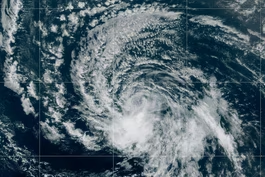
WILLIAM BRANGHAM: Many climatologists and meteorologists say one factor shaping this hot, tumultuous season is the potentially record-breaking El Nino that's brewing out in the Pacific Ocean.
Its dramatic warming of the ocean could shift weather patterns around the world.
This year's El Nino is so potent that many are calling it a Super El Nino.
And one of those people raising the alarm is Jeff Berardelli.
He's a meteorologist at WFLA in Tampa Bay.
Jeff, great to have you back on the program.
First off, just give us a primer again on what an El Nino is and why this one seems so potent.
JEFF BERARDELLI, Chief Meteorologist, WFLA-TV: So El Nino is a warming of the surface waters of the Eastern Tropical Pacific Ocean.
Typically, the warmest water is in the Western Pacific subsurface, so below the ocean.
A lot of heat builds up for years and years, and when conditions are right and the winds weaken, all that warm water can slosh over to the eastern part of the Pacific basin.
And that changes weather patterns around it, kind of causes somewhat of climate chaos around the globe because of this distribution of heat being changed from the Western Pacific into the Eastern Pacific, and this one is a big one.
WILLIAM BRANGHAM: And why is this one -- do we know, why is this one so particularly large?
JEFF BERARDELLI: Well, this is going to be the largest that we have ever seen by a long shot.
And part of the reason for it is all of this excess heat that's building up in the ocean from global warming.
All this heat is then trapped.
About 90 percent of the excess heat is trapped in the ocean.
It is stored, and then eventually it comes back to haunt us.
Right now, we're looking at the probability that this is going to max out around an anomaly, a water temperature anomaly near four degrees Celsius in the Eastern Pacific.
The old record is 2.8 degrees Celsius.
So it's not just slightly above record territory.
It is way above record territory.
Part of the reason is, we have all this excess heat that is building up because of global warming.
And so some of that heat in part is being used to fuel this El Nino.
WILLIAM BRANGHAM: So we have got this tropical storm that's just about to hit the Gulf, Edouard.
There's three seemingly massive hurricanes in the Pacific right now.
Is this the kind of thing that we should expect from a supercharged El Nino?
JEFF BERARDELLI: This is exactly what we should expect, and exactly what our seasonal models told us to expect months and months ago.
It's really warm in the Tropical Pacific, and thus we're seeing a lot of strong hurricanes there.
In the Atlantic, it's warm, but there's a lot of wind shear, and stronger wind shear means that the storms that try to get going in the Atlantic get torn apart.
So the Pacific is active and the Atlantic very inactive, with the exception of Edouard, right?
And the reason it formed in the Gulf is because that's the one area of the Atlantic less impacted by El Nino, and wind shear is actually below normal in the Gulf, but it's at record-setting pace everywhere else in the Atlantic.
WILLIAM BRANGHAM: So given that the Eastern Pacific is so hot right now, we're already seeing these three major hurricanes, what are we likely to see in this country this year and next?
JEFF BERARDELLI: Right.
So this is particularly an east-based El Nino, meaning that a lot of its effects are not in the Central Pacific, but skewed to the Eastern Pacific, and that's when we see the biggest impact here in the U.S.
because we are closer to the Eastern Pacific.
So the way it looks right now, according to our climate models, seasonal models -- and I have no reason to doubt them because they have been very good this summer and they have been very good so far -- they are saying it's going to be very wet across the U.S.
South, especially the southeast U.S.
and Florida, and we could see multiple outbreaks of severe weather.
It's certainly possible.
We may end up seeing a wetter-than--average, if not a lot wetter-than-average winter in the Pacific, especially California.
So, California, it could turn out to be a very rainy winter.
Where it is rainy, it's also going to be more cloudy, and thus it will be cooler.
So we're expecting it to be cool in the southern part of the U.S., but not necessarily cold.
We're talking cool because of cloud cover and lack of sun, but not cold air outbreaks.
I don't think we're going to see many cold air outbreaks across the U.S.
And snowstorms are going to be a little tougher to get because it's probably going to be warm in the northern tier of states, especially in the Great Lakes, and also in the Northeast.
WILLIAM BRANGHAM: You mentioned before the impact of global warming on all of this and climate change.
We know that El Ninos exist and that they exist absent climate change.
Now that we have climate change overlaid onto this system, what is the connection between those two factors?
JEFF BERARDELLI: Well, there's debate in the climate community.
A paper just came out saying that el Ninos are getting stronger because of global warming.
And it is true that the absolute heat that's available to these El Ninos is definitely a lot more than it used to be.
So that is for certain.
But here's the thing.
All the oceans are warming, and the way that we determine the impacts of El Nino is, how warm is the Eastern Pacific relative to the rest of the oceans in the world?
So the Eastern Pacific is warming and it's got a lot more heat, but the other oceans are also warming, and they have a lot more heat, and thus it kind of nullifies the impact a little bit.
WILLIAM BRANGHAM: All right, that is meteorologist Jeff Berardelli.
Thank you so much, as always.
JEFF BERARDELLI: You're welcome.
AMNA NAWAZ: After three decades, there's now a murder conviction in one of the country's most infamous unsolved killings.
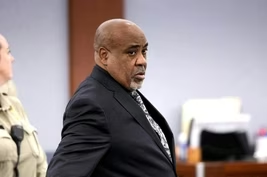
A Nevada jury has found a former gang leader, Duane "Keffe D" Davis, guilty of orchestrating the 1996 drive-by shooting of hip-hop superstar Tupac Shakur.
Davis was found guilty of first-degree murder, but he wasn't accused of pulling the trigger.
Prosecutors argued he ordered the fatal shooting and sought revenge after Shakur and members of his entourage attacked Davis' nephew earlier that night.
Shakur was killed at the peak of his career, having just released a landmark double album, "All Eyez on Me," and starred in a string of popular movies.
He was just 25 years old.
For more on this case and why it's resonated for so many years, we're joined by Joel Anderson.
He's a senior staff writer at The Ringer and a former host of Slate's "Slow Burn" podcast, including a season on the murders of Tupac Shakur and the rapper The Notorious B.I.G.
Joel, welcome to the show.
Thanks for joining us.
JOEL ANDERSON, The Ringer: Thanks for having me, Amna.
AMNA NAWAZ: So it's been almost 30 years since Tupac was killed, for decades, no suspects, no convictions.
Why Duane Davis and why now?
JOEL ANDERSON: Well, Duane Davis -- and I hope you don't mind if I call him Keffe D -- he could not stop talking about his involvement in the murder.
Originally, he got caught dealing drugs in 2007-2008.
And when the feds brought him in, they asked him if he had any involvement in the murder of The Notorious B.I.G., Biggie Smalls.
That was in L.A.
six months after Tupac's murder.
And he says, that wasn't us, but I can give you info on the other one, which was taken to mean Tupac.
And so that was the first time that he admitted to having a role in Tupac's murder.
Now, because he gave that information up as part of a deal that he brokered with law enforcement that was going to cut down his sentencing, he was under that arrangement for a very long time.
But a couple things happened when he sold a book called "Compton Street Legend" in 2019 detailing his role in the murder, it opened up the deal again.
And then he moved from L.A.
into Nevada.
So then he moved within the legal jurisdiction of the place where the murder had been committed.
And so that's what exposed him to the legal peril that he's currently in right now.
AMNA NAWAZ: And we should note there's no statute of limitations on murder trials in Nevada.
But you mentioned how much Davis, or Keffe D, talked about this.
The prosecution's case was largely built on his own words, in those interviews, in that memoirs, as you mentioned, him bragging about the role he played in Shakur's death.
And actually today, the Clark County chief deputy district attorney, Binu Palal, mentioned that.
Here's what he had to say.
BINU PALAL, Chief Deputy District Attorney, Clark County, Nevada: To all of us, to me, Tupac Shakur was an icon or an idea.
But to that family, Tupac Shakur was a brother, a son, a cousin, a loved person that was ripped from them 25 or 30 years ago around.
And I think Mr.
Davis' arrogance and celebration of that murder is ultimately what did him in.
AMNA NAWAZ: Joel, how did Davis or Keffe D's defense team navigate that, handle everything he had to say about this murder?
JOEL ANDERSON: By basically saying he made it all up, that he was a liar, that he was a former drug dealer.
He's getting into his middle age.
He doesn't have really many ways of making money legitimately.
This is the thing that he had, his proximity to this case.
And, of course, his nephew is one of the people that was involved in the fight with Tupac earlier on the night that he died.
So he has this story, right?
And he can tell it and make money off of it.
But the attorney said -- his attorney said, look, he's making all that up.
It's just about the money.
He needed it right now.
And so you have to believe that my client is a liar, is essentially the defense.
AMNA NAWAZ: Also, he didn't pull the trigger that night.
No one alleged he did.
So what about everyone else in the car?
How was that handled in this case?
JOEL ANDERSON: Well, so I mean, everybody else in the car is dead right now.
His nephew, Orlando Anderson, was killed a couple years later at a Compton car wash.
Another one died of actually health-related issues, and then another one was actually killed in a medical marijuana shop in Compton in 2015.
So there's nobody left.
AMNA NAWAZ: I was just want to take a brief step back here, because, as we mentioned, Tupac was just 25 when he was killed.
JOEL ANDERSON: Yes.
AMNA NAWAZ: He was really at the cultural peak of his career, had multiple Platinum albums to his name, starred in multiple starring roles in big movies.
Give us a sense of how big a star he was at that moment and what his murder meant for so many people.
JOEL ANDERSON: Yes, I mean, he was a massive superstar and global icon.
I mean, he dated Madonna.
He was Janet Jackson's love interest in a movie.
He was always on the covers of magazines, newspapers.
If you grew up in that era when "MTV Jams" or BET "Rap City" was on, he was always on there.
Like, you could not get away from Tupac.
He was probably at that point the biggest star the genre had ever produced.
And even if you get beyond the music or the movies or the superstar of it, he'd had legal troubles that put him in there.
I mean, he'd previously gotten shot in 1994 in a shooting that is believed to have been one of the inciting incidents in the old West Coast-East Coast rap war.
He had all these legal troubles.
He'd shot at a couple of cops, off-duty cops, in Atlanta years before.
So he's a guy that had a lot swirling around him, but at the center of it, I mean, you just had this incredibly intelligent, charismatic, handsome, like just very -- a guy that was a star in any room that he walked into.
He's been gone for 30 years now.
We will never get to know what 55-year-old Tupac was like.
So while somebody may actually go to prison for it, I don't think that anybody feels like any justice was served here.
I mean, it's just the end of a really gruesome chapter in American celebrity.
AMNA NAWAZ: Joel Anderson, senior staff writer at The Ringer and former host of Slate's "Slow Burn" podcast, thank you so much.
JOEL ANDERSON: Thanks for having me.
AMNA NAWAZ: And that is the "News Hour" for tonight.
I'm Amna Nawaz.
GEOFF BENNETT: And I'm Geoff Bennett.
For all of us here at the "News Hour," thanks for spending part of your evening with us.
After break, House returns to a changing political landscape
Video has Closed Captions
After long break, House returns to a changing political landscape (4m 59s)

Army secretary's resignation adds to turmoil under Hegseth
Video has Closed Captions
Army secretary's resignation adds to turmoil at Pentagon under Hegseth (3m 26s)
Decades after Tupac Shakur's murder, Duane Davis convicted
Video has Closed Captions
Decades after Tupac Shakur's murder, Duane ‘Keffe D’ Davis convicted (6m 3s)

Families search for loved ones swept away in Nepal floods
Video has Closed Captions
Families desperately search for loved ones swept away in Nepal floods (4m 16s)

Haitian community braces for deportations after TPS ends
Video has Closed Captions
Springfield's Haitian community braces for deportations after protected status ends (9m 28s)

Hegseth's firings create 'climate of fear,' Kendall says
Video has Closed Captions
Hegseth has created 'climate of fear' at Pentagon, former Air Force secretary says (5m 28s)
How a super El Niño is fueling extreme weather patterns
Video has Closed Captions
How a super El Niño is fueling extreme weather patterns (5m 44s)
News Wrap: U.S. strikes Iran after attacks against ships
Video has Closed Captions
News Wrap: U.S. strikes Iran after attempted attacks against ships in Strait of Hormuz (6m 41s)
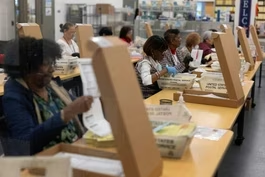
Whistleblower warns USPS system could disrupt mail ballots
Video has Closed Captions
Whistleblower warns USPS rushing new system that could jeopardize mail-in ballots (6m 11s)
Providing Support for PBS.org
Learn Moreabout PBS online sponsorship New Episode
- News and Public Affairs

Today's top journalists discuss Washington's current political events and public affairs.

- News and Public Affairs

FRONTLINE is investigative journalism that questions, explains and changes our world.
 New Episode
 New Episode
 New Episode
 New Episode
 New Episode

 New Episode
 New Episode
 New Episode
Support for PBS provided by:
Major corporate funding for the PBS News Hour is provided by BDO, BNSF, Consumer Cellular, American Cruise Lines, and Raymond James. Funding for the PBS NewsHour Weekend is provided by...