
Valerie Jarrett on the Obama Presidential Center, Growing Up on the South Side
Clip: 6/18/2026 | 9m 48sVideo has Closed Captions
Valerie Jarrett was a senior advisor to President Barack Obama for the entirety of both his terms.
Valerie Jarrett was a senior advisor to President Barack Obama for the entirety of both his terms, making her the longest-serving senior advisor in history. Now she is the CEO of the Obama Foundation and one of the key players in the creation of the Obama Presidential Center.
Problems playing video? | Closed Captioning Feedback
Problems playing video? | Closed Captioning Feedback
Chicago Tonight is a local public television program presented by WTTW
WTTW video streaming support provided by members and sponsors.
Valerie Jarrett on the Obama Presidential Center, Growing Up on the South Side
Clip: 6/18/2026 | 9m 48sVideo has Closed Captions
Valerie Jarrett was a senior advisor to President Barack Obama for the entirety of both his terms, making her the longest-serving senior advisor in history. Now she is the CEO of the Obama Foundation and one of the key players in the creation of the Obama Presidential Center.
Problems playing video? | Closed Captioning Feedback
Where to Watch Chicago Tonight
Chicago Tonight is available to stream on pbs.org and the PBS app.

WTTW News Explains
In this Emmy Award-winning series, WTTW News tackles your questions — big and small — about life in the Chicago area. Our video animations guide you through local government, city history, public utilities and everything in between.Providing Support for PBS.org
Learn Moreabout PBS online sponsorship>> Valerie Jarrett was the senior adviser to President Obama for the entirety of his 2 terms in the White House.
That also made her the longest serving senior adviser in presidential history.
Now she is the CEO of the Obama Foundation and obviously a key player in the creation of the center.
We sat down with her to talk about the enormity of taking on this task.
>> how are you What I am a great welcome the Obama.
>> Presidential center.
I waited a long time to say that.
>> You have.
How does it feel to finally be here after it's been a long road?
It has been a very long and arduous road feel spectacular.
What does it mean for the library to be?
On the South side, both for the library and also for the community that it's I think it's a real gift to the community.
I think that it will allow us to put a spotlight on the South side.
And that's deeply personal to me.
As you know.
>> I grew up here, rode my bike, the Jackson Park and hung out at the point in the Museum Science and Industry.
And also saw that the Sir always kept infusion of capital that deserved compared to the North side and downtown.
And so to now see this major economic engine that will drive investment, not just here, but in the surrounding community as well as being kind of beacon of hope for the world at a time when I think we sorely need that.
That's one of the other comments I've gotten from people who visited is the sense of and renewed sense of hope of hopefulness, which is hard, sometimes.
But quite palpable.
When you walk through the museum.
>> So we are also currently in the newest branch of the Chicago Public Library.
Why did the president want to have a Chicago Public Library on site?
>> Well, a literature for young children is something that's always been very important to both president and Michelle Obama and so have a Chicago public library so that the young people, particularly in the surrounding community >> could come and enjoy this beautiful facility.
Then she ran to the presidential reading room where we're sitting now and see the kinds of books bay favor sparked their interest in literature is something really important to them?
>> to be clear, presidential libraries, of course, the typically house, the paper, the archives from from the president's term.
You all decided to digitize them so that they are accessible everywhere and leave that paper actually in the National Archives.
Correct?
So President Thomas, the first digital president and we have the capability to digitize now.
That's not something that was available to former presidents.
And so he wanted to not take up all that space with pay for.
And in fact, at this library is where the original location of the paper was going to go before we decided to invest in the digitization.
And so, yes, the original papers will be help elsewhere.
But everybody, they come here or live on the other side of the world will be able to go online soon and see all of his papers.
And so we've able to put this space to better use, OK?
So speaking of space is across the campus.
There's the forum next door.
There's Cafe Auditorium Media Suite home court with the NBA regulation size basketball courts and event spaces, the fruit and vegetable garden.
>> You mentioned the playground and what will be its the great lawn right now where folks can sled in the winter.
28 commissioned art installations.
Do you think you left anything out?
>> Well, we'll the public thinks that we should do.
Other things will look at that, particularly when it comes to the programming, how we use the space is going to be something that changes over time.
And I look forward, for example, to >> movies on the Great Lawn and watching activities with our young people and getting them engaged, not just in sports, but in good sportsmanship fan, learning Open their eyes to things that they never thought about before often say it's hard to be what you can't say where you come here.
You're gonna be able to infinite possibilities.
already the young people who've come through, I saw a couple boys going into the Oval Office and sitting behind the desk just imagining that they would be president.
Something that may not occur to them.
But for visit to the Oval Office.
>> I'm sure that you are very familiar with and may be attached to lots of different exhibits and pieces of the campus.
But are there any that are particularly personal you know, remind you of any particular memory or memories of your time with the Obamas.
All very personal since I was there for all 8 years, you can believe that.
But I will say one that I think says a lot about his presidency is.
>> Called 10 letters a day.
So every day during the years President Biden was in office.
His correspondents team selected 10 letters of the nearly 40,000 that he received every single day.
And so they look for a representative sampling of those letters and would send up 10 to his home.
And so in the evening when he was working, he would take a break and he would be the letters and respond to them.
Handwritten notes back and then next to the 10 letters and we have 10 letters that are framed is a video with a narration of.
Beating the letters and him responding to the letters at the end.
It was his way of staying in touch with the American people and sometimes being president can be isolating.
If you let it.
And we did a lot did a lot of different efforts to engage people and bring them into the White House so he could hear the stories of the American people 2 out to just get those 10 letters every single day and believe me, some of them a very complimentary.
Some of them are not.
Some of them are people who change their mind based events and some of them were people who have very strong wanted to express an to him.
So, you know, as we've discussed, getting here, took a while.
There's pushback from the community over concerns around gentrification, pushing out longtime residents.
>> Just recently, a report from the Illinois Answers Project Show that a number of initiatives the included in its anti displacement ordinance for Woodlawn residents that either weren't properly managed are funded.
That's yielding little protection, right?
So the median sale price for single-family home has ballooned up 4.6 times the price.
It was 10 years ago when the library was announced was there more that the foundation could have done?
Do you think with the city or with the community?
>> Look, I think we did our part really well.
Number one designing designing the campus talking to the community and hearing what they wanted to see present here.
>> Reaching out to make sure the contractors from the community to the work.
We hired nearly 5,000 construction workers.
Those of people who came for only from the south and West sides.
So we created jobs.
We have permanent jobs.
Nearly 500 of the foundation as a whole 2.50 will be campus.
We recruited from the community.
So as an economic engine, the 850 million dollars that we spent and the people who worked to this campus whose names will be on a wall worker wall that we have created here in the center.
That's our part in doing what we can do.
We work closely with the alderman.
We work closely with them on South, a terrific organization that's working on planning ways in which we can market from here for shops and restaurants in the surrounding community.
We're going to work closely with the Museum of Science Industry to market together.
We want people not just come visit our campus.
We want them to see all of the tools on the south side of Chicago.
And we are hopeful that this capital investment, he's going to help spur additional job opportunities and stores and businesses in this community.
That's our part.
That's us doing the best of what we can do.
But some critics also observed sort of the growth of presidential libraries has sort of shifting to become monuments to the former president or an opportunity for the former president, whoever he may be.
>> And to sort of rewrite some of that history in the president's favor.
What do you say to that how do you see the intent?
The function of a presidential library?
Will this presidential campus is not intended to be a monument to President Obama.
>> It begins with the people upon whose shoulders he stands with Declaration of Independence.
The suffrage movement, slavery.
Reconstruction, civil rights movement.
All of the different efforts by ordinary people to bring about change change that made his presidency pass.
And so we tell that story.
Then we do tell the story of this presidency that we tell the story not simply what went well, but also well, we were unsuccessfully trying to be very honest and open about that so that people can learn from 7 presidents before President Obama tried to pass legislation to improve our health care system.
We were successful, but because in large part, those efforts pave the way.
And so we're hopeful for where we fell short.
We are paving the way for future efforts.
And so this is really designed.
Not to look backwards.
Except for the purpose of helping move forward and all of our programs designed to help young people predominantly develop the kind of leadership skills that they need to pick up that the time and do their part and letters on the outside of new sound which which from President Obama speech on the 50th anniversary of the walk across the Edmund Pettus Bridge.
It's titled We Are America and it challenges all of us pick up that glorious task of improving our nation.
And so that's the future.
That's what we really intend at this campus to be.
And a piece of it is a
 New
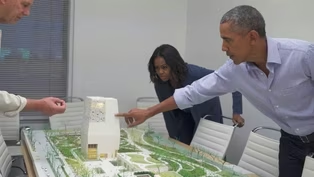
NewGeoffrey Baer Explores the Obama Presidential Center Architecture
Video has Closed Captions
Architects Tod Williams and Billie Tsien explain how it all took shape. (5m 10s)
 New
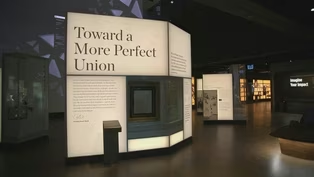
NewTake a Look Inside the Obama Presidential Center
Video has Closed Captions
WTTW News visited the center for a firsthand look at the exhibits, installations and more. (4m 35s)
Providing Support for PBS.org
Learn Moreabout PBS online sponsorship New Episode
- News and Public Affairs

Top journalists deliver compelling original analysis of the hour's headlines.

- News and Public Affairs

Today's top journalists discuss Washington's current political events and public affairs.

 New Episode




 New Episode
 New Episode
 New Episode
Support for PBS provided by:
Chicago Tonight is a local public television program presented by WTTW
WTTW video streaming support provided by members and sponsors.